48293
Published March 31, 2026
Also known as: 48/2(9+3) · The PEMDAS Debate
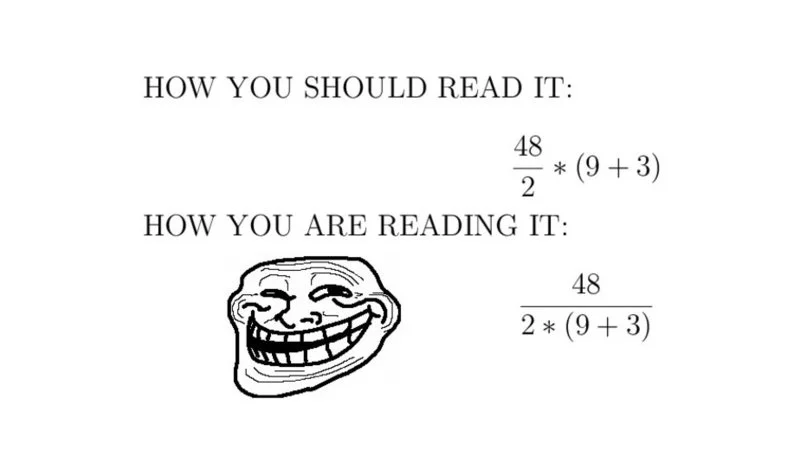
48÷2(9+3) =? is a deliberately ambiguous math equation that split the internet into two warring camps: those who got 2 and those who got 288. First posted on a Texas message board in April 2011, the problem exploited a genuine gap in how people interpret the order of operations, sparking thousands of heated replies across dozens of forums within 48 hours.
Overview
The equation 48÷2(9+3) looks like something a fifth-grader should be able to solve. That's exactly what makes it so effective as bait. The problem hinges on whether you treat the "2" next to the parentheses as implied multiplication (binding it tightly to the parenthetical expression) or as a separate operation that follows standard left-to-right processing after division3. Depending on your interpretation, you get either 2 or 288, and both answers have legitimate mathematical arguments behind them4.
The real trick is that the equation is poorly written on purpose. Professional mathematicians would never leave this kind of ambiguity in their work1. But stripped of context and thrown onto a forum full of people who believe math always has one right answer, it becomes a perfect engine for generating arguments.
Gallery
Origin & Background
How It Spread
How to Use This Meme
The 48÷2(9+3) format typically works as engagement bait. People commonly post the equation (or a similar ambiguous expression) to a social media platform or forum with a prompt like "Can you solve this?" or "Only 1 in 10 people get this right." The resulting comment war between the "2" camp and the "288" camp generates massive engagement. Variations include changing the numbers while preserving the structural ambiguity between implied multiplication and left-to-right division. The key ingredient is always an expression where implied multiplication sits next to the ÷ symbol without clarifying parentheses.
Cultural Impact
Full History
Fun Facts
The original Hot Pursuit poll included 3.14 (pi) and 219 as joke answer options alongside the two real contenders4.
The Bodybuilding.com thread about the equation hit over 2,500 replies in a single day, making it one of the forum's most active non-fitness threads4.
WolframAlpha and Google's calculator both return 288, while many scientific calculators that handle implied multiplication return 24.
The ÷ symbol (called an obelus) is so prone to causing confusion that ISO 80000-2 recommends against using it at all5.
A Math Stack Exchange contributor demonstrated that simply replacing the parenthetical with a variable changes the answer most people give, even though the math is identical7.
Derivatives & Variations
6÷2(1+2) =?
— A closely related equation that produces the same 50/50 split (answers: 1 or 9), featured in Slate's 2013 analysis[1].
Facebook/Twitter math bait
— A whole genre of "Only geniuses can solve this!" posts that use similar notational ambiguity to generate engagement[1].
Calculator comparison posts
— Users began posting screenshots of different calculators giving different answers to the same equation, showing how machines interpret the order of operations differently[4].
Frequently Asked Questions
References (19)
- 1
- 2
- 3
- 448÷2(9+3) = ? - Know Your Memeencyclopedia
- 5Memeencyclopedia
- 6Order of operationsencyclopedia
- 7Division (mathematics)encyclopedia
- 8Division (mathematics) - Wikipediaencyclopedia
- 9
- 10
- 11
- 12
- 1348÷2(9+3)article
- 1448÷2(9+3) = ????article
- 15
- 16Yahoo Search - Web Searcharticle
- 17Google Searcharticle
- 18- Penny Arcadearticle
- 19