Home›Memes›Alignment Charts

Contents

  • Overview
  • Gallery
  • Origin
  • How It Spread
  • FAQ
  • References
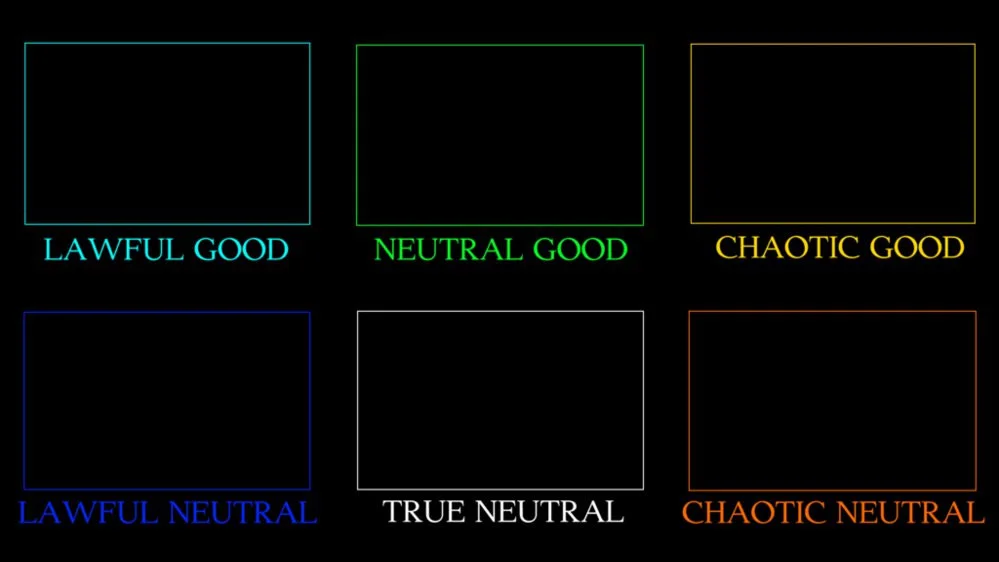
Alignment Charts — Blank six-cell Dungeons and Dragons alignment chart template with colored labels on black background

Alignment Charts

2007image macroclassic

Published October 20, 2026

Alignment Charts repurpose the Dungeons & Dragons nine-box moral grid, sorting fictional characters, snacks or inanimate objects into cells like Lawful Good or Chaotic Evil1. The joke drifted out of tabletop forums into image boards during the late 2000s, and by August 2017 a bread-storage version on Twitter had helped push the format into mainstream feeds.

exploitable templates object labeling multi panel memes gaming late 2000s memes

Overview

Each cell on an Alignment Chart holds one image captioned with its two-axis label and a short justification, mimicking the demotivational poster layout that ran forum culture in the mid-2000s3. A standard chart is three by three, giving nine slots that start at Lawful Good in the top left and end at Chaotic Evil in the bottom right1. Creators pick a themed subject, like horror movie villains, breakfast cereals or coworkers, then argue the picks in replies.

Fans later stretched the grid to 5×5, adding the invented axes "social" and "rebel" alongside "moral" and "impure" for a 25-cell variant with no official rulebook backing2. Single-cell edits and one-off demotivational posters for a specific alignment are also common.

Gallery

Origin & Background

Platform
Tabletop sourcebooks / DeviantArt and Twitter (viral spread)
Date
2007

The alignment system comes from the 1974 release of Dungeons & Dragons by Gary Gygax and Dave Arneson6. A 1977 revision locked in the two-axis structure, pairing Lawful, Neutral or Chaotic with Good, Neutral or Evil for the nine permutations still used in the meme1. Fan comparison posts likely took off after the 2007 D&D sourcebook Complete Scoundrel printed sample alignment lineups3.

5×5 charts are a purely online invention. The earliest known example came from DeviantArt user DoASpotCheck on June 5, 2011, slotting subculture characters into a 25-cell grid with the four extra axis points coined by the artist2.

How It Spread

By 2012, Polyvore user ellerigby13 had published a blank chart template that produced 74 user deviations in its archive5. Image boards and tabletop forums kept the format alive through demotivational-style single-panel edits before it crossed into general audience feeds.

Mainstream Twitter picked up the joke on July 23, 2017, when @tinysubversions posted a nine-cell chart illustrating each D&D alignment with a famous character or quote, collecting over 2,000 retweets and 3,800 likes4. Three weeks later, @aurelianrabbit's chart that assigned a bread-storage method to each cell went viral at a much larger scale3.

Since then the format settled into a steady fan hobby. DeviantArt holds roughly 34,000 deviations tagged "character alignment," and the r/AlignmentCharts subreddit still collects user submissions3.

Timeline

1974

Gary Gygax and Dave Arneson release the first edition of Dungeons & Dragons, introducing character alignment[6].

1977

The two-axis Lawful/Chaotic by Good/Evil alignment system is formalized, producing the nine cells later used by the meme[1].

2007

The D&D sourcebook Complete Scoundrel is sometimes credited with popularizing cross-character alignment comparisons[3].

2011-06-05

DeviantArt user DoASpotCheck uploads the earliest known 5×5 Alignment Chart, coining the extra axis labels[2].

2012

Polyvore user ellerigby13 publishes a blank chart template that spawns 74 user deviations[5].

2017-07-23

Twitter user @tinysubversions posts a D&D alignment chart that collects more than 2,000 retweets[4].

2017-08-10

@aurelianrabbit's bread-storage alignment chart goes viral, pushing the format into mainstream Twitter feeds[3].

Loading tweet...

Frequently Asked Questions

Alignment Charts are meme images that slot subjects into the Dungeons & Dragons nine-cell moral grid labeled Lawful Good through Chaotic Evil, usually styled like demotivational posters1.

The underlying system comes from the 1974 edition of Dungeons & Dragons by Gary Gygax and Dave Arneson6, and the 5×5 variant started on DeviantArt in 20112.

Each cell combines a Lawful-Chaotic reading with a Good-Evil reading to classify a character, object or idea with a joke caption, giving nine possible alignments1.

Creators typically pick a themed subject, place one image per cell on a three-by-three or 5×5 grid, and caption each with its alignment plus a short reason for the pick2.

The format still gets regular posts, with a dedicated subreddit at r/AlignmentCharts and user templates still indexed from older platforms like Polyvore5.

References (6)

  1. 1
    https://en.wikipedia.org/wiki/Alignment_%28Dungeons_%26_Dragons%29
  2. 2
    https://www.deviantart.com/doaspotcheck/art/5-by-5-Alignment-Chart-211890094
  3. 3
    https://knowyourmeme.com/memes/alignment-charts
  4. 4
    https://twitter.com/tinysubversions/status/889294023965462536
  5. 5
    https://web.archive.org/web/20160827233712/http://www.polyvore.com/make_your_own_alignment_chart/template?id=128711
  6. 6
    https://en.wikipedia.org/wiki/Dungeons_%26_Dragons_(1974)

Quick Info

Year
2007
Origin
Tabletop sourcebooks / DeviantArt and Twitter (viral spread)
Type
image macro
Status
classic

Tags

alignmentdungeons and dragonsimage macrotwitterdeviantartdemotivational

Related Memes

  • do men even have feelings
  • sniper elite headshot
  • ramirez do everything
  • ctrlaltdel
  • abbacchio joins the kicking
  • baton roue

More Exploitable Meme Templates Memes

  • Change My Mind
  • Wait That's Illegal
  • Two Buttons
  • Evil Kermit
  • Confused Travolta
  • Disaster Girl
  • Trade Offer
  • Cooking Show Drama
  • Always Has Been
  • Demotivational Posters
  • Scooby Doo Unmasking
  • What's Your Type
View all Exploitable Meme Templates memes →
Browse MemesTopicsCreatorsTrendingPlayAboutLegalPrivacy

© 2026 meme.com