ASCII Art
Published March 23, 2026
Also known as: Text art · typewriter art · AA (Japanese usage)
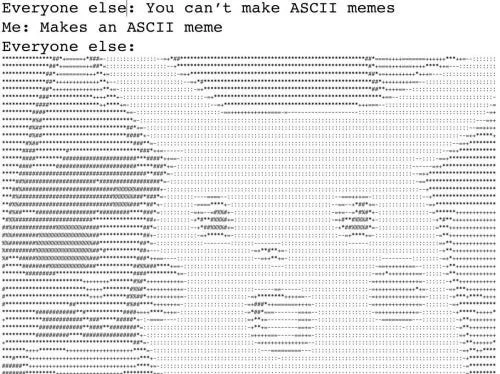
ASCII Art is a graphic design technique that uses the 95 printable characters of the ASCII standard to create visual images, from simple emoticons to elaborate portraits composed of thousands of symbols. The practice traces back to typewriter art in the 19th century but exploded through bulletin board systems and Usenet in the 1980s and 1990s1. It's one of the oldest forms of internet-native visual expression and a direct ancestor of text-based memes and emoticons.
Overview
ASCII Art builds pictures from the letters, numbers, and punctuation defined by the American Standard Code for Information Interchange, a character encoding system standardized in the early 1960s5. Of the 128 characters in the ASCII set, 95 are printable and usable for art1. Artists choose characters by visual density: glyphs like `@` and `#` fill more space and read as dark, while `.` or a space reads as light12. The interplay of character density creates shading and form from nothing but typed text.
Proper display requires a monospaced font like Courier, since proportional fonts break the precise alignment that holds images together1. This made ASCII Art a natural fit for early computer terminals, email clients, and forum interfaces that defaulted to fixed-width rendering.
The scale varies enormously. At one end, it's someone typing `:)` into a chat5. At the other, it's a photorealistic portrait spanning hundreds of carefully composed lines12. Some artists hand-place every character individually. Others use conversion software that analyzes a photograph's brightness values and maps them to text9.
"ASCII Art" also works as a loose umbrella for related text-based art forms. ANSI art extends the palette to 256 characters and adds color through terminal escape sequences1. PETSCII used the character set of Commodore 64 computers to create its own visual tradition2. These formats are technically distinct, but casual use lumps them all under the ASCII Art label.
Gallery
Origin & Background
How It Spread
How to Use This Meme
ASCII Art works at several levels of complexity:
Inline emoticons and kaomoji. Type short character combinations directly into text: `:)` for a smiley, `(╯°□°)╯︵ ┻━┻` for a table flip, `¯\_(ツ)_/¯` for a shrug. These go into any text field that supports standard characters.
Copy-paste from archives. Find pre-made ASCII Art from community collections like Textfiles.com or ascii-art.de and paste it into a message610. This is how most people encounter and share ASCII Art. The art displays correctly in any monospaced text environment.
Hand-crafted originals. Open a text editor, set a monospaced font, and build an image character by character. Dense characters (`@`, `#`, `M`, `W`) produce dark areas, medium-density characters (`*`, `+`, `=`) create mid-tones, and sparse characters (`.`, `,`, space) make highlights12. Work from a reference image and think in terms of a grid.
Automated generation. Upload any image to a web-based ASCII Art converter. The software divides the image into cells, measures brightness, and maps each cell to a character of matching visual weight9. High-contrast images with simple compositions give the best results9.
For any ASCII Art to render properly, the viewing context needs a monospaced font. Discord code blocks (triple backticks), Reddit code formatting (four-space indent), and HTML `<pre>` tags all force fixed-width display.
Cultural Impact
Full History
Fun Facts
Todd Rundgren may have created the first "ASCII selfie." His 1974 double album *Todd* included a poster depicting his face composed entirely from the names of fans who had mailed back postcards from his previous release1.
During the Korean War (circa 1950), a Korean artist named Gwang Hyuk Lee hand-drew a portrait of Jesus using the full text of the Bible's "Book of John"1.
ASCII Art Farts ran as a daily text-art comic for nearly 15 years, publishing 5,372 entries between its first installment on June 25, 1999, and its final one on March 9, 201411.
Early computing students in 1970s computer labs shared a rite of passage: learning to print a Snoopy banner on the line printer. It was one of the first things new arrivals figured out1.
Guillaume Apollinaire's handwritten "calligrams" from the early 20th century, visual poems shaped into images, are considered precursors to both concrete poetry and modern text-based art4.
Derivatives & Variations
ANSI Art
— Extended ASCII art using 256 characters plus color escape codes, popular in BBS scenes
Shift JIS Art
— Japanese variant using the Shift JIS character set with proportional fonts, dominant on 2channel[2]
Emoticons
— Simple character combinations like `:)` that grew from ASCII art into universal shorthand[7]
Kaomoji
— Japanese-style emoticons read horizontally, like `(╯°□°)╯︵ ┻━┻`
FIGLET
— A program that generates large text banners from ASCII characters in various font styles[17]
Braille Unicode Art
— Modern text art using Unicode Braille characters for higher resolution[3]
ASCII Comics
— Webcomics drawn entirely in ASCII characters[4]
LOL ASCII
— Humorous, often crude ASCII images shared for comedy[1]
Frequently Asked Questions
References (18)
- 1
- 2
- 3
- 4ASCII Art - Know Your Memeencyclopedia
- 5Shift JIS artencyclopedia
- 6ASCII Art - Urban Dictionarydictionary
- 7ASCII artencyclopedia
- 8Urban Dictionary: ASCII artdictionary
- 9History of ASCII Artarticle
- 10
- 11
- 12
- 13
- 14
- 15ASCII Art Fartsarticle
- 16
- 17T E X T F I L E Sarticle
- 18HIGH WEIRDNESS BY E-MAILarticle