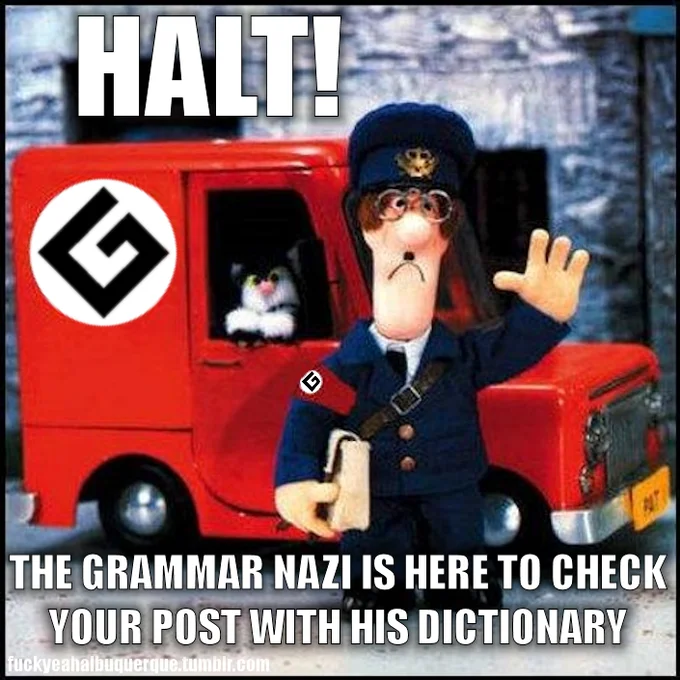
Grammar Nazi
Published March 23, 2026
Also known as: Grammar Police · Grammar Pedant · Spelling Nazi
"Grammar Nazi" is a label for people who compulsively correct others' spelling, grammar, and punctuation mistakes, particularly in online conversations. The term appeared on Usenet forums as early as 1991 and spread across the internet with the rise of social media in the mid-2000s2. It grew into one of the internet's defining behavioral archetypes, spurring academic research into "literacy privilege," dedicated Facebook communities, and "Weird Al" Yankovic's 2013 parody song "Word Crimes"1.
Overview
Also known as "Grammar Police" or "Grammar Pedant," a Grammar Nazi is someone who prioritizes correcting linguistic errors over engaging with the substance of a conversation6. The label usually carries a negative connotation: the corrector cares more about pointing out that you wrote "your" when you meant "you're" than responding to what you actually said8. In forums, chat rooms, and social media comment sections, Grammar Nazis are the users who respond to a heartfelt post with nothing but "*their, not there."
The term works on two levels. It gets lobbed as an insult at pedantic correctors, but some people wear it as a proud self-identifier, openly embracing their obsessive attention to proper English1. While "nazi" in this compound shifted meaning for many internet users to simply describe anyone unreasonably strict about a subject, critics point out that this casual application strips the word of its connection to actual historical atrocities1.
Gallery
Origin & Background
How It Spread
How to Use This Meme
"Grammar Nazi" functions as a social label rather than a visual meme template. Common uses include:
As an accusation: Directed at someone who derails a discussion to fix a typo. "Can you respond to the argument instead of just being a Grammar Nazi about my spelling?"
As self-identification: Used in bios, forum signatures, and usernames by people who own their pedantic tendencies. A common format: "Proud Grammar Nazi since [year]."
As image macros: Visual formats often feature parody military imagery with grammar-related elements, such as a flag with a "G" replacing other symbols, or figures captioned with spelling corrections.
As a reaction: Posting the label or a related image when someone corrects grammar in a comment thread.
Cultural Impact
Full History
Fun Facts
Roughly 70% of the mistakes flagged by Grammar Nazi communities are spelling errors, not actual grammar mistakes in the strict linguistic sense1.
The 1995 alt.gothic thread that helped popularize the term was about whether "thusly" is a real word. A responder pointed out the Oxford English Dictionary lists it as a valid colloquial adverb, meaning the Grammar Nazi was technically wrong3.
A 2003 Usenet poster identified himself as "a Grammar Nazi, a Spelling Nazi, and a fan of the serial comma" in a thread about whether automated grammar checkers actually work7.
The alt.language newsgroup had a poster who painstakingly explained the difference between "your" and "you're" to the group. One reply was simply: "Fuck off and die"8.
TV Tropes points out that many "rules" Grammar Nazis enforce, like never splitting infinitives, are borrowed from Latin grammar and don't actually apply to English6.
Derivatives & Variations
Spelling Nazi:
A narrower variant focused specifically on spelling errors, often claimed alongside the Grammar Nazi label[6].
Grammar Police:
A softer synonym that avoids the controversial "Nazi" suffix[5].
Grammar Trap:
The intentional use of bad grammar designed to bait Grammar Nazis into correcting it, a form of trolling[5].
"Word Crimes" by Weird Al Yankovic:
The 2013 parody song that became an unofficial anthem for grammar pedants, picking up over 37 million YouTube views[1].
Russian "граммар-наци" communities:
Russian-language groups that created parody Nazi-style emblems with the letter "G," drawing law enforcement scrutiny[4].
Grammar Nazi Facebook pages:
Organized communities in multiple languages dedicated to collecting and ridiculing language errors, later studied by academics[1].
Frequently Asked Questions
References (34)
- 1
- 2Граммар-наци — Википедияarticle
- 3Grammar Nazi - TV Tropesarticle
- 4Grammar Nazi - Know Your Memeencyclopedia
- 5Grammar Naziencyclopedia
- 6Grammar Nazi - Urban Dictionarydictionary
- 7Urban Dictionary: Network Nazidictionary
- 8Urban Dictionary: facebook nazidictionary
- 9Urban Dictionary: Music Nazidictionary
- 10Urban Dictionary: Heat Nazidictionary
- 11Urban Dictionary: WikiNazidictionary
- 12Urban Dictionary: Forum Nazidictionary
- 13Urban Dictionary: Health Nazidictionary
- 14Urban Dictionary: Food Nazidictionary
- 15Urban Dictionary: safety nazidictionary
- 16Urban Dictionary: Computer Nazidictionary
- 17Urban Dictionary: enviro-nazidictionary
- 18Urban Dictionary: Door Nazidictionary
- 19Urban Dictionary: language nazidictionary
- 20
- 21Morigia: A Dragon's Talearticle
- 22Grammar Nazi on the Rampage!article
- 23On the use of "your".article
- 24
- 25
- 26
- 27
- 28
- 29
- 30
- 31
- 32McGraw Hill Higher Educationarticle
- 33
- 34