Manchester New Year's Eve Photo

2016image macroclassic

Published September 6, 2026

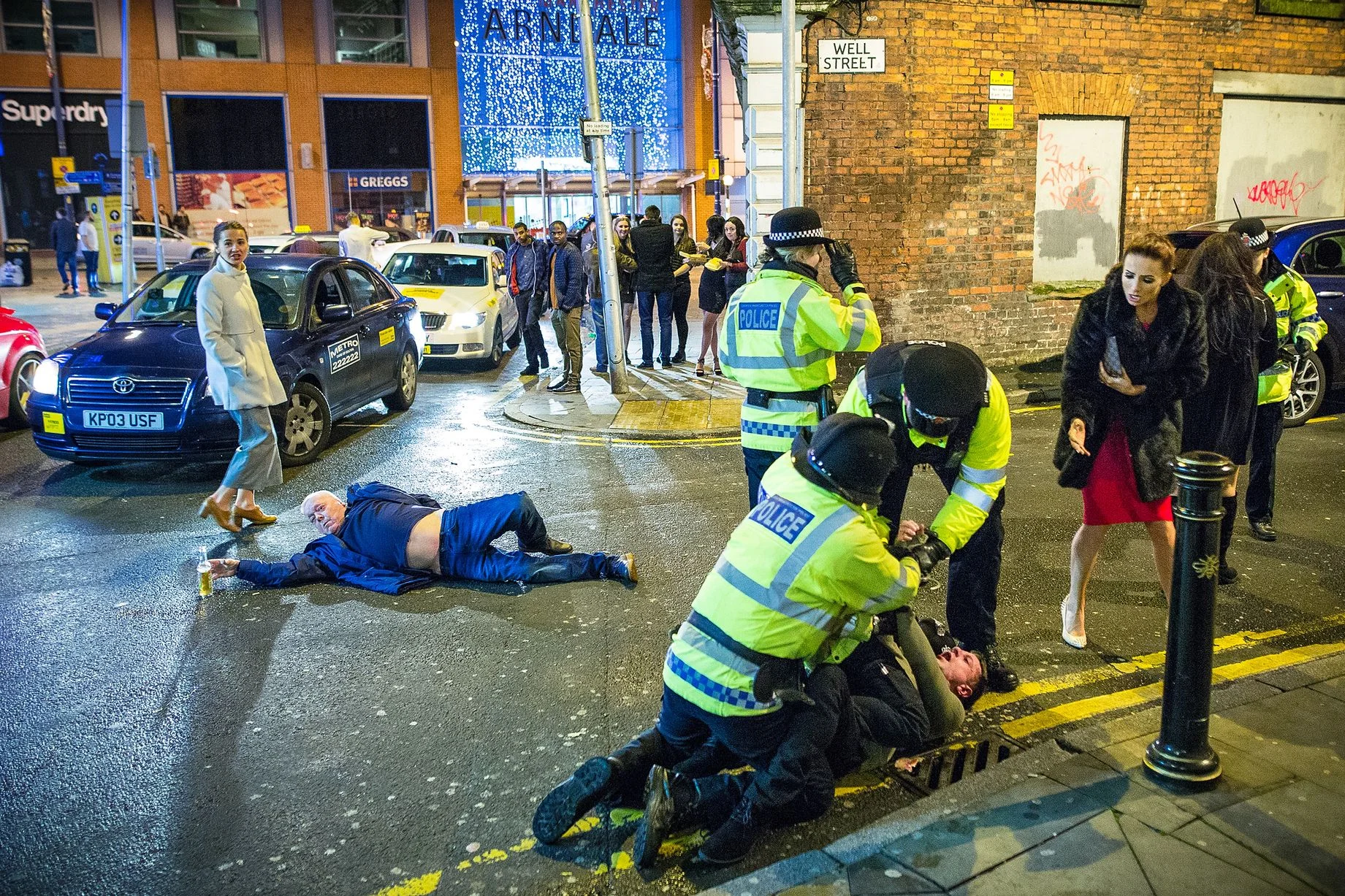
The Manchester New Year's Eve Photo is a viral news photograph shot by Joel Goodman on December 31, 2015 that captured a chaotic Well Street scene, complete with a man in blue reclining in the road clutching a beer. After a BBC producer tweeted it on January 1, 2016 comparing it to a beautiful painting, Twitter users noticed its composition matched the Golden Ratio and turned it into one of the defining Photoshop battles of 2016.

Overview

The photo shows a Well Street scene in central Manchester on New Year's Eve: police wrestling a young man in the foreground, a woman in a red dress reaching toward him, a man in blue splayed across the road with his shirt riding up while he keeps a firm grip on a beer bottle, and a cluster of youngsters watching in the background outside a Greggs bakery and a Superdry store3. The picture went viral not for the drunkenness on display, but for how oddly composed it looked, a chaotic street tableau that seemed to obey the same balance rules as a Renaissance painting1.

The meme format that grew out of it works two ways. The first is compositional: users overlaid the Fibonacci spiral on the image to argue that the golden ratio really did line up with the action1. The second is edit-based: the man in blue, arm outstretched with beer in hand and a serene look on his face, was cut out and dropped into famous paintings, mimicking classical religious poses2. He most often shows up as God in Michelangelo's Creation of Adam, but also lounges by the Seine in Georges Seurat's Bathers at Asnières and drifts through watercolor and fresco versions of the whole street scene1. The joke keeps working because the swap barely needs editing, his pose already reads as classical.

Origin & Background

Platform
Manchester Evening News (source photo) / Twitter (viral spread)
Creator
Joel Goodman; Roland Hughes
Date
2016

On January 1, 2016, the Manchester Evening News published a 31-photo gallery titled "New Years Eve 2016 – party, party, party," documenting the previous night's celebrations across the city5. The 20th photograph, credited to staff photographer Joel Goodman and captioned "Police hold on to a man while another lies in the road," showed the now-famous scrum on Well Street5. Later that same day, BBC senior news producer Roland Hughes plucked the image out of the gallery and posted it to Twitter with the line, "So much going on this pic of New Year in Manchester by the Evening News. Like a beautiful painting."3 Hughes credited the newspaper in the tweet, which he later said was his default assumption for a post he expected almost no one to read3.

How It Spread

Hughes' post picked up momentum within minutes, first with a Dutch follower in the Netherlands before jumping across the Channel to UK audiences later that afternoon3. By January 5, 2016, the tweet had been retweeted more than 25,600 times and favorited over 29,600 times5. Twitter user @GroenMNG replied with an overlay showing the photo's composition matching the Fibonacci spiral, the same mathematical rule used by Leonardo da Vinci in works like The Last Supper and The Annunciation6. That reply alone gathered over 860 retweets and 1,000 favorites, and it gave the joke the art-history spine that pushed it into serious virality5.

Redditors piled on the same day. The photo landed on r/pics (2,399 points, 89% upvoted), r/AccidentalRenaissance (497 points, 91% upvoted), and r/photoshopbattles (187 points, 93% upvoted, 48 replies)5. Mainstream press picked it up almost as fast. The Guardian ran it under the headline "'Like a beautiful painting': image of New Year's mayhem in Manchester goes viral"1. The Daily Mail described it as a "tableaux of drunkenness" and cataloged the Photoshop edits2. The Independent tracked down Hannah Kirby, the woman in the red dress, who identified the two men on the ground and clarified that the man in blue "wasn't casually chilling and reaching for his beer" but had just been knocked over during a fight with police4. Kirby said the man the officers were holding "didn't get arrested; he was fine in the end" and that she only learned she was in the image when her father called4.

Coverage kept spreading through international outlets, including Le Monde and reports in France, Australia, and New Zealand, and Twitter picked the image as its global "Moment" for that Friday3. Hughes wrote a first-person BBC blog post outlining what he called the five stages of unexpectedly going viral, apologizing to Goodman for accidentally routing the world's attention his way3. Greater Manchester Police weighed in with a wry tweet calling the scene "just a normal night for cops, captured brilliantly"4.

How to Use This Meme

The template usually centers on the man in blue and his outstretched, beer-clutching arm. A common convention is to cut him out and drop him into a Renaissance painting, most often as God reaching for Adam in Michelangelo's Creation of Adam2. Others place him into other classical works like Seurat's Bathers at Asnières, or run the full street scene through a watercolor filter such as the Waterlogue app to get an oil-painting look1. A separate style leaves the photo alone and just overlays the Fibonacci golden-ratio spiral, using the image as a straight-faced example of accidental Renaissance composition1.

Cultural Impact

The image is often held up as a defining British viral moment of 2016 and a foundational post for the r/AccidentalRenaissance style of joke, where mundane photos get read as classical art through their composition1. It brought new attention to the way the golden ratio is used to argue for beauty in unexpected places, a topic covered in art writing about Da Vinci and other masters6. It also gave photographer Joel Goodman a global byline overnight and pushed a routine city-page slideshow into international news coverage3.

Frequently Asked Questions