"Millennials Are Killing..."

2013catchphraseclassic

Published September 6, 2026

"Millennials Are Killing..." is a phrasal template that mocks trend pieces blaming the millennial generation for the decline of various industries and traditions. The joke built through 2013 to 2016, then broke wide open after a viral Economist tweet about diamond sales in June 2016, becoming one of the defining Twitter running gags of the late 2010s.

Overview

The template works by taking any headline built around the words "Millennials Are Killing" plus some industry, tradition, or product, and either sharing it with a dry caption or inventing absurd new versions that push the framing to its logical extreme5. The bite of the joke has two layers. Older outlets kept publishing near-identical trend pieces blaming one generation for shifting consumer habits, while the actual reason young people were not buying diamonds, fabric softener, or napkins was usually financial pressure that the original articles refused to name1.

Formats vary but tend to follow a few conventions. Users post screenshots of real headlines with a one-line reply, string together multiple headlines side by side to show the pattern, or invent parody versions that swap in ridiculous targets. The tone stays sardonic rather than angry, and the joke lands hardest when the industry in question is either obviously in decline for unrelated reasons, such as movie theaters losing teens to streaming3, or the target is something the audience finds unappealing anyway, like mass-market American cheese or fast food. When Gothamist ran a 2014 piece titled "Promiscuous Millennials Are Killing McDonald's," the writer openly mocked the framing while quoting a McDonald's executive complaining that young diners were "promiscuous in their brand loyalty"2.

Origin & Background

Platform
News headlines / Twitter (viral spread)
Date
2013

The pushback that produced the meme built through 2013. Time Magazine ran its "The Me Me Me Generation" cover story on millennials that spring, and Gothamist responded with a widely read roundup collecting a year's worth of New York Times pieces about the generation, arguing the paper had painted young people as lazy, entitled, and unmotivated while ignoring the recession, student debt, and housing costs shaping their choices1. The New York Times itself published pieces criticizing the same coverage cycle that year5.

The "killing" framing started appearing in headlines soon after. In 2014, Gothamist ran the piece on McDonald's blaming younger diners for its worst sales slump in a decade, with the fast food giant's Global Chief Brand Officer arguing that the millennial generation had "a wider range of choices than any generation before them"2. Similar articles followed, and by April 2016 the New York Post was reporting on Hollywood's "millennial problem," citing a 3.6 percent drop in teen moviegoers and industry powwows about how to get young people back into theaters3.

How It Spread

The joke went from recurring gripe to full-blown template on June 30, 2016, when The Economist tweeted "Why aren't millennials buying diamonds?"5. The replies were brutal, with users pointing out the obvious answer that millennials do not have much money and mocking the transparent framing. That tweet became the reference point every subsequent "Millennials Are Killing" joke pointed back to.

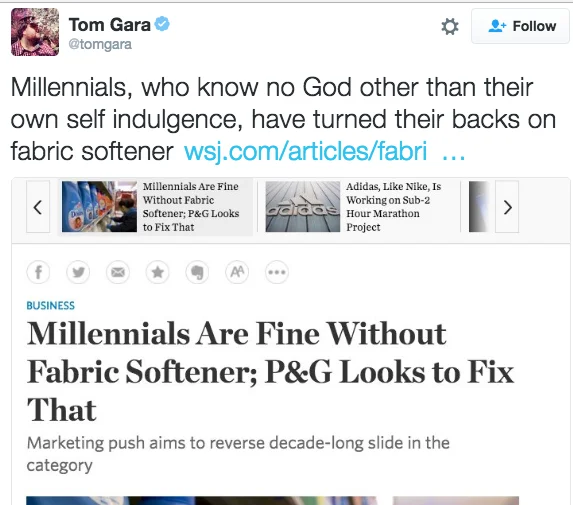
Momentum built through the summer of 2016. On August 24, Fusion published a piece that linked out to 47 separate articles, each accusing millennials of killing a different industry or tradition, from cereal to bar soap to golf. Two days later, Twitter user @necrosofty posted a compilation image of "Millennials are killing" headlines that pulled more than 2,400 retweets and 2,600 likes, and the Daily Dot declared on August 27 that the backlash had hit its peak5. The template kept returning every time a new think piece arrived. On December 16, 2016, the Wall Street Journal ran a story about Procter & Gamble trying to sell fabric softener to millennials, which triggered another round of jokes led by a BuzzFeed editor's tweet that pulled over 2,000 retweets.

Philly Mag revived the format on August 11, 2018 with an essay titled "How Millennials Killed Mayonnaise," in which the author described her home-cooked potato salad and Waldorf salad going untouched at family picnics and blamed the rise of what she called "identity condiments"4. The article included a passage where the author appeared to link her daughter's aversion to mayonnaise to being a feminist, and Twitter users pounced, with journalist Jamelle Bouie's reply arguing that mayonnaise salad "rightfully" died pulling roughly 3,200 likes4. Business Insider then ran a piece on October 10, 2018 arguing that American cheese was falling out of favor because of millennial taste, and the whole cycle repeated again5.

How to Use This Meme

Making a "Millennials Are Killing" joke typically starts with a real trend piece from a legacy business outlet. Common conventions include screenshotting the headline without comment, replying with a one-line explanation that names the actual cause (usually wages, student debt, or housing costs), or stringing several matching headlines together to expose the pattern. Parody versions tend to swap in absurdly small targets, like the napkin industry or fabric softener, to push the framing past its breaking point. The joke works best when the target industry is either objectively bad or in decline for reasons unrelated to any generation.

Cultural Impact

The joke got picked up by business and food writers themselves, and any new think piece about generational consumer behavior in the late 2010s risked being turned into a punchline within hours of publishing. Marketing teams took notice too; the December 2016 Wall Street Journal piece about Procter & Gamble openly discussed reworking fabric softener marketing to appeal to a younger audience, which itself became meme material. The Philly Mag mayonnaise essay from August 2018 was so widely mocked that Twitter Moments compiled the response, and the phrase "identity condiments" was pulled out of the article and used as its own recurring joke4. By late 2018, food publications running stories about American cheese losing ground to sharper alternatives had to acknowledge the format directly to avoid being subsumed by it3.

Frequently Asked Questions