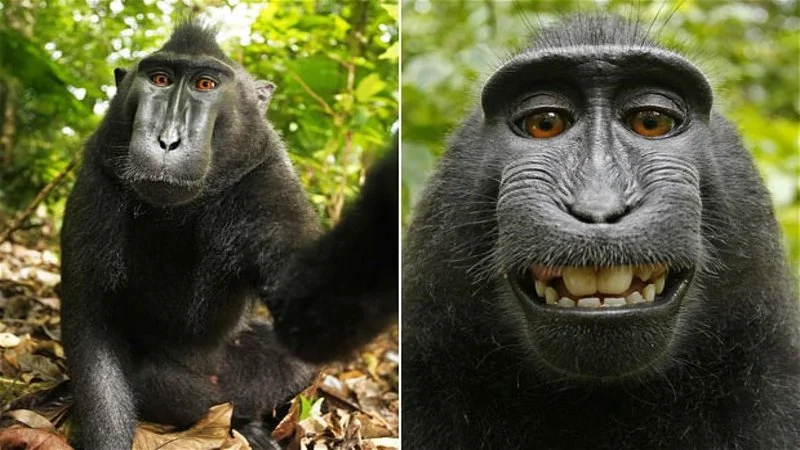
Monkey Selfie
Published March 24, 2026
Also known as: Naruto Selfie · Macaque Selfie · Monkey Self-Portrait
The Monkey Selfie is a viral self-portrait photograph taken by a Celebes crested macaque using British wildlife photographer David Slater's camera in the jungles of Sulawesi, Indonesia. First going viral in July 2011, the grinning monkey photo sparked one of the most unusual copyright disputes in history, drawing in Slater, Wikimedia Commons, and PETA in a legal fight over whether a non-human animal could own a copyright. The case set legal precedent that still shapes debates around AI-generated art and non-human authorship today.
Overview
The Monkey Selfie refers to a series of photographs, most famously a sharp, close-up self-portrait showing a female Celebes crested macaque grinning directly into the camera with wide amber eyes and a distinctive punk-like crest of black hair. The image stands out for its uncanny resemblance to a human selfie, with the macaque appearing to pose deliberately. Slater's Canon EOS 5D DSLR was set up on a tripod with a wide-angle zoom lens at f/8 in aperture priority mode when the monkeys interacted with the equipment2. The resulting photos looked so intentional that their authenticity was questioned on social media, though Slater confirmed they were genuine1.
Gallery
Origin & Background
How It Spread
How to Use This Meme
The Monkey Selfie is not a traditional meme template with a customizable format. Instead, people typically use the image in discussions about:
- Copyright and ownership debates: The photo is often shared when discussing who owns creative works, especially in conversations about AI-generated art. Users post it alongside questions like "If a monkey can't own a copyright, can an AI?" - Animal humor: The grinning macaque is used as a reaction image for situations involving unexpected cleverness, happy accidents, or "nailing it on the first try." - Legal absurdity: The image surfaces whenever bizarre legal cases or unusual intellectual property disputes make the news.
The photo is in the public domain under U.S. law, so anyone can freely use, share, or remix it without permission7.
Cultural Impact
Full History
Fun Facts
Slater's camera was a Canon EOS 5D set to aperture priority at f/8 with a wide-angle zoom lens. He also rigged a flash gun and predictive autofocus to maximize his chances of getting a usable shot if the monkeys approached2.
The macaques were initially scared by the shutter sound but quickly returned, drawn to the noise and their own reflections in the lens1.
Slater described the monkeys' interaction with the camera as "chimping," a photography term for obsessively checking your LCD screen, which took on a literal meaning in this context11.
The settlement between PETA and Slater in 2017 was not a court order but a private agreement to end the costly litigation. Slater chose to donate 25% of future revenues to macaque habitat protection as a practical business decision13.
The Celebes crested macaque is critically endangered, threatened by forest clearance, crop-raiding persecution, and bushmeat poaching. Slater noted that the monkeys could still be found at local markets sold as meat11.
Derivatives & Variations
AI copyright debate meme:
The monkey selfie is regularly invoked in online discussions about whether AI-generated images can be copyrighted, with users drawing direct parallels between Naruto pressing a shutter and an algorithm generating pixels[12].
"Even a monkey can do it" jokes:
The phrase became a running gag in photography communities, referencing the idea that professional photography boils down to pressing a button[10].
Wildlife Personalities book:
Slater published the photos in a hardcover book through Blurb, Inc., which itself became the subject of PETA's lawsuit[9].
Wikimedia Commons category:
The photographs are maintained as a dedicated category on Wikimedia Commons with 19 freely available files, making them among the most famous public domain photographs on the platform[7].
Frequently Asked Questions
References (18)
- 1
- 2
- 3
- 4Monkey Selfie - Know Your Memeencyclopedia
- 5Selfieencyclopedia
- 6
- 7
- 8
- 9
- 10
- 11
- 12
- 13
- 14
- 15
- 16
- 17
- 18