POV Memes

2019Video format / image macro / roleplay memeactive

Also known as: POV Roleplay · #POV · Point of View memes

POV memes are a video and image format where the caption "POV: You're [something]" places the viewer directly into a specific scenario, usually humorous, awkward, or absurd. The format took off on TikTok in early 2019 and quickly spread to Twitter, Reddit, Instagram, and iFunny, becoming one of TikTok's defining content genres3. By inviting the audience to experience a situation firsthand rather than just observe it, POV memes turned passive scrolling into something weirdly personal.

Overview

POV memes borrow a filmmaking technique (point-of-view shots) and turn it into an interactive joke format. The standard setup is a caption reading "POV: You're [object/person in a situation]" paired with a video or image showing what that perspective would look like3. The viewer isn't watching a meme happen to someone else. They ARE the meme.

Loading tweet...

On TikTok, creators typically look directly into the camera and act out a scene, casting the viewer as a character in the scenario2. The scenarios range from wholesome ("POV: you don't have a lunch at school and I offer you my entire lunch") to horror-themed to completely unhinged. The format works because TikTok's vertical, front-facing camera style already mimics eye contact, making the roleplay feel surprisingly immersive4.

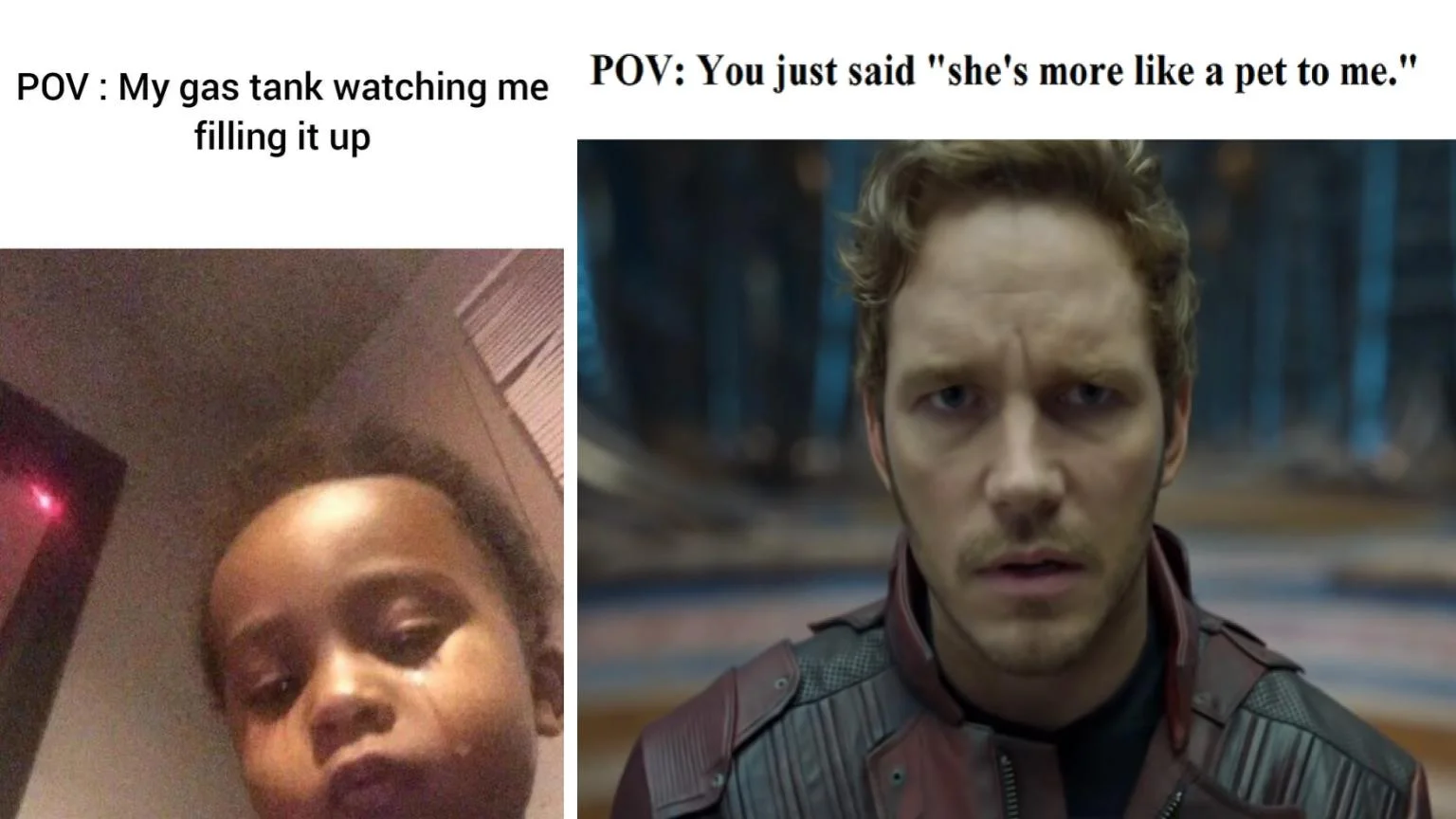
On image-based platforms like Reddit and iFunny, POV memes tend to use photos or illustrations showing an object's-eye view of a situation, like being a figurine placed in a jar or a LEGO minifigure falling into a river3.

The POV technique has roots in film and gaming. In esports, "POV camera" means watching from one player's perspective. In movies, POV shots put the audience in a character's shoes3. But the meme format, built around the caption formula "POV: You're..." is a TikTok invention.

One of the earliest known POV memes on TikTok was posted on February 17, 2019, by user @benoftheweek3. His video was captioned "what ur nintendo ds lite sees when u pictochat ur crush," placing the viewer in the role of a Nintendo DS Lite console. The video picked up over 72,400 likes and 2,100 shares within three months, eventually climbing past 472,600 likes3.

The key innovation was simple: instead of making a joke about a situation, you made the viewer live through it.

Origin & Background

Platform
TikTok (meme format), Twitter (cross-platform spread)
Key People
@benoftheweek
Date
2019

The POV technique has roots in film and gaming. In esports, "POV camera" means watching from one player's perspective. In movies, POV shots put the audience in a character's shoes3. But the meme format, built around the caption formula "POV: You're..." is a TikTok invention.

One of the earliest known POV memes on TikTok was posted on February 17, 2019, by user @benoftheweek3. His video was captioned "what ur nintendo ds lite sees when u pictochat ur crush," placing the viewer in the role of a Nintendo DS Lite console. The video picked up over 72,400 likes and 2,100 shares within three months, eventually climbing past 472,600 likes3.

The key innovation was simple: instead of making a joke about a situation, you made the viewer live through it.

How It Spread

The format caught on fast. On March 25, 2019, TikTok user @uekan_gopro posted a POV roleplay that showed an alternative perspective of a performance, pulling in over 199,000 likes3. On May 2, @symplisam uploaded a video casting the viewer as a beauty blender, earning 21,700 likes within a week3.

The jump to Twitter happened on April 29, 2019, when @WoahTxler posted a POV meme that racked up 820,700 views and 47,600 likes within a year3. The next day, @DANNYDEVITHOE pushed the format into darker comedy territory with "POV: you're a fetus and i abort you with a topshop coat hanger," which hit 510,000 views3. On May 2, @izzysmh went wholesome with a boyfriend-reassurance POV that got 213,000 views3. The Daily Dot covered the trend on May 8, 20193.

A Vice report explained why the format worked so well on TikTok specifically. The app's For You page pushes content from strangers directly onto your screen, and with only 15 seconds to grab attention, POV memes had a structural advantage: they pull the viewer in immediately by making them part of the story2. As TikToker @porrinate (Adam) told Vice, "I think it makes it very personal to the viewer, because the video is through their eyes"2.

By late 2019, POV memes had spread to Reddit, iFunny, and Instagram3. On November 12, 2019, iFunny user EvilDead posted a cum jar POV meme that got 2,900 smiles3. On February 9, 2020, a Redditor posted a "A Man Has Fallen Into the River in Lego City" POV crossover that pulled 22,500 upvotes in r/okbuddyretard3.

Platforms

TikTokYouTubeTwitter

How to Use This Meme

The POV format is simple:

1

Write the caption. Start with "POV:" followed by a scenario that places the viewer as a specific person, object, or character. Example: "POV: you're the last slice of pizza at a party."

2

Shoot or find the visual. On TikTok, this typically means looking directly into the camera and acting out the scene. On image platforms, use a photo or illustration that matches the described perspective2.

3

Pick the tone. POV memes work across the full emotional spectrum: wholesome, creepy, absurd, relatable, nostalgic4. The format is loose enough to support almost anything.

Cultural Impact

POV memes helped define TikTok's identity as a platform distinct from YouTube or Instagram. Vice's Becca Lewis, a researcher with Data and Society, pointed out that different platforms produce different content cultures based on their structural constraints2. TikTok's short format, algorithmic For You page, and sound-recycling system created the conditions for POV content to thrive2.

The format also demonstrated the limits of algorithmic content moderation. The 2020 "daddy daughter POV" controversy showed how engagement-driven recommendation systems could amplify harmful content even when individual videos didn't technically violate platform rules1. Absofacto's fan-driven reclamation campaign became an early example of community-led content moderation on TikTok, where users organized to flood a hashtag with positive content rather than waiting for top-down enforcement1.

The broader impact on meme culture was structural. POV memes proved that a format built on viewer participation could sustain long-term popularity across platforms. The "POV:" prefix is now a standard part of internet vocabulary, used even outside formal meme contexts4.

Full History

The POV format didn't just spread. It mutated into one of TikTok's most versatile content genres.

Through the first half of 2019, most POV TikToks followed a fairly innocent pattern. Creators acted out school scenarios, relationship moments, and silly object perspectives3. The format's emotional range was what set it apart from other TikTok trends. As Vice noted, most TikTok content at the time followed a rigid Mad Libs structure: a popular sound bite plus a specific joke, with the punchline baked in2. POV videos broke that mold. Instead of recycling a single punchline, they recycled a framing device while letting the emotional content vary wildly2.

This openness made POV memes uniquely good at tapping into shared experiences. TikToker Olivia Giordano posted a POV captioned "there's not enough seats at the lunch table today, so you have nowhere to sit," essentially weaponizing secondhand embarrassment2. Another creator made "ur teacher lets u pick partners but u have 2 friends in ur class who partnered up"2. These weren't just jokes. They functioned like exposure therapy, forcing viewers to relive uncomfortable moments in a safe digital space2.

Nir Eyal, author of *Hooked: How to Build Habit-Forming Products*, told Vice that TikTok's meme model risked boring users through repetition2. But POV content dodged that problem because the "variable reward," the emotional surprise inside each video, was different every time. The container stayed the same; the contents were unpredictable2.

The format's dark side surfaced in mid-2020. A subset of POV TikToks labeled "daddy daughter POV" videos emerged, using Absofacto's song "Dissolve" as a soundtrack1. These videos showed young users making eye contact with the camera while setting up scenarios involving a daughter walking in on her father. Some were vaguely unsettling; others were disturbing enough that survivors of childhood sexual abuse began messaging the musician directly1.

Jonathan Visger (Absofacto) described receiving those messages as "uncharted territory"1. His song had been a TikTok fixture since 2019, gaining millions of streams and a minor chart placement four years after its original release1. But the algorithm created a feedback loop: users who had previously liked "Dissolve" videos were shown more of them, including the disturbing subset, while the controversy itself generated engagement that promoted the videos further1.

Visger responded with a TikTok post calling on fans to "take back the song and beat back the gross daddy POV trend," which pulled in half a million likes1. Fans launched a wave of countermemes under the same audio tag. One popular response video was captioned "I'm your cool aunt looking at a picture you just colored with your other aunt after I get back from burying your creepy pedophilic dad in the woods"1. A gay couple posted a response with "POV: you got taken away from your creepy dad and adopted by a lesbian witch family"1. Many original creators took down their posts and apologized. Visger later dedicated his TikTok account to spreading awareness about child sexual abuse1.

The incident exposed a tension at the heart of the POV format. Its power comes from putting the viewer inside the scenario, but that same mechanism can be used to normalize uncomfortable or harmful dynamics. TikTok's algorithm, which surfaces content based on engagement rather than intent, made it difficult to distinguish between critique and endorsement1.

Despite the controversy, the format kept growing. By the early 2020s, "POV:" had become a universal caption prefix across every major social platform4. The format adapted to image macros on Reddit and iFunny, where the viewer perspective is implied through camera angle rather than direct address3. Short text-over-image POV memes also spread, distilling entire emotional arcs into a single frame and caption4. The format's flexibility, from horror to wholesome to absurdist, kept it from burning out the way more rigid meme templates do.

Fun Facts

TikToker Adam (@porrinate) based his wholesome POV about offering lunch on his own high school experience of not having enough to eat2.

Absofacto's "Dissolve" gained millions of streams from TikTok POV usage before the 2020 controversy, charting four years after its 2015 release1.

Nir Eyal, a behavioral design expert, specifically cited POV content as the exception to his concern that TikTok's meme model would bore users through repetition2.

The earliest known TikTok POV cast the viewer as a Nintendo DS Lite3.

Derivatives & Variations

Wholesome POV TikToks

— Creators like @porrinate made POV videos about small acts of kindness, like sharing lunch with a classmate who doesn't have food[2]

Horror POV TikToks

— A subgenre using the format for jump scares and creepy scenarios, placing the viewer as a victim or witness[3]

Object POV Memes

— Videos and images from the perspective of everyday items (beauty blenders, shampoo bottles, the refrigerator at 3 AM), with @benoftheweek's Nintendo DS video as the prototype[3]

Counter-POV Memes

— Response videos that directly subvert or reclaim a POV trend, as seen in the Absofacto "Dissolve" reclamation campaign[1]

Reddit/iFunny POV Image Macros

— Static image versions adapting the format to platforms without TikTok's video infrastructure, including crossovers with existing meme templates like "A Man Has Fallen Into the River in Lego City"[3]

Frequently Asked Questions