Roof Koreans
Published March 31, 2026
Also known as: Rooftop Koreans
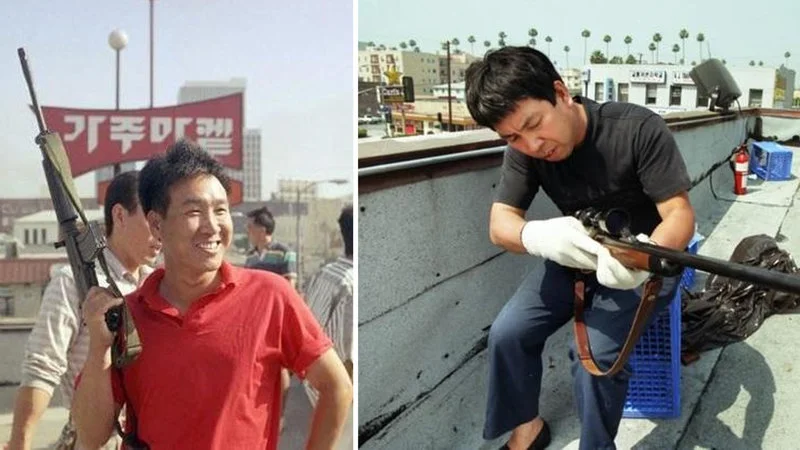
"Roof Koreans" is a slang term and image macro meme built around news photographs and video of Korean American business owners who armed themselves on store rooftops during the 1992 Los Angeles riots after police abandoned Koreatown. The term became an internet meme in the early 2010s, adopted by Second Amendment advocates and gun rights communities as a symbol of armed self-defense. The meme is one of the most politically contested images from American civil unrest, celebrated by some as a display of community self-reliance and criticized by many Korean Americans for stripping a traumatic event of its painful context1.
Overview
"Roof Koreans" refers to Korean American store owners who stood on rooftops with rifles, shotguns, and handguns during the 1992 LA riots, defending their businesses from looters and arsonists. The images, originally broadcast on live television and published in newspapers, show men in casual clothes, sometimes wearing white headbands, wielding everything from hunting shotguns to semiautomatic rifles while perched atop markets, electronics shops, and liquor stores in LA's Koreatown2.
In meme form, these photographs are used as image macros with captions about self-defense, civil unrest, and gun ownership. Pro-gun communities adopted the imagery to argue for private firearm ownership, while many Korean Americans view the meme as a painful oversimplification of a community crisis1. The meme spikes in use whenever riots, protests, or looting make the news in the United States.
Gallery
Origin & Background
How It Spread
How to Use This Meme
The Roof Koreans meme typically takes one of several forms:
Image macro: A 1992 photograph of armed Korean Americans on rooftops, paired with a caption about self-defense or civil unrest. Common captions include variations of "Everybody [X] until the roof starts speaking Korean."
Reaction image: The photographs are posted without captions in response to news about riots, protests, or looting, implying armed self-defense as the answer.
Satirical classified ad: Posts offering "Roof Korean services for hire" during periods of civil unrest, following the template set by the 2014 Craigslist ad13.
Political commentary: The images are shared alongside pro-Second Amendment arguments, often framed around the idea that communities cannot rely on police during crises.
Cultural Impact
Full History
Fun Facts
Many of the Korean men on the rooftops had completed South Korea's mandatory military service, while some younger Korean Americans had weapons experience from involvement in street gangs. "We were mostly ex-military," Kim Duk said. "But during the riots, they helped defend the community"9.
Radio Korea functioned as an emergency coordination hub, shutting down all programming and entering a two-month "recovery period" after the riots ended, during which accountants at the station helped community members file insurance claims10.
Prof. Edward T. Chang stated that not a single person was shot and killed by the Korean shop owners. They fired warning shots only1.
Yongsik Lee's first stop before climbing to his roof was not a gun store. He went to Home Depot to buy fire extinguishers3.
The California Market (Gaju) on 5th and Western was one of the most heavily photographed locations, with the Los Angeles Times describing defenders wielding "shotguns and automatic weapons" on the roof2.
Derivatives & Variations
"Roof Korean for hire" posts:
Satirical classified ads offering armed rooftop defense services, originating with the 2014 Ferguson Craigslist post and replicated across Reddit and social media[13].
"Roof Korean Day":
A joke holiday on April 29, the anniversary of the riots, referenced on Urban Dictionary and in gun culture forums[5].
Gun culture merchandise:
Stickers, patches, and T-shirts depicting the 1992 rooftop defenders, sold on platforms like Etsy and gun accessory sites[1].
"OG Roof Korean" identity:
Tony Moon and other original participants have adopted the label as a personal brand and social media identity tied to Second Amendment advocacy[3].
Bat Signal parody:
Tony Moon posted a meme of his face replacing the Bat Signal over a city skyline in response to the 2025 LA protests[3].
Frequently Asked Questions
References (14)
- 1
- 2
- 3
- 4Roof Koreans - Know Your Memeencyclopedia
- 5Rooftop Koreansencyclopedia
- 6Roof Koreans - Urban Dictionarydictionary
- 71992 Los Angeles riotsencyclopedia
- 8
- 9
- 10
- 11
- 12
- 13
- 14Roof Koreans for hirearticle