Spreading Misinformation
Published November 15, 2026
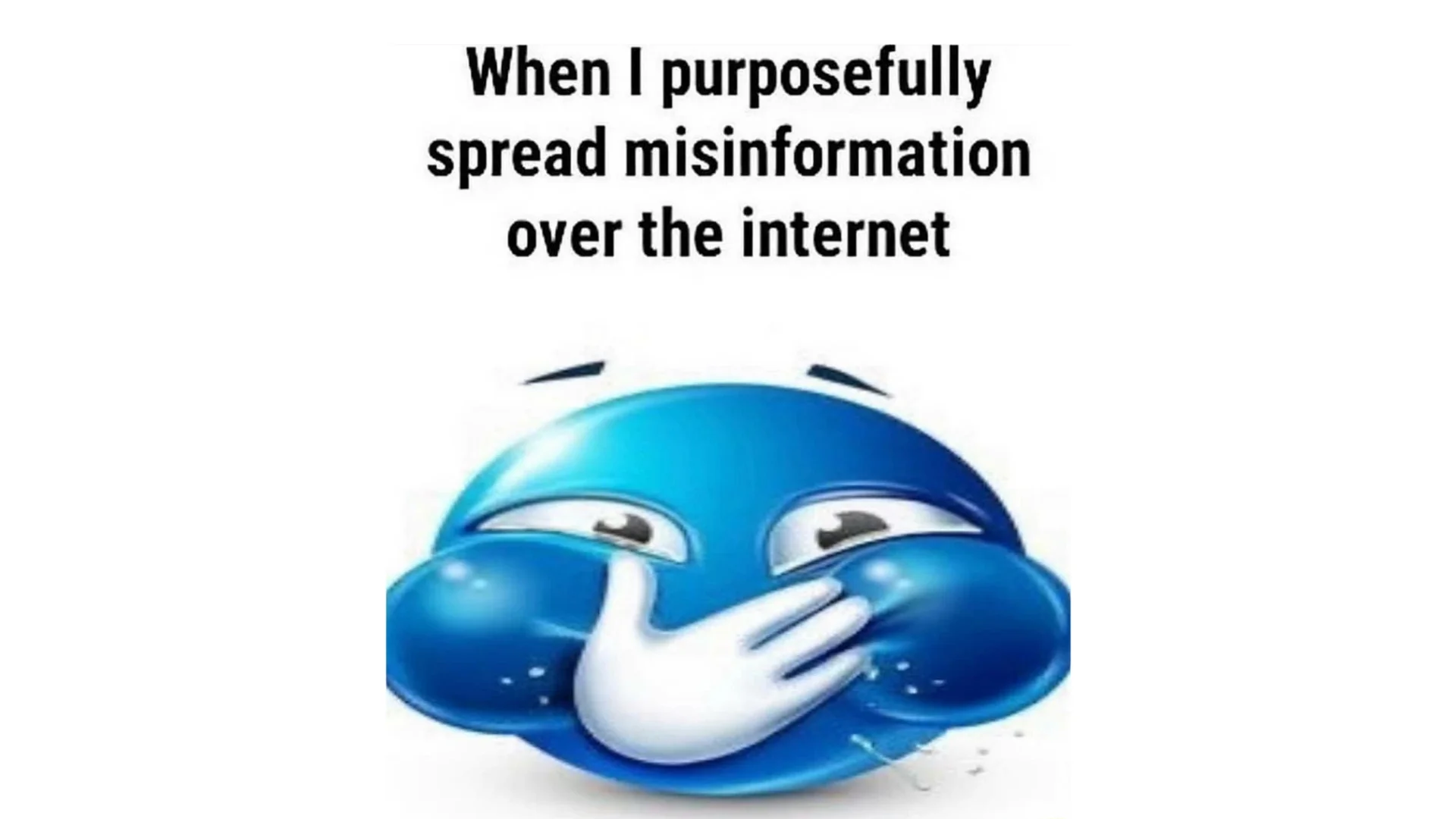
Spreading Misinformation is a joke format where posters cheerfully admit to publishing false claims online for laughs, with the admission itself as the punchline. The format first appeared across Facebook and iFunny in 2020 before breaking out in February 2021 through a Blue Emoji redraw of the Laughing Squidward GIF. By April 2022, Twitter users were replying to their own fake trivia with Mercy Offers a Hand edits that confessed the bit.
Overview
Most posts in the format pair a laughing or smug visual with a caption where the poster happily owns up to lying on purpose. A common template uses a frozen frame of the Squidward Laughing GIF or its Blue Emoji redraw, captioned 'When I purposefully spread misinformation over the internet'3. Video captions swap in a smirking character narrating fabricated trivia or pointing at deliberately wrong 'facts', which gave the format a second life on iFunny and Instagram8.
The joke rides on the poster's willingness to be dishonest for comedy rather than on any particular lie, so the template works just as well as a self-reply. Users will post an outlandish claim and then quote-reply themselves with a Squidward caption that confesses the trick5. Related jokes including Sam Hyde Did It attribution gags1 and Mercy Offers a Hand edits10 stretch the bit into other formats while keeping the same self-aware admission.
Gallery
Origin & Background
How It Spread
Timeline
How to Use This Meme
Posters typically take a laughing or smug image, such as the Squidward Laughing GIF, the Blue Emoji variant, or a Mercy Offers a Hand screenshot, and caption it with something like 'When I purposefully spread misinformation over the internet.' A common move is to drop an obviously false claim in one post and self-reply with the image, owning the bit. Video edits often add a character narrating a fake 'fact' to the camera.
Frequently Asked Questions
References (10)
- 1
- 2
- 3
- 4
- 5
- 6
- 7
- 8
- 9
- 10