St Javelin Saint Javelin
Published March 24, 2026
Also known as: St. Javelin · Святая Джавелина · Madonna Javelin
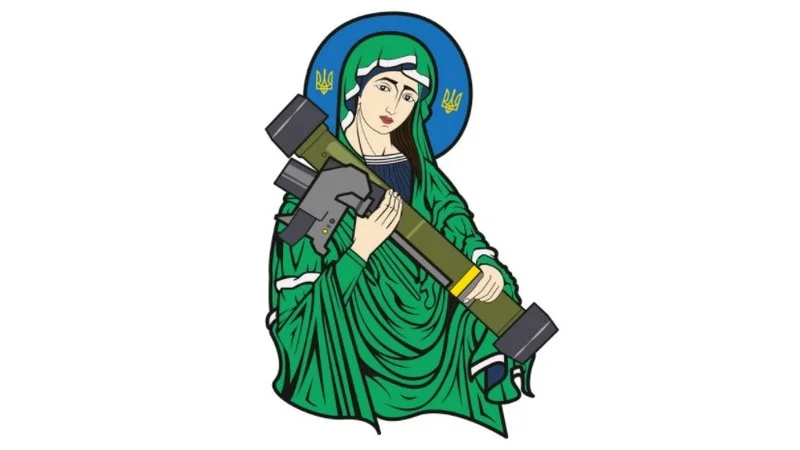
Saint Javelin is an internet meme depicting the Virgin Mary in a traditional Orthodox icon style, cradling an FGM-148 Javelin anti-tank missile instead of the baby Jesus. The image originated from American artist Chris Shaw's 2012 painting "Madonna Kalashnikov," which was edited by an anonymous user on VKontakte in January 2018 to swap the AK-47 for a Javelin missile1. The meme exploded globally during the 2022 Russian invasion of Ukraine, becoming one of the war's most recognizable symbols of resistance and raising over one million dollars for Ukrainian humanitarian causes through a merchandise campaign run by Ukrainian-Canadian journalist Christian Borys2.
Overview
The Saint Javelin meme shows a female figure styled after the Virgin Mary in Eastern Orthodox iconography, holding a US-made FGM-148 Javelin anti-tank missile launcher in the position where the infant Jesus would typically appear3. Her robes are usually military green or Ukrainian blue and yellow rather than traditional gold and purple. An early version featured a red halo, which was later changed to blue and yellow to match Ukraine's national colors5.
The humor comes from swapping a sacred religious element with modern military hardware. While religious icons have historically been depicted with weapons like swords (as in images of Saint Michael), the Javelin missile launcher is aggressively contemporary and very specific to the Russia-Ukraine conflict3. The figure is commonly misidentified as Mary Magdalene or Saint Olga of Kyiv, but she is based on a traditional Madonna representation5.
Gallery
Origin & Background
How It Spread
How to Use This Meme
Saint Javelin is typically used as a symbol of solidarity with Ukraine rather than as a traditional exploitable meme template. Common uses include:
Display: Putting Saint Javelin stickers, patches, or images on laptops, cars, or social media profiles to signal support for Ukraine
Sharing: Posting the image on social media during major events in the Russia-Ukraine conflict
Redrawing: Creating fan art variations that maintain the Orthodox icon style but swap in different weapons or Ukrainian military equipment
Merchandise: Wearing or displaying official or unofficial Saint Javelin branded items
Cultural Impact
Full History
Fun Facts
Chris Shaw originally painted "Madonna Kalashnikov" alongside a companion piece called "Madonna with a Suicide Belt" in 20121.
The first 100 Saint Javelin stickers were printed on February 14, 2022, Valentine's Day, just ten days before Russia's full-scale invasion2.
The first known use of the name "Saint Javelin" for the image was a tweet by user @golub on May 28, 20184.
Borys, a former journalist, later admitted he wished he had documented the early viral explosion on video but was too busy packing sticker orders2.
The Saint Javelin online store produced a HIMARS salt and pepper shaker, described by Borys as "really hilarious and out there"2.
Derivatives & Variations
Saint HIMARS:
A variation featuring the HIMARS rocket launcher system instead of a Javelin, created as the brand expanded its "saints" lineup to reflect other Western weapons supplied to Ukraine[3]
Saint Bayraktar:
A version featuring the Turkish Bayraktar TB2 drone, another weapon that became iconic during the war's early months[3]
Rainbow Collection:
LGBTQ+ themed Saint Javelin merchandise with proceeds earmarked for LGBTQ+ Ukrainians[3]
Recycled Artillery Shell Products:
Figurines, keychains, and challenge coins crafted from spent artillery casings by Ukrainian veterans Andriy and Mykhailo[9]
Defender Collection:
A practical clothing line (fleeces, backpacks, bamboo T-shirts) manufactured in Ukraine and partially donated to Ukrainian soldiers[2]
Fan art and redraws:
The image spawned numerous reinterpretations across social media, with users creating their own versions featuring different weapons, Ukrainian symbols, and artistic styles[4]
Frequently Asked Questions
References (11)
- 1Святая Джавелина — Википедияarticle
- 2
- 3Saint Javelin - Wikiwandarticle
- 4St. Javelin / Saint Javelin - Know Your Memeencyclopedia
- 5Saint Javelin - Wikipediaencyclopedia
- 6
- 7
- 8/cum/ - 4archivearticle
- 9
- 10Saint Javelin Officialarticle
- 11Saint Javelin Explainedarticle