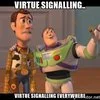
Virtue Signalling
Published March 24, 2026
Also known as: Virtue signaling (American spelling)
"Virtue signalling" is a pejorative term used to accuse someone of making conspicuous public displays of moral goodness, not out of genuine conviction, but to boost their social reputation1. British journalist James Bartholomew popularized the expression in an April 2015 article for *The Spectator*, though the Oxford English Dictionary traces its earliest known use to 20133. The term became a go-to weapon in online culture wars, deployed across Twitter, Reddit, and comment sections to dismiss everything from profile picture overlays to celebrity activism2.
Overview
"Virtue signalling" describes the act of publicly expressing moral opinions or taking symbolic stances primarily to signal one's own goodness to others. The accusation implies that the person cares more about being *seen* as virtuous than actually *being* virtuous1. Common examples include changing a profile picture to show solidarity with a cause, posting outraged social media takes about issues without taking concrete action, or loudly proclaiming boycotts that never materialize9.
The term draws loosely from signalling theory in evolutionary biology, where organisms display costly traits to honestly advertise their genetic fitness12. In this academic framework, "honest signals" are reliable because they carry real costs, like a peacock's tail that's genuinely burdensome to maintain. Virtue signalling, by contrast, suggests that modern moral displays are *cheap* signals, requiring no real sacrifice or behavioral change1. A person might declare "I hate 4x4s!" not because they've restructured their life around environmental principles, but because the statement earns social approval within their peer group1.
Origin & Background
How It Spread
How to Use This Meme
"Virtue signalling" typically functions as an accusation, not a self-description. Nobody opens with "I'm virtue signalling right now." The term gets deployed in a few common patterns:
Direct dismissal: "She's just virtue signalling" when someone makes a public moral statement you believe is insincere or performative
Symbolic action callout: Pointing out that changing a profile picture, posting a hashtag, or sharing an article does nothing practical to address the issue at hand9
Hypocrisy attack: Accusing someone of expressing values they don't live by, like celebrities preaching about carbon offsets before boarding private jets10
Debate deflection: Dismissing an opponent's moral position without engaging with its substance, effectively short-circuiting the argument2
Cultural Impact
Full History
Fun Facts
Bartholomew described virtue signalling as a "positional good" in economic terms. If someone outbids you on moral concern, you have to raise your bid to keep your position. This creates an escalating auction that can detach from the actual issue entirely1.
The OED's earliest recorded use is from 2013, but the concept was described (without the specific phrase) by linguistic and political commentators going back to at least 200423.
The term occurs roughly 0.5 times per million words in modern written English, making it about as common as words like "gentrification" or "mansplaining"3.
Comedian usage follows a specific pattern: making fun of approved targets (UKIP, bankers, the *Daily Mail*) lets audiences enjoy "a sense of community, let off some anger and have a laugh all at the same time," which Bartholomew identified as a particularly efficient form of collective virtue signalling1.
The Kaepernick kneeling controversy produced virtue signalling from both sides at once: protesters signalling commitment to racial justice, and counter-protesters signalling patriotic devotion, each accusing the other of insincerity11.
Derivatives & Variations
Apathy-signalling / cruelty-signalling:
Counter-terms describing the stance of people who mock virtue signalling, suggesting their cynicism is itself performative[13].
Slacktivism:
An older, overlapping concept for feel-good online activism that requires minimal effort, like signing petitions or sharing awareness posts[4].
Woke (as pejorative):
The word "woke" traveled a parallel trajectory, originating in Black activist communities as a call to awareness about systemic injustice, then getting weaponized as a dismissal in the same contexts where "virtue signalling" thrives[13].
Competitive pearl-clutching:
A synonym used in some conservative commentary circles, often alongside "moral preening" and "flashing tribal signs"[7].
Frequently Asked Questions
References (15)
- 1
- 2
- 3
- 4Performative maleencyclopedia
- 5Virtue Signalling - Urban Dictionarydictionary
- 6Signalling theory - Wikipediaencyclopedia
- 7
- 8
- 9
- 10
- 11
- 12
- 13Easy virtuearticle
- 14
- 15virtue signallingarticle