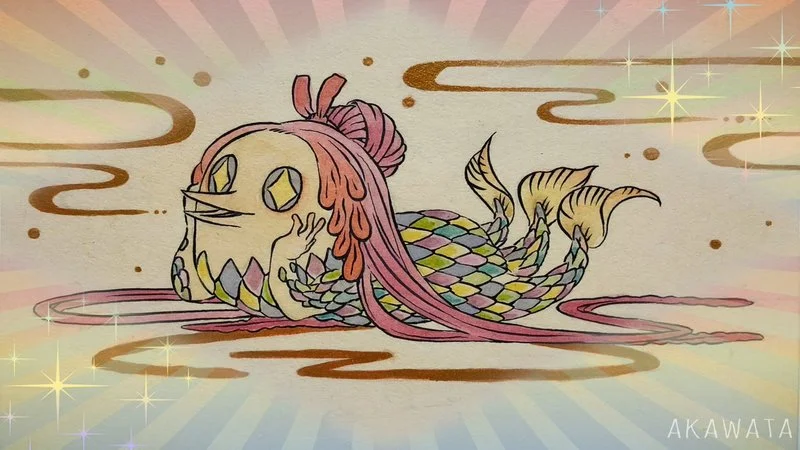
Amabie
Also known as: アマビエ · Amabie Challenge · #AMABIEchallenge
Amabie is a Japanese yōkai from 1846 folklore that exploded into a global participatory art movement during the COVID-19 pandemic in early 2020. The three-legged, beak-faced sea creature, said to ward off disease when its image is shared, inspired tens of thousands of original illustrations posted under hashtags like #AMABIEchallenge. What started as a niche bit of Edo-period folklore turned into one of 2020's most distinctive internet memes, crossing from Japanese Twitter to international art communities and government public health campaigns.
Overview
Amabie is a mermaid-like spirit from Japanese folklore depicted with long hair, a bird's beak, fish scales, and three fin-like legs. According to legend, the creature appeared to a government official in Higo Province (modern-day Kumamoto Prefecture) in 1846, predicted six years of good harvests followed by disease, and instructed the official to draw its image and share it with the sick1. This encounter was documented in a single woodblock-printed bulletin called a kawaraban, now housed at the Kyoto University Library4.
For over 170 years, Amabie stayed almost entirely forgotten. Then in early 2020, as COVID-19 spread across Japan and the world, Japanese social media users rediscovered the creature's legend and began drawing and sharing their own versions. The meme's core mechanic was baked into the original folklore: draw Amabie, share the image, ward off plague. It was, as Stanford graduate student Victoria Rahbar put it, "an Edo Period meme"1.
The legend dates to mid-May 1846, when a glowing object appeared nightly in the sea off Higo Province4. A town official went to investigate and encountered a bizarre creature that identified itself as Amabie. It predicted good harvests for six years but warned of coming disease, instructing the official: "Draw a picture of me and show the picture of me to those who fall ill"2. The official sketched the creature and the story was published via kawaraban, the woodblock-printed news sheets of the Edo period.
Amabie's record exists only in that single broadsheet preserved by Kyoto University Library4. Scholars believe the name may be a copyist's error for "amabiko," a similar prophetic yōkai with far more extensive historical documentation dating back to the 1840s6. Unlike the mermaid-like Amabie, amabiko was depicted in various forms, from ape-like figures to daruma doll shapes.
Amabie stayed obscure for generations. A small number of anime fans knew the creature from its appearance in the 2007 anime adaptation of GeGeGe no Kitarō, Shigeru Mizuki's famous yōkai manga franchise, where it appeared as a cute, pastel-scaled mermaid friend of the title character10. But for most people, Amabie was a deep-cut footnote in yōkai studies until COVID-19 changed everything.
Origin & Background
How It Spread
How to Use This Meme
The Amabie meme is one of the most open-ended formats around. The basic idea:
Draw your own Amabie. The creature's features are loose enough to allow wild interpretation, but typically include some combination of a bird-like beak, long hair, fish scales, and three fin-like legs or tail-fins.
Post it online with hashtags like #AMABIEchallenge, #アマビエ, or similar tags.
Include a wish for health or an end to illness. Some people write captions like "May the plague go away" alongside their artwork.
Cultural Impact
Full History
Fun Facts
Amabie may just be a typo. Scholars believe the name was likely a copyist's error for "amabiko," a similar prophetic yōkai with far more historical records.
The only known original Amabie image is a single 1846 woodblock print stored at the Kyoto University Library, making it one of the most thinly documented yōkai in Japanese folklore.
Manga artist Mari Okazaki, who drew her own Amabie, said the trend worked because "when people paint or draw, it tends to calm them down, so people are drawing for both themselves and others".
Amabie's beak coincidentally looks similar to a paper surgical mask, which commentators noted made the creature feel oddly fitting for a pandemic-era symbol.
The 1846 woodblock has been described as looking more like a modern "yuru-chara" (loose mascot character) than a terrifying monster, which likely helped its 2020 appeal.
Derivatives & Variations
Junji Ito's Amabie (2020):
Horror manga master Junji Ito drew Amabie in his signature semi-realistic style, with star-like flesh around the eyes, a crooked beak, and four-finned tails, posted on social media in May 2020[10].
Hello Kitty x Amabie:
Sanrio released a product line featuring Hello Kitty dressed as Amabie or paired with a chibi Amabie friend, including Mochiri-yaki, candy packaging, keychains, and bags[10].
Ministry of Health poster (April 2020):
Japan's MHLW created official COVID-19 prevention posters with Amabie's image urging citizens to prevent the spread of infection[2].
Kumamoto bronze statue:
A small bronze statue of Amabie was installed in the creature's legendary home prefecture[10].
Yu-Gi-Oh! card:
Amabie received official card art in the Yu-Gi-Oh! trading card game[10].
GeGeGe no Kitarō Amabie:
In the 2007 anime, Amabie appears as a cute, pastel-colored mermaid yōkai with fortune-telling powers[10].
Nishinomiya city campaign:
The city used artist Takai Yoshikazu's Amabie illustration in COVID-19 vaccination outreach[10].
IDEO designer collection:
16 professional designers created wildly varied interpretations including paper-cut art, psychedelic collage, and geometric pen-and-ink drawings[8].
Frequently Asked Questions
References (14)
- 1
- 2
- 3
- 4Amabie - Know Your Memeencyclopedia
- 5Amabieencyclopedia
- 6Shigeru Mizukiencyclopedia
- 7Yōkai - Wikipediaencyclopedia
- 8GeGeGe no Kitarō - Wikipediaencyclopedia
- 9
- 10
- 11Amabie - TV Tropesarticle
- 12
- 13
- 14新型コロナウイルス感染症について|厚生労働省article