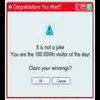
Congratulations You Won

2008Audio clip / pop-up ad / internet scam memeclassic

Also known as: 1 Millionth Visitor · You Are the 999 · 999th Visitor · Congratulations You've Won

Congratulations You Won is a 2008 audio-clip meme from pop-up ad scams, featuring a male voice announcing fake prize winnings later remixed into viral internet humor.

"Congratulations, You Won!" is an infamous audio clip and pop-up ad format featuring a male voice announcing fake prize winnings, designed to lure internet users into malware downloads and phishing scams. The scam traces its roots to the mid-1990s pop-up ad era and became one of the most recognized forms of online fraud by the late 2000s. The audio clip itself became a meme, remixed into YouTube videos, creepypasta stories, and ironic jokes about the shared misery of browsing the early internet.

TL;DR

"Congratulations, You Won!" is an infamous audio clip and pop-up ad format featuring a male voice announcing fake prize winnings, designed to lure internet users into malware downloads and phishing scams.

Overview

The "Congratulations, You Won!" meme centers on an unmistakable audio soundbite: a male voice enthusiastically declaring that the user has won a prize. The clip played automatically through intrusive pop-up ads that flooded web browsers throughout the 2000s and 2010s4. These ads typically claimed the visitor was the "999,999th" or "1,000,000th" visitor to a website and urged them to click a link to "claim" their prize1. In reality, clicking led to phishing pages, malware downloads, or data-harvesting scam sites like Freelotto1.

The ad format was visually loud: flashing colors, rotating banners, and urgent text designed to overwhelm users into compliance1. The voice clip gave these scams an audio signature that an entire generation of internet users can identify instantly. That shared recognition turned the scam into a meme, with the audio and visual style becoming shorthand for "obvious internet fraud" and a staple of ironic internet humor6.

Pop-up ads themselves were invented by Ethan Zuckerman in the mid-1990s while working at the web hosting company Tripod3. Zuckerman built a tool to display ads in separate browser windows, separating them from web page content to generate more revenue3. He later expressed regret when malware developers seized on the format to build deceptive ads3.

The specific "Congratulations, You Won!" scam variant emerged from this pop-up ecosystem, though pinpointing exactly who created the first version is difficult. The scam ads were produced by countless bad actors across the web3. One of the earliest documented write-ups came on December 17, 2008, when the internet scams blog Fraudo published an article titled "Congratulations You Won"1. The post described an ad displaying the text "Contragulations! You are the 999,999th visitor" that redirected users to Freelotto, a site requiring personal details under the guise of "releasing your winnings"1. Fraudo's author noted the link always showed the same visitor number regardless of actual traffic, and that Freelotto's terms revealed the "prize" was essentially a lottery sign-up buried in advertising spam1.

Origin & Background

Platform
Web browsers (scam ads), YouTube (meme spread)
Creator
Unknown; Ethan Zuckerman
Date
Mid-1990s (pop-up ads), ~2008 (meme awareness)

Pop-up ads themselves were invented by Ethan Zuckerman in the mid-1990s while working at the web hosting company Tripod. Zuckerman built a tool to display ads in separate browser windows, separating them from web page content to generate more revenue. He later expressed regret when malware developers seized on the format to build deceptive ads.

The specific "Congratulations, You Won!" scam variant emerged from this pop-up ecosystem, though pinpointing exactly who created the first version is difficult. The scam ads were produced by countless bad actors across the web. One of the earliest documented write-ups came on December 17, 2008, when the internet scams blog Fraudo published an article titled "Congratulations You Won". The post described an ad displaying the text "Contragulations! You are the 999,999th visitor" that redirected users to Freelotto, a site requiring personal details under the guise of "releasing your winnings". Fraudo's author noted the link always showed the same visitor number regardless of actual traffic, and that Freelotto's terms revealed the "prize" was essentially a lottery sign-up buried in advertising spam.

How It Spread

By 2010, the scam had become so pervasive that it started generating ironic content. On May 11, 2010, YouTuber dwightpudding uploaded a video titled "Congratulations, You Won!" featuring the notorious audio clip playing over a slideshow of humorous images.

The meme gained momentum in 2011 when YouTuber ostolero uploaded a clip from *Neon Genesis Evangelion* with the "Congratulations! You won!" audio layered over the anime's famous congratulations scene. This mashup style caught on as a way to juxtapose the scam's cheesy enthusiasm with unrelated content.

On October 15, 2012, tech news site Neowin reported on a Microsoft survey conducted for National Cyber Security Awareness Month. The survey found that 44% of respondents had encountered some variation of the "Congratulations, you've won!" scam, making it the single most popular type of online fraud. Other common scams included fake virus alerts (40%), phishing emails disguised as official sources (39%), and money transfer requests (39%).

A November 10, 2013 Reddit post on r/nosleep by user puddlesofblood turned the scam into horror fiction, writing a creepypasta story about a malicious "Congratulations! You won!" ad. The post earned over 1,000 upvotes with a 94% approval rate before being archived. On December 2, 2014, a Steam Community forum member posted a thread complaining about an auto-play ad that announced "Congratulations you've won a trophy". By August 2015, the scam had migrated to mobile, prompting the tech site IgoPedia to publish a step-by-step guide for removing the "Congratulations-you-won.com-yourprize.com" pop-up from iPhones and iPads running Safari.

The death of Adobe Flash in 2020 dealt a blow to many pop-up ad formats, but the "1 millionth visitor" scam adapted. Malware developers rebuilt the ads using HTML5, ensuring the format survived the technology transition.

How to Use This Meme

The "Congratulations, You Won!" meme typically appears in a few forms:

1

Audio mashup: Layer the iconic voice clip over unrelated video footage, especially scenes that involve actual congratulations or ironic failure. The *Evangelion* congratulations scene is a classic pairing.

2

Screenshot jokes: Post mock-ups or real screenshots of the flashing pop-up ads with captions about internet nostalgia or gullibility.

3

Ironic celebration: Use the phrase "Congratulations, you won!" sarcastically to describe situations where someone has "won" something worthless or harmful, like a computer virus or an obvious scam.

4

Creepypasta/horror: Write fictional stories where the pop-up ad turns genuinely sinister, expanding on the unsettling feeling of an unknown voice addressing you through your computer.

Cultural Impact

Microsoft's 2012 survey data positioned the "Congratulations, you've won" format as the most common online scam type, ahead of fake virus alerts and phishing emails. The finding was reported widely as part of National Cyber Security Awareness Month efforts.

The scam's cultural footprint extends beyond the meme itself. Ethan Zuckerman's regret over inventing pop-up ads became a well-known story in tech circles, with the "Congratulations" ads often cited as the worst-case outcome of his creation. The format also became a teaching tool for internet safety education. Multiple tech blogs and mobile guides published removal instructions specifically for this pop-up variant, with IgoPedia's 2015 iOS guide being one of the most detailed.

Urban Dictionary's entry for the term captures the generational sentiment concisely: "The ultimate insult to your intelligence on the internet. At best, you've won nothing but an annoying pop-up ad. At worst, if you actually fall for it, you might have just won yourself a virus".

Fun Facts

Ethan Zuckerman, the inventor of the pop-up ad, built the format while working at Tripod in the 1990s as a way to separate ads from page content. He later publicly apologized for unleashing pop-ups on the world.

The Fraudo blog post that first documented the scam noted the ad text contained a typo: "Contragulations" instead of "Congratulations".

The identity of the male voice actor behind the iconic audio clip is still unknown.

Despite the death of Flash in 2020, the scam persists. Developers rebuilt it using HTML5 and modern web technologies.

The Microsoft survey found that the "you've won" scam format beat out fake virus alerts, phishing emails, and Nigerian prince-style money transfer scams in prevalence.

Derivatives & Variations

Evangelion congratulations mashup:

YouTuber ostolero combined the audio with the famous congratulations scene from *Neon Genesis Evangelion*, creating one of the first notable meme edits of the clip[4].

Creepypasta fiction:

The r/nosleep story by puddlesofblood reframed the scam ad as a genuine horror scenario, earning over 1,000 upvotes and spawning similar horror takes on familiar internet annoyances[4].

Animated GIF loops:

YouTuber Caius Abadon and others created looping animated GIFs of the flashing "Congratulations" message paired with the repeating audio clip[4].

"1 Millionth Visitor" umbrella:

While "Congratulations, You Won!" is the most recognized audio variant, the broader "1 millionth visitor" scam family includes silent banner ads, survey pop-ups, and redirect chains that all use the same visitor-count deception[3].

Frequently Asked Questions

CongratulationsYouWon

2008Audio clip / pop-up ad / internet scam memeclassic

Also known as: 1 Millionth Visitor · You Are the 999 · 999th Visitor · Congratulations You've Won

Congratulations You Won is a 2008 audio-clip meme from pop-up ad scams, featuring a male voice announcing fake prize winnings later remixed into viral internet humor.

"Congratulations, You Won!" is an infamous audio clip and pop-up ad format featuring a male voice announcing fake prize winnings, designed to lure internet users into malware downloads and phishing scams. The scam traces its roots to the mid-1990s pop-up ad era and became one of the most recognized forms of online fraud by the late 2000s. The audio clip itself became a meme, remixed into YouTube videos, creepypasta stories, and ironic jokes about the shared misery of browsing the early internet.

TL;DR

"Congratulations, You Won!" is an infamous audio clip and pop-up ad format featuring a male voice announcing fake prize winnings, designed to lure internet users into malware downloads and phishing scams.

Overview

The "Congratulations, You Won!" meme centers on an unmistakable audio soundbite: a male voice enthusiastically declaring that the user has won a prize. The clip played automatically through intrusive pop-up ads that flooded web browsers throughout the 2000s and 2010s. These ads typically claimed the visitor was the "999,999th" or "1,000,000th" visitor to a website and urged them to click a link to "claim" their prize. In reality, clicking led to phishing pages, malware downloads, or data-harvesting scam sites like Freelotto.

The ad format was visually loud: flashing colors, rotating banners, and urgent text designed to overwhelm users into compliance. The voice clip gave these scams an audio signature that an entire generation of internet users can identify instantly. That shared recognition turned the scam into a meme, with the audio and visual style becoming shorthand for "obvious internet fraud" and a staple of ironic internet humor.

Pop-up ads themselves were invented by Ethan Zuckerman in the mid-1990s while working at the web hosting company Tripod. Zuckerman built a tool to display ads in separate browser windows, separating them from web page content to generate more revenue. He later expressed regret when malware developers seized on the format to build deceptive ads.

The specific "Congratulations, You Won!" scam variant emerged from this pop-up ecosystem, though pinpointing exactly who created the first version is difficult. The scam ads were produced by countless bad actors across the web. One of the earliest documented write-ups came on December 17, 2008, when the internet scams blog Fraudo published an article titled "Congratulations You Won". The post described an ad displaying the text "Contragulations! You are the 999,999th visitor" that redirected users to Freelotto, a site requiring personal details under the guise of "releasing your winnings". Fraudo's author noted the link always showed the same visitor number regardless of actual traffic, and that Freelotto's terms revealed the "prize" was essentially a lottery sign-up buried in advertising spam.

Origin & Background

Platform
Web browsers (scam ads), YouTube (meme spread)
Creator
Unknown; Ethan Zuckerman
Date
Mid-1990s (pop-up ads), ~2008 (meme awareness)

Pop-up ads themselves were invented by Ethan Zuckerman in the mid-1990s while working at the web hosting company Tripod. Zuckerman built a tool to display ads in separate browser windows, separating them from web page content to generate more revenue. He later expressed regret when malware developers seized on the format to build deceptive ads.

The specific "Congratulations, You Won!" scam variant emerged from this pop-up ecosystem, though pinpointing exactly who created the first version is difficult. The scam ads were produced by countless bad actors across the web. One of the earliest documented write-ups came on December 17, 2008, when the internet scams blog Fraudo published an article titled "Congratulations You Won". The post described an ad displaying the text "Contragulations! You are the 999,999th visitor" that redirected users to Freelotto, a site requiring personal details under the guise of "releasing your winnings". Fraudo's author noted the link always showed the same visitor number regardless of actual traffic, and that Freelotto's terms revealed the "prize" was essentially a lottery sign-up buried in advertising spam.

How It Spread

By 2010, the scam had become so pervasive that it started generating ironic content. On May 11, 2010, YouTuber dwightpudding uploaded a video titled "Congratulations, You Won!" featuring the notorious audio clip playing over a slideshow of humorous images.

The meme gained momentum in 2011 when YouTuber ostolero uploaded a clip from *Neon Genesis Evangelion* with the "Congratulations! You won!" audio layered over the anime's famous congratulations scene. This mashup style caught on as a way to juxtapose the scam's cheesy enthusiasm with unrelated content.

On October 15, 2012, tech news site Neowin reported on a Microsoft survey conducted for National Cyber Security Awareness Month. The survey found that 44% of respondents had encountered some variation of the "Congratulations, you've won!" scam, making it the single most popular type of online fraud. Other common scams included fake virus alerts (40%), phishing emails disguised as official sources (39%), and money transfer requests (39%).

A November 10, 2013 Reddit post on r/nosleep by user puddlesofblood turned the scam into horror fiction, writing a creepypasta story about a malicious "Congratulations! You won!" ad. The post earned over 1,000 upvotes with a 94% approval rate before being archived. On December 2, 2014, a Steam Community forum member posted a thread complaining about an auto-play ad that announced "Congratulations you've won a trophy". By August 2015, the scam had migrated to mobile, prompting the tech site IgoPedia to publish a step-by-step guide for removing the "Congratulations-you-won.com-yourprize.com" pop-up from iPhones and iPads running Safari.

The death of Adobe Flash in 2020 dealt a blow to many pop-up ad formats, but the "1 millionth visitor" scam adapted. Malware developers rebuilt the ads using HTML5, ensuring the format survived the technology transition.

How to Use This Meme

The "Congratulations, You Won!" meme typically appears in a few forms:

1

Audio mashup: Layer the iconic voice clip over unrelated video footage, especially scenes that involve actual congratulations or ironic failure. The *Evangelion* congratulations scene is a classic pairing.

2

Screenshot jokes: Post mock-ups or real screenshots of the flashing pop-up ads with captions about internet nostalgia or gullibility.

3

Ironic celebration: Use the phrase "Congratulations, you won!" sarcastically to describe situations where someone has "won" something worthless or harmful, like a computer virus or an obvious scam.

4

Creepypasta/horror: Write fictional stories where the pop-up ad turns genuinely sinister, expanding on the unsettling feeling of an unknown voice addressing you through your computer.

Cultural Impact

Microsoft's 2012 survey data positioned the "Congratulations, you've won" format as the most common online scam type, ahead of fake virus alerts and phishing emails. The finding was reported widely as part of National Cyber Security Awareness Month efforts.

The scam's cultural footprint extends beyond the meme itself. Ethan Zuckerman's regret over inventing pop-up ads became a well-known story in tech circles, with the "Congratulations" ads often cited as the worst-case outcome of his creation. The format also became a teaching tool for internet safety education. Multiple tech blogs and mobile guides published removal instructions specifically for this pop-up variant, with IgoPedia's 2015 iOS guide being one of the most detailed.

Urban Dictionary's entry for the term captures the generational sentiment concisely: "The ultimate insult to your intelligence on the internet. At best, you've won nothing but an annoying pop-up ad. At worst, if you actually fall for it, you might have just won yourself a virus".

Fun Facts

Ethan Zuckerman, the inventor of the pop-up ad, built the format while working at Tripod in the 1990s as a way to separate ads from page content. He later publicly apologized for unleashing pop-ups on the world.

The Fraudo blog post that first documented the scam noted the ad text contained a typo: "Contragulations" instead of "Congratulations".

The identity of the male voice actor behind the iconic audio clip is still unknown.

Despite the death of Flash in 2020, the scam persists. Developers rebuilt it using HTML5 and modern web technologies.

The Microsoft survey found that the "you've won" scam format beat out fake virus alerts, phishing emails, and Nigerian prince-style money transfer scams in prevalence.

Derivatives & Variations

Evangelion congratulations mashup:

YouTuber ostolero combined the audio with the famous congratulations scene from *Neon Genesis Evangelion*, creating one of the first notable meme edits of the clip[4].

Creepypasta fiction:

The r/nosleep story by puddlesofblood reframed the scam ad as a genuine horror scenario, earning over 1,000 upvotes and spawning similar horror takes on familiar internet annoyances[4].

Animated GIF loops:

YouTuber Caius Abadon and others created looping animated GIFs of the flashing "Congratulations" message paired with the repeating audio clip[4].

"1 Millionth Visitor" umbrella:

While "Congratulations, You Won!" is the most recognized audio variant, the broader "1 millionth visitor" scam family includes silent banner ads, survey pop-ups, and redirect chains that all use the same visitor-count deception[3].

Frequently Asked Questions