Elf on the Shelf

2009Photo fad / snowclone / seasonal memeclassic

Also known as: Elf on a Shelf · EOTS

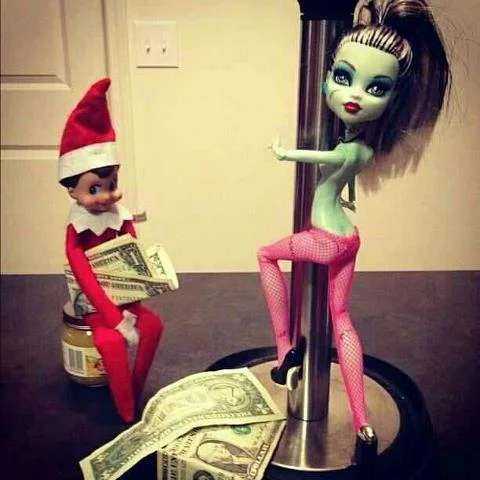
Elf on the Shelf is a Christmas-themed toy and children's book from 2005 that became an internet meme through parody photographs showing the elf doll in inappropriate, violent, or sexually suggestive scenarios. The meme peaked in the mid-2010s with annual holiday cycles of increasingly elaborate staged photos, and spawned the viral "You've heard of Elf on the Shelf" rhyming snowclone format in 2016-2017.

Overview

The Elf on the Shelf meme takes a wholesome children's toy, a small elf doll meant to "watch" kids and report their behavior to Santa, and places it in wildly inappropriate situations. Parents and internet users photograph the elf staging crime scenes, snorting substances off tables, partying with Barbie dolls, or engaging in various acts of chaos around the house2. The humor comes from the contrast between the doll's innocent smile and the decidedly un-family-friendly scenarios.

A second major meme format emerged in late 2016: the "You've heard of Elf on the Shelf, now get ready for..." snowclone, where users post images of objects or characters whose names form a rhyme when paired with a location2.

The source material is a 2005 children's book called *The Elf on the Shelf: A Christmas Tradition*, written by Carol Aebersold and her daughter Chanda Bell, with Aebersold's other daughter Christa Pitts handling marketing3. The book comes packaged with a toy elf that families name and treat as a real scout for Santa Claus. Each night, parents move the elf to a new spot in the house, creating a daily game of hide-and-seek3. The product won Best Toy awards from Learning Express in 2008, 2009, and 20102.

The meme version started on November 28, 2009, when a Facebook page called "Elf on a Shelf Gone Bad" launched, featuring the doll posed in violent, sexual, and degenerate scenarios2. Within five years, that page hit over 111,000 likes2.

Origin & Background

Platform
Facebook (parody photos), Tumblr (snowclone format)
Creator
Unknown
Date
2009

The source material is a 2005 children's book called *The Elf on the Shelf: A Christmas Tradition*, written by Carol Aebersold and her daughter Chanda Bell, with Aebersold's other daughter Christa Pitts handling marketing3. The book comes packaged with a toy elf that families name and treat as a real scout for Santa Claus. Each night, parents move the elf to a new spot in the house, creating a daily game of hide-and-seek3. The product won Best Toy awards from Learning Express in 2008, 2009, and 20102.

The meme version started on November 28, 2009, when a Facebook page called "Elf on a Shelf Gone Bad" launched, featuring the doll posed in violent, sexual, and degenerate scenarios2. Within five years, that page hit over 111,000 likes2.

How It Spread

The meme jumped to Reddit on December 2, 2011, when user shadeofpalms posted an Imgur album showing the elf as a voyeur wreaking havoc around a family home. The post pulled in over 3,400 upvotes and 110 comments2.

By November 2012, a Tumblr blog called "Elf on the Shelf is creepy" collected similar photos2. That same month on Reddit, user Mitch444 posted the elf sitting next to a scantily clothed Barbie in a staged overdose scene2. In December, user BeefAddict's album of the elf in various acts of debauchery scored over 20,400 upvotes on r/funny2.

The annual cycle kept building. In December 2013, user ketchuppacket shared photos of the elf posing next to sleeping children with doodles drawn on their faces, earning 4,400 upvotes2. BuzzFeed ran a compilation of naughty elf photos the same day1. By December 2014, a photo of the elf taped to a wall hit 11,200 votes on r/funny2. December 2015 brought a viral Craigslist ad for a "Living Elf on the Shelf," featuring a man dressed as the doll seated above a fireplace, which grabbed 8,200 votes2.

October 2016 saw the meme enter creepypasta territory when Reddit user iia posted an Elf on the Shelf horror story to r/nosleep, pulling 1,900 upvotes2. The following month, the YouTube channel What's Inside cut open an actual elf doll in a video that hit 5.88 million views within a month2.

The snowclone format launched on December 3, 2016, when Tumblr user fuckin-rockets posted "You've heard of Elf on the Shelf, now get ready for..." above an image of an Ash Ketchum figure in a garbage can ("Ash in the Trash"). The post collected over 53,000 notes in ten months2. By September 2017, Reddit's r/me_irl ran with the format hard. User PM_ME_YOUR_CHEETOS posted Shrek on a deck (19,000 points), pebblesom posted Waluigi on a squeegee (20,000 points), and Havokmin posted Link on a sink (5,000 points)2.

Platforms

TwitterRedditTikTokInstagram

Timeline

2016

Elf on the Shelf meme format emerges

2017

Becomes annual seasonal meme

2018-01-01

Elf on the Shelf reached mainstream popularity and media coverage

2019-01-01

Brands and companies started using Elf on the Shelf in marketing

2021-01-01

Elf on the Shelf entered the broader pop culture conversation

2024

Continues resurgent seasonal pattern

View on Google Trends

How to Use This Meme

Staged photo format: Place an Elf on the Shelf doll in an inappropriate, chaotic, or absurd situation. Common setups include the elf in crime scenes, partying with other toys, vandalizing household items, or mimicking adult activities. Photograph and share during the holiday season for maximum relevance.

Snowclone format: Start with "You've heard of Elf on the Shelf, now get ready for..." then post an image of a recognizable character or object placed on or in something whose name rhymes. The name pairing is typically left for the viewer to figure out. Examples: Shrek on a deck, Ash in the trash, Link on a sink2.

Create Your Own

Cultural Impact

The Elf on the Shelf backlash drew attention from major publications and academics. Multiple privacy researchers criticized the toy for normalizing surveillance of children3. Psychology Today writer David Kyle Johnston called it "a dangerous parental crutch"3. The debate split along predictable lines: critics saw a dystopian training tool, defenders saw a harmless holiday motivator. Clinical professor Judith Tellerman told Yahoo Parenting that "the elf is a visual cue to act nice" and "might remind kids not to fight with their brother"3.

The parental arms race around elf setups became a media story in its own right by the early 2020s. What started as a simple tradition of moving a doll each night escalated into elaborate productions requiring significant time and creativity, prompting the manufacturer to sell official idea kits to reduce the burden3.

Full History

The Elf on the Shelf began its life as a self-published family project. Aebersold, Bell, and Pitts spent three years promoting the book at trade shows and signings before it caught on commercially3. By 2013, it hit the No. 1 spot on the USA Today bestsellers list3. That October, the team released a companion book, *The Elf on the Shelf: A Birthday Tradition*, extending the elf's visits beyond the holiday season3.

The product's mainstream success fueled the parody meme. What started as a niche Facebook page in 2009 grew into an annual internet tradition. Each November and December, social media filled with increasingly elaborate and transgressive elf setups. The humor worked because the product itself was so aggressively wholesome, making any subversion instantly funny.

The staged-photo format peaked around 2014-2016. Parents competed to outdo each other with creative scenarios, from the elf riding a pet dog to elaborate setups involving miniature crime scenes. By 2022, the one-upmanship had become its own phenomenon, with parents creating scenes where the elf swung from ceiling lights on toilet paper or filled sinks with hot chocolate and marshmallows3. Scenarios grew so elaborate that the company released "The Official 24-day Ultimate Elf Ideas Kit" in December 2024 to help overwhelmed parents keep up3. One academic noted the irony: "The elf is increasingly being caught doing things a child would get in trouble for doing, which seems to contradict the point of it all"3.

The meme also tapped into genuine cultural anxiety about the product. *The Atlantic* columnist Kate Tuttle called it "a marketing juggernaut dressed up as a tradition" designed "to spy on kids"3. *Washington Post* reviewer Hank Stuever described it as "just another nannycam in a nanny state obsessed with penal codes"3. Professor Laura Pinto argued the toy conditions children to accept surveillance: "If you grow up thinking it's cool for the elves to watch me and report back to Santa, well, then it's cool for the NSA to watch me and report back to the government"3. *Vox* warned the toy "can breed competition (and potentially feelings of inadequacy)" while adding "holiday stress" for parents3. Urban Dictionary's top definitions reflect this cultural split, with entries ranging from straightforward descriptions to sharp critiques calling it "an extraordinarily stupid holiday tradition" involving a "creepy doll"4.

The snowclone spinoff had a different lifecycle. After its Tumblr debut in December 2016, it went dormant until Reddit's r/me_irl picked it up in September 2017, flooding the subreddit with rhyming variations2. The format's appeal was its simplicity: any object-on-a-surface combo that rhymed worked. Shrek on a deck, Waluigi on a squeegee, Link on a sink, the template was infinitely expandable2. The format eventually died down as the joke wore thin, but it still resurfaces seasonally.

On the media side, CBS aired a thirty-minute animated special, *An Elf's Story: The Elf on the Shelf*, on November 26, 20113. The *Washington Post* dismissed it as "just a half-hour advertisement for a book and a toy," while Common Sense Media called it "a great addition to families' holiday TV traditions"3. In October 2020, Netflix partnered with the Lumistella Company for additional Elf on the Shelf content3.

Fun Facts

The original book was entirely self-published. Aebersold, Bell, and Pitts spent three years promoting it at trade shows before it took off commercially3.

The elf doll's rules state children cannot touch it or its magic disappears. Professor Laura Pinto suggested this "no touch" rule teaches kids to accept authority without question3.

The product hit #1 on the USA Today bestsellers list in 2013, eight years after its initial release3.

By December 2024, the company was selling official scenario kits to help exhausted parents who couldn't keep up with the creative pressure of nightly elf setups3.

The snowclone format's biggest Reddit day was September 14, 2017, when r/me_irl posted dozens of rhyming variations, with the top posts each clearing 19,000+ points2.

Derivatives & Variations

Various elf on shelf rhyming variations

A variation of Elf on the Shelf

(2016)

Absurdist elf concepts

A variation of Elf on the Shelf

(2016)

Extended holiday meme content

A variation of Elf on the Shelf

(2016)

Frequently Asked Questions