Greater Internet Fuckwad Theory
Published March 24, 2026
Also known as: GIFT · Penny Arcade Internet Fuckwad Theory · Gabriel's Greater Internet Fuckwad Theory
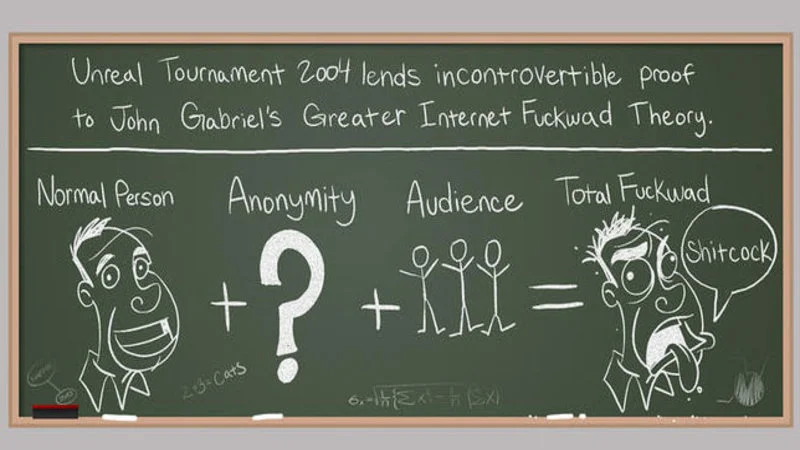
The Greater Internet Fuckwad Theory (GIFT) is a concept from the webcomic Penny Arcade, expressed as a simple equation: Normal Person + Anonymity + Audience = Total Fuckwad. Published on March 19, 2004, the comic strip gave a blunt, funny name to a behavioral pattern that anyone who'd spent time in online forums, game lobbies, or comment sections already knew by heart. The theory became one of the internet's most cited axioms for explaining why people act like jerks online, predating and later overlapping with psychologist John Suler's formal concept of the "online disinhibition effect."
Overview
The Greater Internet Fuckwad Theory boils down online toxicity to a blackboard equation. A normal, well-adjusted person, when given the shield of anonymity and an audience to perform for, transforms into a "total fuckwad." The original Penny Arcade comic presented this as a formula scrawled on a green chalkboard, styled like a physics proof for something everyone on the internet had already observed firsthand1.
The theory's power is its simplicity. It doesn't require a psychology degree to understand. You've seen it in YouTube comments, Xbox Live lobbies, anonymous forums, and under every political news article2. GIFT gave the internet a shorthand for a dynamic that social scientists would formally study for years afterward.
Gallery
Origin & Background
How It Spread
How to Use This Meme
The Greater Internet Fuckwad Theory isn't a traditional meme template. It's typically invoked as shorthand in discussions about online behavior. Common uses include:
Explaining trolling or toxic comments — When someone encounters abusive behavior in an online space, citing "GIFT" or the equation is a quick way to diagnose why it's happening.
Arguing for or against anonymity — The theory regularly appears in debates about real-name policies, anonymous posting apps, and comment moderation systems.
Game design discussions — Developers reference the theory when discussing anti-toxicity measures in multiplayer games.
Sharing the original comic — The Penny Arcade strip itself gets posted as a reaction image when someone witnesses particularly egregious online behavior.
Cultural Impact
Full History
Fun Facts
The concept predates the internet entirely. A 1978 New Yorker article about Johnny Carson noted that CB radio, which let truckers communicate anonymously, produced "disturbing amounts of racism and masturbation fantasies"9.
Urban Dictionary users connected the theory to Plato's Republic, specifically the allegory of the Ring of Gyges, which asks whether anyone would behave justly if they could act without consequences7.
The theory's acronym, GIFT, is itself ironic, spelling out a word associated with generosity to describe a concept about people being terrible12.
At Colgate University, faculty fought back against anonymous Yik Yak abuse by flooding the app with signed, positive posts, a real-world test of GIFT's implications8.
Researcher Jean-Loup Richet noted that GIFT's biggest flaw is its "completeness," arguing that because it seemed to explain everything wrong with the internet, nobody bothered refining it for over a decade4.
Derivatives & Variations
Wheaton's Law
— "Don't be a dick," coined by Wil Wheaton at PAX 2007 as the aspirational inverse of GIFT. Became its own widely-cited internet axiom[5].
xkcd "YouTube" comic
— Published December 27, 2006, this strip commented on YouTube's notoriously awful comment quality, applying the same logic as GIFT to a specific platform[5].
SIDE model analysis
— Communication scientist Jean-Loup Richet formally analyzed and expanded on GIFT using the Social Identity model of Deindividuation Effects, addressing the theory's blind spots around positive behavior and targeted abuse[4].
Invisible Jerkass trope
— TV Tropes catalogued the broader concept across media, from anime to comics to film, with GIFT cited as the internet-specific manifestation[8].
Frequently Asked Questions
References (15)
- 1
- 2
- 3
- 4Greater Internet Fuckwad Theory - Know Your Memeencyclopedia
- 5
- 6Online disinhibition effectencyclopedia
- 7
- 8
- 9
- 10
- 11
- 12
- 13newsarticle
- 14
- 15Forum Speak - TV Tropesarticle