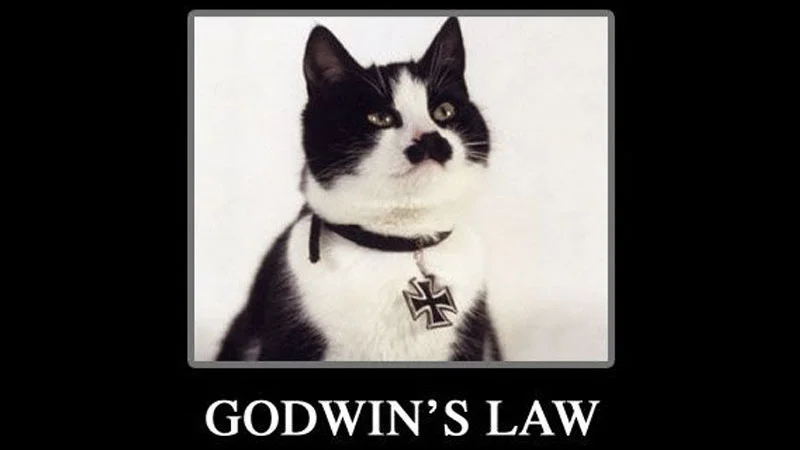
Godwin's Law

1990Internet adage / debate ruleclassic

Published March 10, 2026 · Updated March 18, 2026

Also known as: Godwin's Rule of Nazi Analogies

Godwin's Law is an internet adage coined by attorney Mike Godwin in 1990 stating that "as an online discussion grows longer, the probability of a comparison involving Nazis or Hitler approaches one"4. Originally formulated as a "natural law of Usenet," it became one of the internet's most widely recognized rules of online discourse, added to the Oxford English Dictionary in 20123. The law was deliberately designed as a counter-meme to discourage lazy Hitler comparisons that trivialized the Holocaust7.

Overview

Godwin's Law is the observation that as any online discussion drags on, the probability of somebody comparing another person or idea to Hitler or the Nazis approaches one1. It started as a piece of Usenet folk wisdom in 1990 and got formal enough over the decades that the Oxford English Dictionary added it in 20122.

The rule is descriptive, not prescriptive. Godwin never argued that every Hitler comparison is automatically fallacious, only that hyperbolic ones tend to derail whatever conversation was happening3. In many forum cultures, an unspoken codicil developed on top of the law itself: the first person to reach for the Nazi comparison is treated as having lost the argument, and any deliberate attempt to trigger the law for that thread-ending effect does not count4.

The short version most people repeat online is close to Godwin's original wording, and it is used both as a genuine warning that a debate has gone off the rails and as a punchline whenever someone in a comment section inevitably invokes the Third Reich5.

Origin & Background

Platform
Usenet
Key People
Mike Godwin, Richard Sexton
Date
1990

Mike Godwin, an American attorney who later served as counsel for the Electronic Frontier Foundation and the Wikimedia Foundation, coined the law in 19902. He formulated it after observing the pattern of gratuitous Nazi comparisons spreading across Usenet newsgroups, the Well, and various BBS communities7.

In his own words from a 1994 Wired article, Godwin described his creation as an experiment in memetic engineering. He had decided that "the Nazi-comparison meme had gotten out of hand" and set out to build a counter-meme7. The resulting formulation: "As an online discussion grows longer, the probability of a comparison involving Nazis or Hitler approaches one"4.

Godwin deliberately framed the law to sound like a mathematical or scientific principle, but its purpose was rhetorical and pedagogical4. He wanted people "who glibly compared someone else to Hitler to think a bit harder about the Holocaust"4. The observation itself was originated by Richard Sexton, but Godwin popularized it and gave it the form that stuck2.

He seeded the law into Usenet newsgroups wherever he spotted a lazy Nazi reference. Other users began citing it independently, and the counter-meme replicated on its own7. Know Your Meme researchers identified Godwin's 1994 Wired piece as one of the earliest uses of the word "meme" to describe viral media and the spread of ideas through internet communication3.

How It Spread

After its initial seeding on Usenet, the law spread organically across early internet discussion spaces. The Usenet community formalized a corollary as "Usenet Rule #4," which stated that any off-topic mention of Hitler or Nazis would cause a thread to end quickly2. A tradition developed in many groups that once someone invoked a Nazi comparison, the thread was over and that person had lost5.

As threaded discussion moved from Usenet to web forums, chat rooms, comment sections, and wikis in the 2000s, Godwin's Law traveled with it3. The rule proved surprisingly durable because the behavior it described never went away. Any platform with arguments had someone ready to play the Hitler card.

On October 9, 2009, the r/GodwinsLaw subreddit launched, describing itself as "the place to highlight those who belittle horror of the most reprehensible figures in history by comparing them to people and things they simply don't like"3. In 2012, Godwin's Law was formally added to the third edition of the Oxford English Dictionary4.

PBS Ideas Channel covered the law in a July 2015 video titled "Three Laws of The Internet Explained!" which pulled in over 230,000 views3. QI: Quite Interesting uploaded "What Is Godwin's Law?" in January 2017, earning more than 52,000 views3. In March 2017, a TIL post on Reddit quoting the law received over 1,800 upvotes and 190 comments3.

The law received a major real-world stress test in January 2017 when Donald Trump tweeted "Are we living in Nazi Germany?" in response to intelligence leaks. Twitter users immediately declared he had triggered Godwin's Law8. Then in August 2017, following the Unite the Right rally in Charlottesville where actual neo-Nazi groups marched, Godwin himself weighed in on Twitter: "By all means, compare these shitheads to Nazis. Again and again. I'm with you"3. The tweet picked up more than 20,000 retweets and 48,000 likes in under a week, and was covered by the Washington Post, the Telegraph, HuffPost, Esquire, and other outlets3.

Platforms

RedditTwitterTikTokInstagram
View on Google Trends

How to Use This Meme

People typically invoke Godwin's Law in one of two ways. The first is as a live referee call in a comment thread: once someone drops a Hitler or Nazi comparison, another user replies with "Godwin's Law" or posts the hashtag to declare the debate effectively over6. The second common use is meta, as a shorthand for the general pattern that any long enough internet argument will end up in Nazi territory, often quoted in the paraphrased form "As an online discussion grows longer, the probability of a comparison involving Hitler approaches 1"5.

Create Your Own

Frequently Asked Questions