Green Line Test
Published October 19, 2026
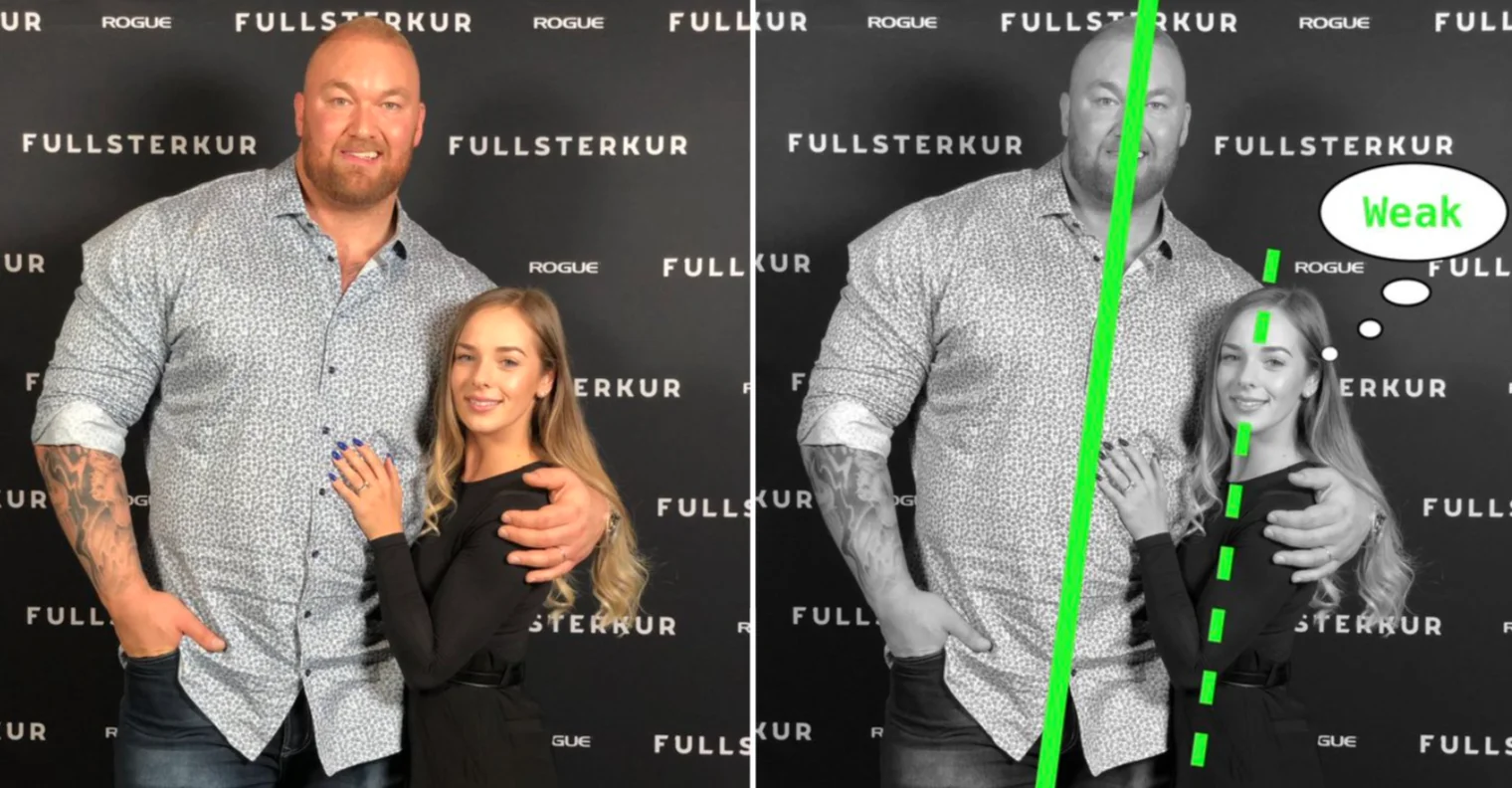
On May 2, 2020, Twitter user @alpharivelino drew green vertical lines over a photo of strongman Hafþór Júlíus Björnsson and his wife Kelsey Henson to argue his slight lean toward her exposed a weak, needy mindset. Critics mocked the thread within days, parody edits spread across Twitter, and the format roared back in April 2022 when TikToker JackMacBarstool applied the test to a picture of Kim Kardashian and Pete Davidson.
Overview
Users apply the Green Line Test / Don't Lean In format by overlaying straight vertical green lines on two people in a photo and reading who tilts toward whom as a sign of relationship 'polarity'1. Earnest posts cast the vertical partner as dominant and the leaning partner as needy, repurposing @alpharivelino's 'sexual polarity' theory even when the caption plays the whole idea as a joke3.
Parody versions ignore couples entirely. Posters have applied the lines to the collapsing Twin Towers5 and to classic Loss panels6, mocking the test's pseudo-scientific logic. On TikTok, a second life for the format produced earnest couple diagnostics and ironic takes side by side, with creators analyzing their own vacation photos next to viral celebrity edits1.
Gallery
Origin & Background
How It Spread
Timeline
2020-05-02
@alpharivelino posts the original edit of Hafþór Júlíus Björnsson and Kelsey Henson, captioned 'Don't lean in, strong man!'
2020-05-04
Justin Whang quote-tweets the thread with his 'beta male' line, and parody edits by @MattMcGurn (Twin Towers) and @roun_sa_ville (Loss) take off.
2022-04-11
TikToker JackMacBarstool posts two Green Line Test videos applying the format to Kim Kardashian and Pete Davidson.
2022-05
Dexerto reports on the TikTok revival and quotes body language experts Joe Navarro and Janine Driver on whether the test holds up.
How to Use This Meme
Creators typically place a straight vertical green line down the center of each person in a two-person photo, then compare how far either line tilts from true vertical. The person whose line stays upright is read as 'dominant,' while the leaner is read as submissive or needy1. Comedic versions apply the format to inanimate objects, such as the collapsing Twin Towers5 or Loss panels6.
Frequently Asked Questions
References (8)
- 1
- 2
- 3
- 4
- 5
- 6
- 7
- 8