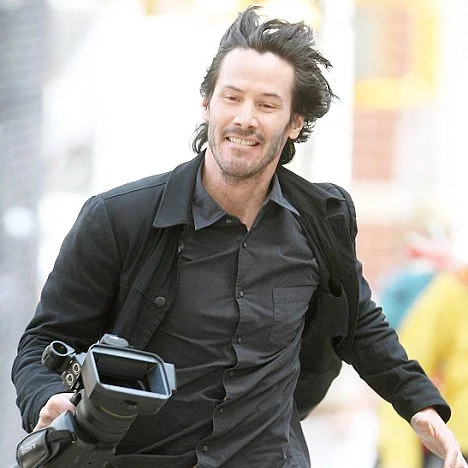
Happy Keanu
Published August 27, 2026
In October 2010, paparazzi caught Keanu Reeves sprinting through New York's East Village with a huge grin and a camcorder in hand while shooting the indie film Generation Um1. The Daily Mail dubbed him "Happy Keanu" in the headline, and photoshop artists who had spent the summer editing the sullen Sad Keanu bench photo pounced on the cheerful sequel2. Within twenty-four hours the image spawned a dedicated Tumblr blog and locked in Happy Keanu as the third chapter of the actor's growing exploitable series4.
Overview
Editors mask Reeves out of his East Village backdrop, keeping the raised knee, the outstretched camcorder, and the strip of stomach peeking above his belt intact, then drop the cutout into scenes where his skipping run reads as absurdly out of place1. Common riffs paste him into somber news photos, Renaissance paintings, sci-fi stills, and awkward celebrity moments, where his beaming face collides with the tone of the host image4. Unlike a captioned image macro, Happy Keanu is a pure cutout template, so the joke usually lives in the visual mismatch rather than in a punchline.
Fans of the earlier bench photo treated the new shot as canon proof that the internet's cheer-up campaign had worked, and many collages pair the two poses back to back as a mood reversal joke2. The template plays on the contrast with the Sad Keanu spread that had dominated Reeves fan pages all summer, since the same person moping alone in June was practically levitating with joy four months later5.
Origin & Background
How It Spread
How to Use This Meme
Making a Happy Keanu edit typically starts with the cleanly masked cutout of Reeves mid-skip, which was widely shared as a transparent PNG on the original Tumblr4. Editors drop him into any setting where his cheerful sprint would look out of place, then lean into the contrast between his beaming face and the somber, historical, or dramatic scene behind him. A common convention pairs Happy Keanu directly with the earlier Sad Keanu bench cutout in a before-and-after collage, using the two poses as a joke about the internet's power to lift a celebrity's mood2. Captions are optional since the visual gag usually carries itself, though some editors add tabloid-style headlines that mirror the Daily Mail's original wording1.
Fun Facts
Urban Dictionary's top-voted entry for "Happy Keanu" has nothing to do with the meme; it defines the term as the crud that collects under keyboard keys6
The Daily Mail's original headline invented the name "Happy Keanu" by treating the photos as a sequel to Sad Keanu, using the word "AGAIN" in the title1
The scene being shot when the photo was taken involved Reeves' Generation Um character stealing a camcorder from cowboys and running away from them1
Cheer Up Keanu Day was proposed by 21-year-old Daniel Murphy, who told the Daily Mail he did not actually think Reeves was sad and just felt the actor's work was under-appreciated1
The single-topic Tumblr blog Happy Keanu went live on the same day the Daily Mail article ran, October 7th, 20104
Derivatives & Variations
Sad Keanu, the June 2010 park bench photoshop series whose fan campaign was folded directly into Daily Mail's coverage of the Happy Keanu photos[1]
Happy Keanu Tumblr, a single-topic blog launched on October 7th, 2010 that collected community edits of the East Village photo[4]
Cheer Up Keanu Day, a June 15th Facebook holiday started by 21-year-old Daniel Murphy that primed the audience for a happy sequel[1]
Frequently Asked Questions
References (7)
- 1
- 2
- 3
- 4
- 5
- 6
- 7