Hinomoto Oniko (日本鬼子)
Published August 27, 2026
Also known as: 日本鬼子 · ひのもとおにこ · Riben Guizi moe project
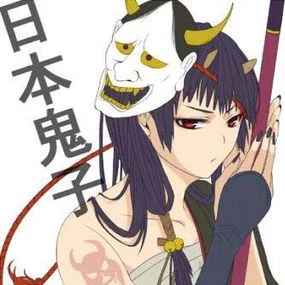
Hinomoto Oniko (日本鬼子 / ひのもとおにこ) is a moe anime character created by Japanese internet users in October 2010 to neutralize a Chinese anti-Japanese slur. By reinterpreting the Chinese insult *rìběn guǐzi* (日本鬼子, "Japanese devils") as a cute girl's name using alternative Japanese readings of the same characters, artists on 2channel turned a wartime epithet into an adorable demon girl wearing a kimono and carrying a naginata. The project went viral across Japanese platforms and left Chinese netizens largely baffled, producing thousands of fan illustrations and videos within weeks.
Overview
Hinomoto Oniko is a fictional moe character designed as a young woman between 16 and 18 years old with long black hair, pale skin, two small devil horns, and red eyes that appear when she's angered3. She wears an autumn leaf-patterned kimono, sometimes carries a hannya mask from traditional Noh theater, and wields a naginata polearm4. The character was deliberately crafted to be politically neutral. Expressions promoting Sino-Japanese friendship or anti-Chinese feelings were both discouraged by the project's organizers3.
The entire concept hinges on a linguistic trick. In Chinese, 日本鬼子 is pronounced *rìběn guǐzi* and means "Japanese devil," a slur dating back to the Second Sino-Japanese War5. But the same characters can be read using Japanese kun'yomi readings as "Hinomoto Oniko," which sounds like a perfectly normal (if unusual) female name4. The "surname" Hinomoto (日本) means "origin of the sun," and the given name Oniko (鬼子) ends with the feminine suffix *-ko* (子), commonly found in Japanese girls' names7.
Gallery
Origin & Background
How It Spread
How to Use This Meme
Hinomoto Oniko isn't a meme template in the traditional sense. There's no exploitable image macro or fill-in-the-blank format. Instead, it's a participatory art project. Artists typically draw a young woman matching the established design: long black hair, two horns, a kimono (often with autumn leaf patterns), and optionally a naginata or hannya mask34. The character's eyes are commonly drawn red, particularly in battle scenes. Side characters like Konipon, Hiwaidori, or Yaikagashi can be included for added detail3.
The original intent was for these images to appear in search results for the slur 日本鬼子. Artists would tag their work with the Chinese characters to maximize search engine visibility. The approach works best as a collective effort: the more artists participate, the more thoroughly the cute imagery displaces the hateful original meaning in search results.
Cultural Impact
Full History
Fun Facts
The 1000th fan illustration was uploaded to Pixiv just 15 days after the first one appeared3.
One of the most notable Chinese reactions to the project was a calm request to "please give her long straight black hair"9.
The character Yaikagashi is named after an actual Japanese tradition of frying smelly fish heads at the end of winter to drive away evil spirits3.
Hinomoto Oniko's design specifies that when she gets angry, the ends of her sleeves and dress produce autumn leaves, while Konipon's produce cherry blossom petals that can transform into heart shapes3.
The project explicitly banned both pro-friendship and anti-Chinese expressions to stay politically neutral3.
Derivatives & Variations
Konipon / Kohinomoto (小日本):
A younger companion character derived from the Chinese insult *xiǎo rìběn* ("little Japan"), created November 6, 2010. Depicted as a small girl with a cherry blossom kimono and oversized katana. Her name in hiragana (こひのもと) can be read as "the essence of love"[4][3].
Hiwaidori (ヒワイドリ):
A perverted rooster demon that lives in hearts with "indecent thoughts." Known for its catchphrase about wanting to discuss breasts[3].
Yaikagashi (ヤイカガシ):
A fish demon with holly leaf arms and an inexplicable fondness for panties, named after a traditional Japanese evil-warding custom[3].
Bishōnen versions:
Female fans created handsome male anthropomorphized versions of Hiwaidori and Yaikagashi, inspired by illustrations from Pixiv user coro[3].
Vocaloid song "Hakumei":
A dedicated song uploaded November 8, 2010, that hit #1 on Nico Nico Douga's rankings and spawned multiple video responses[3].
ISIS-chan:
A later moe character using the same concept of flooding search results with cute imagery, this time targeting ISIS propaganda. Wikipedia directly connects it to the Hinomoto Oniko precedent[4].
Frequently Asked Questions
References (26)
- 1
- 2
- 3
- 4Hinomoto Oniko - 日本 鬼子 - Know Your Memeencyclopedia
- 5Hinomoto Onikoencyclopedia
- 6Anti-Japanese sentimentencyclopedia
- 7Anti-Japanese propagandaencyclopedia
- 8Fukuzawa Yukichiencyclopedia
- 9Datsu-A Ronencyclopedia
- 10Anti-Japanese sentiment in Chinaencyclopedia
- 11Anti-Japanese sentiment in Koreaencyclopedia
- 12Second Sino-Japanese Warencyclopedia
- 13Senkaku Islands - Wikipediaencyclopedia
- 14Kun'yomi - Wikipediaencyclopedia
- 15Japanese Devils - Wikipediaencyclopedia
- 162005 anti-Japanese demonstrations - Wikipediaencyclopedia
- 17On'yomi - Wikipediaencyclopedia
- 18Hannya - Wikipediaencyclopedia
- 19Bishōnen - Wikipediaencyclopedia
- 20Kimono - Wikipediaencyclopedia
- 21Japanese sword - Wikipediaencyclopedia
- 22Naginata - Wikipediaencyclopedia
- 23Latest Videos | CNNarticle
- 24
- 25
- 26