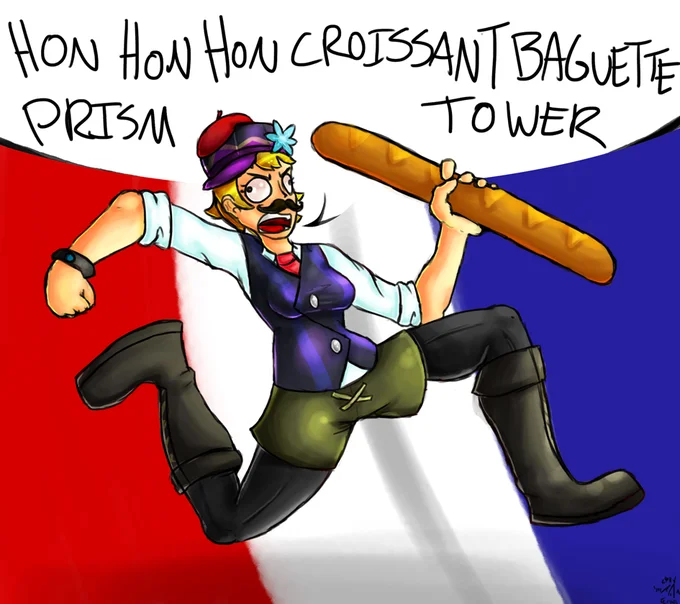
Hon Hon Hon
Published March 24, 2026
Also known as: French laugh · hon hon · hon hon baguette
"Hon hon hon" is the written representation of a stereotypical French laugh, meant to mimic the nasal vowel sounds of the French language. The phrase took root in Anglophone pop culture through mid-20th century entertainment, most notably the French actor and singer Maurice Chevalier, and was later cemented by cartoon characters like Pepe Le Pew and Disney's Chef Louis2. Online, it became a go-to shorthand for anything French-coded, showing up in Polandball comics, TF2 fan art, and ironic TikTok videos about pretentious behavior4.
Overview
"Hon hon hon" is an onomatopoeia that English speakers use to represent how French people supposedly laugh. The "n" isn't actually pronounced. It signals a nasalized "o" sound, landing somewhere between "huh" and "hoh," distinct from the "ho ho ho" already claimed by Santa Claus2. The phrase is almost always paired with other French stereotypes: berets, baguettes, striped shirts, and strings of onions4.
No French person actually laughs like this. The sound is a phonetic hallucination, the result of English-speaking ears interpreting the nasal vowels that define the French language (sounds like *on*, *en*, and *un*) and filtering them through their own phonetic framework4. When non-French speakers try to mimic that nasal quality while laughing, what comes out is "hon hon hon." It's an imitation of a texture, not an actual sound4.
Gallery
Origin & Background
How It Spread
How to Use This Meme
The most common use is simply typing "hon hon hon" in any context involving France, French culture, or exaggerated sophistication. Typical applications include:
- Text reactions: Drop a "hon hon hon" when someone mentions baguettes, wine, berets, or anything vaguely Parisian - Image macros: Overlay the phrase on images of French stereotypes, often paired with a beret, mustache, or baguette - Polandball comics: France's country ball character typically speaks in "hon hon hon" as a verbal tic - TikTok/video: Use the phrase as a voiceover or text overlay when showing something pretentious, fancy, or ironically elegant - Gaming: TF2 Spy mains and Minecraft players sometimes use it as an in-character exclamation
The phrase works both as genuine stereotype humor and as self-aware irony. Someone eating a particularly good pastry might caption their post "hon hon hon" to playfully acknowledge they're leaning into the cliché4.
Cultural Impact
Fun Facts
The "n" in "hon" is never actually pronounced. It's there to signal to English readers how the "o" should sound: nasalized, not like the English word "on"2.
If you used "hon hon hon" in an actual Parisian café, locals would probably stare at you like you'd lost your mind. It's the equivalent of going to Texas and saying "Howdy partner, yee-haw!" every five seconds4.
Pepe Le Pew, despite being largely retired or critiqued in recent years for his "persistence," left a lasting phonetic legacy with the laugh4.
The French word *bon* (good) demonstrates the exact nasal vowel that English speakers are trying to imitate. If you said *bon* quickly while laughing, you might get close to the sound, but it would be a stretch4.
Derivatives & Variations
"Hon hon baguette"
— a compressed version combining the laugh with the most iconic French food stereotype, common in Polandball comics and TF2 fan art[1].
TF2 Spy "Hon Hon Hon"
— Team Fortress 2's French Spy character spawned a dedicated meme subgenre, with fan art and Garry's Mod videos featuring the phrase[1].
Minecraft/FNAF usage
— content creators adapted the phrase as a humorous exclamation, with a6d notably interpreting it as a substitute for profanity[3].
Frequently Asked Questions
References (6)
- 1
- 2
- 32 Phút Hơnencyclopedia
- 4Hon Hon Hon - Urban Dictionarydictionary
- 5Urban Dictionary: hon hon hondictionary
- 6