I Can't Even

2010catchphraseclassic

Published August 29, 2026

"I Can't Even" is an internet catchphrase used to signal speechless overwhelm, either from joy or exasperation, that spread through Tumblr in the early 2010s. The unfinished sentence became one of the defining verbal tics of Tumblr-era online speech, feeding reaction images, comedy sketches, and even a Grammy acceptance speech by 2014.

Overview

"I Can't Even" works by breaking off before the verb that would finish the thought, leaving the listener to fill in whatever the speaker is unable to do, whether that is speak, think, or cope1. Writer Mallory Ortberg described a companion variant, "I have lost all ability to can," as a piece of Tumblr-Internet-speak that only reads as clever if you already share the reference points behind it1. The joke depends on that shared literacy, which is why the line spread fastest inside fandom-heavy communities rather than through mainstream press.

In practice the catchphrase is paired with reaction images of people collapsing, covering their faces, or gesturing helplessly, and it gets stretched into new grammatical shapes like "I can't" on its own or the sarcastic "I don't even"2. Urban Dictionary contributors framed it as a mock medical condition, joking about the "sudden onset of the cessation of brain activity" that leaves the sufferer unable to breathe, talk, or think2. That deadpan register, treating minor overwhelm as full-body shutdown, is what separates "I Can't Even" from earlier speechlessness slang.

Origin & Background

Platform
Urban Dictionary / Tumblr (viral spread)
Date
2010

The seed of the catchphrase was an Urban Dictionary entry for the incomplete phrase "I can't" submitted by user JJFADS on January 7, 2005, which defined it as an expression for reaching a breaking point3. The "even" half showed up separately around April 2007 in the phrasing "What is this? I don't even," which carried the same trailing-off feeling of being unable to react3.

The two halves fused into the modern form on July 3, 2010, when Urban Dictionary user tooyoung posted an entry for "I can't even" and specifically tagged it as an expression used by people on Tumblr3. From that point the phrase was documented as native Tumblr slang rather than a general internet joke.

How It Spread

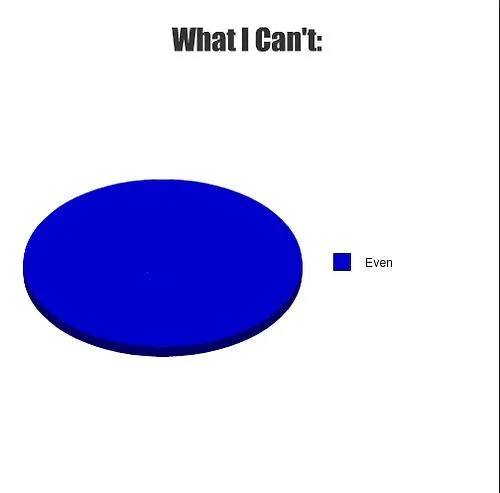
Tumblr users pushed the line into visual form quickly. On August 10, 2010, blogger blaketh posted a pie chart titled "What I Can't," filled entirely with the wedge "even," and the post picked up more than 1,100 notes over the following four years3. Reaction-image blogs then started captioning gifs of people collapsing with variations on the phrase, and the satirical site The Bunion Paper ran a piece called "Rich Girl in Dining Hall Can't Even" on October 9, 2013, which reached around 1,900 notes within seven months3.

The catchphrase broke out of Tumblr in late 2013 and early 2014. On November 20, 2013, The Toast published Mallory Ortberg's essay "Yes, You Can Even," which analyzed the grammar of the phrase and its riff "I have lost all ability to can" as a case study in how internet speech assumes shared context1. Country singer Kacey Musgraves repeated "I can't even" during her Best Country Album acceptance speech at the 2014 Grammys on January 26, 2014, giving the Tumblr-ism a mainstream stage3. Thought Catalog followed on February 3, 2014, with an article criticizing overuse of the phrase3.

Comedy videos then piled on. On March 18, 2014, Garlic Jackson Comedy uploaded a sketch in which a man calls an emergency hotline about his girlfriend saying "I can't" and "I'm literally dying," which pulled over 630,000 views in two months3. An Imgur macro of teenage girls captioned "Tumblr can't even right now" landed on April 8, 2014, and drew more than 13,600 points inside a month3. On May 10, 2014, YouTuber Sam Tabor posted a Photo Booth swirl-effect impression of teenage girls tweeting "I can't even," and Redditor EducatedCloud cross-posted it to r/videos two days later, where it collected over 15,900 upvotes in the first sixteen hours4.

How to Use This Meme

Typical usage drops the phrase into a caption, tweet, or text message as a stand-alone reaction to something overwhelming, funny, or infuriating, with no object attached. A common convention is to pair it with a reaction image or gif of someone collapsing or covering their face, or to stretch it further into shortened forms like "I can't" or the mock-medical "I have lost all ability to can"1.

Frequently Asked Questions