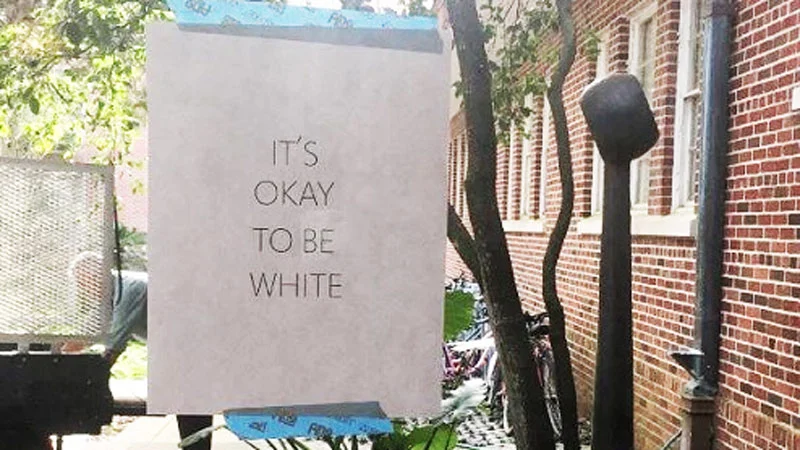
It's Okay to Be White
Published November 27, 2026
It's Okay to Be White is a slogan launched on 4chan's /pol/ board on October 31, 2017, as a planned trolling operation to flood public places with innocuous-looking signs and provoke media backlash. Within days the posters appeared at a Maryland high school, Harvard Square and the University of Alberta, and by October 2018 the exact phrase had been written into a failed Australian Senate resolution introduced by Pauline Hanson.
Overview
It's Okay to Be White, often shortened to IOTBW, works as a scripted trolling operation rather than a traditional image macro. The template is deliberately plain: black text on a white sheet with no imagery, no logos and no signature, designed so that anything controversial would have to be read into the message by whoever reacted to it1. The point, as laid out in the original 4chan thread, was to bait news outlets and local officials into treating a short declarative sentence as hate propaganda, then screenshot the coverage as evidence that neutral statements about white people were being pathologized2.
Beyond the paper sign, users printed stickers, laminated cards and small handbills so the slogan could be left on lampposts, electrical boxes and inside retail packaging3. Later iterations appended QR codes or URLs on the reverse side that pointed to white supremacist outlets such as The Daily Stormer and The Right Stuff, which pushed the format from a plausible-deniability prank into straightforward recruitment material4. Reporters at ThinkProgress described this drift as goading intent giving way to sincere embrace by figures like David Duke and Milo Yiannopoulos, who sold shirts using the phrase5.
In practice, a successful IOTBW post is one that produces a news segment, a tweet from a local politician or a police statement. The slogan, in that sense, is only half the meme, the other half is the reaction it provokes, which /pol/ users then clipped and reposted as proof the operation worked6.
Gallery
Origin & Background
How It Spread
Timeline
Frequently Asked Questions
References (13)
- 1
- 2
- 3
- 4
- 5
- 6
- 7
- 8
- 9
- 10
- 11
- 12
- 13