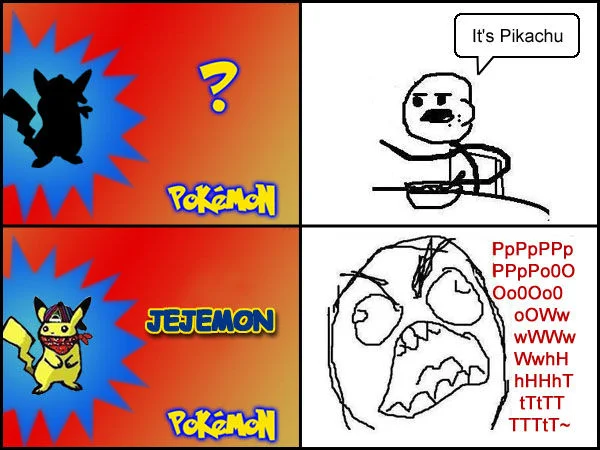
Jejemon
Published September 2, 2026
Jejemon is Filipino internet slang for people who write in scrambled text like 'lYk3 tH1s pfOuh,' with sticky caps, number-for-letter swaps, and Spanish-flavored laughs. The style broke out on Pinoy Tumblr on April 14, 2010 after a mock election poster relabeled candidate Jejomar Binay as 'Jejemon Binay,' and grew into a full subculture with its own fashion, a translator site, and a rival 'Jejebusters' backlash movement.
Overview
Jejenese pulls standard spelling apart with a mix of moves: swapping vowels for numbers (A becomes 4, E becomes 3), scattering random consonants, alternating uppercase and lowercase mid-word, tacking on tails like 'pfoUh' or 'jEjEjE,' and often opening screen names with 'El' followed by a random Spanish word7. Past the writing, jejemons picked up a visible uniform, most recognizable in the colorful 'Jeje caps' worn at cocked angles7.
Filipino writers sorted jejenism into four half-serious grades, mild, moderate, severe, and terminal, with terminal cases producing text that needs a translator to parse1. The tag was rarely worn as a compliment: it worked mostly as a put-down aimed at posters framed as the new wave of the older 'jologs' slur used for low-taste Filipino teens7.
Gallery
Origin & Background
How It Spread
How to Use This Meme
To write in Jejenese, take normal English or Tagalog and swap vowels for digits (A→4, E→3, I→1), scatter extra consonants, alternate uppercase and lowercase inside single words, and finish sentences with laughing tails like 'jEjEjE' or 'pfoUh'7. Screen names often lead with 'El' plus a random Spanish word so a reader can spot a jeje at a glance7.