Jesusland

2004Satirical map / image macrosemi-active

Also known as: Jesusland Map · United States of Canada vs. Jesusland

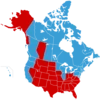
Jesusland is a 2004 satirical map meme splitting North America into "The United States of Canada" (blue states) and "Jesusland" (red states), created after George W. Bush's re-election.

Jesusland is a satirical map meme created on November 3, 2004, the day after George W. Bush won re-election, splitting the United States and Canada into two fictional nations: "The United States of Canada" (liberal blue states merged with Canada) and "Jesusland" (the remaining conservative red states)1. The New York Times called it "an instant Internet classic" just weeks after it appeared2. The map keeps resurfacing during politically charged moments, most recently trending on Twitter in February 2021 after Gab CEO Andrew Torba posted it4.

TL;DR

Jesusland is a satirical map meme created on November 3, 2004, the day after George W.

Overview

The Jesusland meme takes the form of a redrawn map of North America with a new border slicing through the United States. The "blue states" from the 2004 presidential election (New England, the Mid-Atlantic, the Pacific coast, and the Great Lakes states of Illinois, Michigan, Minnesota, and Wisconsin) are merged with Canada to form a single nation labeled "The United States of Canada"1. Everything else, the "red states," gets the name "Jesusland." Some versions also lump in the Canadian province of Alberta due to its conservative politics1.

The humor is blunt: liberal Americans would rather join Canada than live under four more years of Bush, and the conservative heartland is reduced to a theocratic caricature. The Freakonomics blog said the map captured the "despair, division, and bitterness" of the 2004 election campaign1. Slate noted it may have been why the Canadian immigration website got six times its usual traffic the day after the election1.

On November 3, 2004, one day after Bush defeated John Kerry, a forum user named G. Webb posted the map in a thread titled "I've solved it! Now the Jesusland watch thread" on YakYak, an internet message board dedicated to fans of British video game designer Jeff Minter6. The post was meant to explain (sarcastically) why Bush had won5. The map split neatly along the 2004 electoral map lines, with Kerry-voting states joining Canada and Bush-voting states forming Jesusland.

That same day, the map appeared on the personal blog Slapnose6. By November 4th, it had spread to political blogs including Politics on About.com, Uncyclopedia, and Flickr6. The first Urban Dictionary definition of "Jesusland" also went up on November 4th8. The speed was remarkable: a map cooked up on a niche gaming forum reached major political blogs within 24 hours.

Origin & Background

Platform
YakYak forum (original post), political blogs and forums (viral spread)
Creator
G. Webb
Date
2004

On November 3, 2004, one day after Bush defeated John Kerry, a forum user named G. Webb posted the map in a thread titled "I've solved it! Now the Jesusland watch thread" on YakYak, an internet message board dedicated to fans of British video game designer Jeff Minter. The post was meant to explain (sarcastically) why Bush had won. The map split neatly along the 2004 electoral map lines, with Kerry-voting states joining Canada and Bush-voting states forming Jesusland.

That same day, the map appeared on the personal blog Slapnose. By November 4th, it had spread to political blogs including Politics on About.com, Uncyclopedia, and Flickr. The first Urban Dictionary definition of "Jesusland" also went up on November 4th. The speed was remarkable: a map cooked up on a niche gaming forum reached major political blogs within 24 hours.

How It Spread

The Jesusland map moved through the internet in waves. During late 2004, it circulated on Canadian blog Cool.ca, community platform Tribe, conservative forum Free Republic, and San Francisco Weekly. Partisan blogs from both left and right referenced it heavily through 2004 and 2005. On Free Republic, conservative commenters mocked the map while simultaneously discussing what a divided America might look like.

By December 2004, The New York Times published a piece titled "Neo-Secessionism" that referenced the Jesusland map alongside real discussions about blue-state secession, calling it "an instant Internet classic". The article compared post-2004 frustration to the Hartford Convention of 1814, when New England states toyed with secession from the Union.

The meme inspired real creative work. In April 2005, indie musician Ben Folds released "Jesusland" as a track on his album *Songs for Silverman*. In July 2005, punk band NOFX put out a 7-inch single called "Leaving Jesusland," later included on their 2006 album *Wolves in Wolves' Clothing*. Both songs channeled the same sense of blue-state alienation that made the map click.

Internet users also created their own versions of the map, adding extra countries and borders. The LA Times ran opinion pieces referencing the concept in 2011, debating whether Christian politicians represented a "Jesusland" mentality. The New York Times Freakonomics blog also referenced the meme in the late 2000s.

In December 2009, Saturday Night Live aired an animated TV Funhouse short called "Blue State Santa," where Santa skips houses in red states that voted for Bush. During the sketch, he holds up a map resembling the original Jesusland image but labeled "Dumb****istan".

How to Use This Meme

The Jesusland map is typically shared as-is during politically charged moments, especially elections. The standard use is:

1

Wait for a political event that highlights the American liberal/conservative divide (an election, a Supreme Court decision, a culture war flashpoint).

2

Post the original Jesusland map or a modified version.

3

Add commentary expressing either wish fulfillment ("I'd move to the United States of Canada") or mockery ("welcome to Jesusland").

Cultural Impact

The Jesusland meme's reach extended well beyond internet forums. The New York Times covered it within weeks of its creation, framing it alongside real secessionist movements in American history. The LA Times published opinion columns debating the "Jesusland" framing of conservative Christianity in American politics.

The map inspired two commercially released songs: Ben Folds' "Jesusland" (2005) and NOFX's "Leaving Jesusland" (2005/2006). Saturday Night Live's "Blue State Santa" animated short in 2009 used a nearly identical map concept, proving the meme had penetrated mainstream comedy.

Big Think's "Strange Maps" column featured it as one of its notable entries, calling it "the meme that captured the 2004 post-election blues". The map also drove measurable traffic to government websites: Slate reported that Canada's immigration site received six times its normal page views the day after the 2004 election.

In 2021, the Gab CEO's reposting showed the map still carried political charge 17 years after its creation. Multiple news outlets covered the Twitter trend, and the Forward ran a full satirical analysis of Jesusland's geopolitical viability.

Full History

The Jesusland map didn't appear in a vacuum. The 2004 election sharpened an already deep American political divide. Bush won with a clear majority, and exit polls pointed to "moral values" as a top concern for many voters. For liberals who saw the result as a repudiation of their worldview, the map provided a cathartic fantasy: just cut the country in two and let each side have what it wants.

The concept had roots in real academic talk. Paul Lewis, a professor at Boston College, had noted in 2003 that Al Gore's states from the 2000 election "are contiguous either to Canada or to other Gore states". Lewis argued, half-seriously, that these states should "secede from the Union, reform into provinces and join Canada". The Jesusland map gave that thought experiment a viral visual.

On Canadian blog Cool.ca, the map sparked genuine discussion about what American immigration to Canada would look like. One anonymous Canadian commenter laid out a 13-point list of what Americans should expect: strict gun control, the metric system, two official languages, and a national medical system. An American commenter responded with surprising earnestness, saying she hadn't had health insurance since 1992 and would welcome Canadian healthcare. The exchange revealed how the joke map touched real anxieties about healthcare, gun violence, and cultural identity.

Meanwhile, conservative forums treated the map as evidence of liberal hysteria. Free Republic users shared articles discouraging moves to Canada, pointing out that immigration was harder than liberals assumed and Canadian beer was "way overrated". The meme became a Rorschach test: liberals saw a map of escape, conservatives saw a map of delusion.

The journalist Julia Scheeres added historical depth, reporting that she had seen a sign for "Jesus Land" in rural Indiana back in the 1970s, suggesting the label had pre-digital roots. Despite the name being most associated with G. Webb's map, the concept of a Christian-dominated American interior had been floating around for decades.

After its initial explosion, Jesusland settled into a pattern of cyclical resurgence. It would surface during every major election or political flashpoint, each time reigniting the same debate. The map became a shorthand for the red/blue divide itself.

The most notable revival came on February 23, 2021, when Gab CEO Andrew Torba posted the Jesusland map on his platform. Twitter user PatriotTakes retweeted it, writing "In case you were wondering what Gab CEO Andrew Torba wants, take a look". The tweet went viral. "Jesusland" trended on Twitter as users reacted with humor, anger, and confusion. Some asked if it was a new theme park. Others pointed out that millions of Black, Brown, and Indigenous people live in the so-called "Jesusland" states and would be written off by such a division.

The 2021 revival also brought new satirical commentary. The Forward ran an analysis of what Jesusland would mean for Jewish Americans, noting that Jesusland would lose most of its GDP by jettisoning blue states, and that "I'm not sure he'd want his name attached to a landmass he never visited or knew existed". Film Daily observed that the map keeps trending "because that's what Jesusland does every few years".

Critics from across the political spectrum have pushed back on the meme's simplistic framing. As Michael Hill of the League of the South told the NYT in 2004, the real divide isn't red states vs. blue states but rural vs. urban. Many counties in blue states vote red, and many people in red states vote blue. One Urban Dictionary entry captured this frustration: "I'm from 'Jesusland,' yet I'm a bisexual atheist who didn't vote for Bush". The map's reductiveness is both its weakness as analysis and its strength as a meme.

Fun Facts

The meme originated on a forum for fans of Jeff Minter, a British game designer known for psychedelic shoot-em-ups featuring llamas and camels. Nothing about the forum suggested it would birth a political meme.

Journalist Julia Scheeres reported seeing a "Jesus Land" sign in rural Indiana in the 1970s, decades before the internet meme existed.

One of the most thoughtful responses to the meme came from an anonymous Canadian on Cool.ca, who helpfully explained that "Canada's main enemies are the U.S. (now Jesusland) and Denmark".

The term "Jesusland" also loosely overlaps with the Bible Belt, a region where evangelical Protestantism heavily influences politics and culture, though the meme's boundaries are based on electoral maps, not church attendance data.

Derivatives & Variations

Modified electoral maps:

Users created updated versions reflecting later elections, adding or removing states. Some included Alberta, Canada, as part of Jesusland due to its conservative politics[1].

"Dumb****istan" (SNL):

Saturday Night Live's 2009 "Blue State Santa" sketch featured a version of the map renamed "Dumb****istan"[6].

"Coastopia":

A related concept proposing that West Coast and East Coast blue states unite, mentioned in NYT coverage alongside the Jesusland map[2].

Counter-maps from conservative forums:

Users on Free Republic and other right-leaning sites created alternative maps, some showing the US broken into six regions under foreign influence, as predicted by Russian academic Igor Panarin[12].

Frequently Asked Questions

Jesusland

2004Satirical map / image macrosemi-active

Also known as: Jesusland Map · United States of Canada vs. Jesusland

Jesusland is a 2004 satirical map meme splitting North America into "The United States of Canada" (blue states) and "Jesusland" (red states), created after George W. Bush's re-election.

Jesusland is a satirical map meme created on November 3, 2004, the day after George W. Bush won re-election, splitting the United States and Canada into two fictional nations: "The United States of Canada" (liberal blue states merged with Canada) and "Jesusland" (the remaining conservative red states). The New York Times called it "an instant Internet classic" just weeks after it appeared. The map keeps resurfacing during politically charged moments, most recently trending on Twitter in February 2021 after Gab CEO Andrew Torba posted it.

TL;DR

Jesusland is a satirical map meme created on November 3, 2004, the day after George W.

Overview

The Jesusland meme takes the form of a redrawn map of North America with a new border slicing through the United States. The "blue states" from the 2004 presidential election (New England, the Mid-Atlantic, the Pacific coast, and the Great Lakes states of Illinois, Michigan, Minnesota, and Wisconsin) are merged with Canada to form a single nation labeled "The United States of Canada". Everything else, the "red states," gets the name "Jesusland." Some versions also lump in the Canadian province of Alberta due to its conservative politics.

The humor is blunt: liberal Americans would rather join Canada than live under four more years of Bush, and the conservative heartland is reduced to a theocratic caricature. The Freakonomics blog said the map captured the "despair, division, and bitterness" of the 2004 election campaign. Slate noted it may have been why the Canadian immigration website got six times its usual traffic the day after the election.

On November 3, 2004, one day after Bush defeated John Kerry, a forum user named G. Webb posted the map in a thread titled "I've solved it! Now the Jesusland watch thread" on YakYak, an internet message board dedicated to fans of British video game designer Jeff Minter. The post was meant to explain (sarcastically) why Bush had won. The map split neatly along the 2004 electoral map lines, with Kerry-voting states joining Canada and Bush-voting states forming Jesusland.

That same day, the map appeared on the personal blog Slapnose. By November 4th, it had spread to political blogs including Politics on About.com, Uncyclopedia, and Flickr. The first Urban Dictionary definition of "Jesusland" also went up on November 4th. The speed was remarkable: a map cooked up on a niche gaming forum reached major political blogs within 24 hours.

Origin & Background

Platform
YakYak forum (original post), political blogs and forums (viral spread)
Creator
G. Webb
Date
2004

On November 3, 2004, one day after Bush defeated John Kerry, a forum user named G. Webb posted the map in a thread titled "I've solved it! Now the Jesusland watch thread" on YakYak, an internet message board dedicated to fans of British video game designer Jeff Minter. The post was meant to explain (sarcastically) why Bush had won. The map split neatly along the 2004 electoral map lines, with Kerry-voting states joining Canada and Bush-voting states forming Jesusland.

That same day, the map appeared on the personal blog Slapnose. By November 4th, it had spread to political blogs including Politics on About.com, Uncyclopedia, and Flickr. The first Urban Dictionary definition of "Jesusland" also went up on November 4th. The speed was remarkable: a map cooked up on a niche gaming forum reached major political blogs within 24 hours.

How It Spread

The Jesusland map moved through the internet in waves. During late 2004, it circulated on Canadian blog Cool.ca, community platform Tribe, conservative forum Free Republic, and San Francisco Weekly. Partisan blogs from both left and right referenced it heavily through 2004 and 2005. On Free Republic, conservative commenters mocked the map while simultaneously discussing what a divided America might look like.

By December 2004, The New York Times published a piece titled "Neo-Secessionism" that referenced the Jesusland map alongside real discussions about blue-state secession, calling it "an instant Internet classic". The article compared post-2004 frustration to the Hartford Convention of 1814, when New England states toyed with secession from the Union.

The meme inspired real creative work. In April 2005, indie musician Ben Folds released "Jesusland" as a track on his album *Songs for Silverman*. In July 2005, punk band NOFX put out a 7-inch single called "Leaving Jesusland," later included on their 2006 album *Wolves in Wolves' Clothing*. Both songs channeled the same sense of blue-state alienation that made the map click.

Internet users also created their own versions of the map, adding extra countries and borders. The LA Times ran opinion pieces referencing the concept in 2011, debating whether Christian politicians represented a "Jesusland" mentality. The New York Times Freakonomics blog also referenced the meme in the late 2000s.

In December 2009, Saturday Night Live aired an animated TV Funhouse short called "Blue State Santa," where Santa skips houses in red states that voted for Bush. During the sketch, he holds up a map resembling the original Jesusland image but labeled "Dumb****istan".

How to Use This Meme

The Jesusland map is typically shared as-is during politically charged moments, especially elections. The standard use is:

1

Wait for a political event that highlights the American liberal/conservative divide (an election, a Supreme Court decision, a culture war flashpoint).

2

Post the original Jesusland map or a modified version.

3

Add commentary expressing either wish fulfillment ("I'd move to the United States of Canada") or mockery ("welcome to Jesusland").

Cultural Impact

The Jesusland meme's reach extended well beyond internet forums. The New York Times covered it within weeks of its creation, framing it alongside real secessionist movements in American history. The LA Times published opinion columns debating the "Jesusland" framing of conservative Christianity in American politics.

The map inspired two commercially released songs: Ben Folds' "Jesusland" (2005) and NOFX's "Leaving Jesusland" (2005/2006). Saturday Night Live's "Blue State Santa" animated short in 2009 used a nearly identical map concept, proving the meme had penetrated mainstream comedy.

Big Think's "Strange Maps" column featured it as one of its notable entries, calling it "the meme that captured the 2004 post-election blues". The map also drove measurable traffic to government websites: Slate reported that Canada's immigration site received six times its normal page views the day after the 2004 election.

In 2021, the Gab CEO's reposting showed the map still carried political charge 17 years after its creation. Multiple news outlets covered the Twitter trend, and the Forward ran a full satirical analysis of Jesusland's geopolitical viability.

Full History

The Jesusland map didn't appear in a vacuum. The 2004 election sharpened an already deep American political divide. Bush won with a clear majority, and exit polls pointed to "moral values" as a top concern for many voters. For liberals who saw the result as a repudiation of their worldview, the map provided a cathartic fantasy: just cut the country in two and let each side have what it wants.

The concept had roots in real academic talk. Paul Lewis, a professor at Boston College, had noted in 2003 that Al Gore's states from the 2000 election "are contiguous either to Canada or to other Gore states". Lewis argued, half-seriously, that these states should "secede from the Union, reform into provinces and join Canada". The Jesusland map gave that thought experiment a viral visual.

On Canadian blog Cool.ca, the map sparked genuine discussion about what American immigration to Canada would look like. One anonymous Canadian commenter laid out a 13-point list of what Americans should expect: strict gun control, the metric system, two official languages, and a national medical system. An American commenter responded with surprising earnestness, saying she hadn't had health insurance since 1992 and would welcome Canadian healthcare. The exchange revealed how the joke map touched real anxieties about healthcare, gun violence, and cultural identity.

Meanwhile, conservative forums treated the map as evidence of liberal hysteria. Free Republic users shared articles discouraging moves to Canada, pointing out that immigration was harder than liberals assumed and Canadian beer was "way overrated". The meme became a Rorschach test: liberals saw a map of escape, conservatives saw a map of delusion.

The journalist Julia Scheeres added historical depth, reporting that she had seen a sign for "Jesus Land" in rural Indiana back in the 1970s, suggesting the label had pre-digital roots. Despite the name being most associated with G. Webb's map, the concept of a Christian-dominated American interior had been floating around for decades.

After its initial explosion, Jesusland settled into a pattern of cyclical resurgence. It would surface during every major election or political flashpoint, each time reigniting the same debate. The map became a shorthand for the red/blue divide itself.

The most notable revival came on February 23, 2021, when Gab CEO Andrew Torba posted the Jesusland map on his platform. Twitter user PatriotTakes retweeted it, writing "In case you were wondering what Gab CEO Andrew Torba wants, take a look". The tweet went viral. "Jesusland" trended on Twitter as users reacted with humor, anger, and confusion. Some asked if it was a new theme park. Others pointed out that millions of Black, Brown, and Indigenous people live in the so-called "Jesusland" states and would be written off by such a division.

The 2021 revival also brought new satirical commentary. The Forward ran an analysis of what Jesusland would mean for Jewish Americans, noting that Jesusland would lose most of its GDP by jettisoning blue states, and that "I'm not sure he'd want his name attached to a landmass he never visited or knew existed". Film Daily observed that the map keeps trending "because that's what Jesusland does every few years".

Critics from across the political spectrum have pushed back on the meme's simplistic framing. As Michael Hill of the League of the South told the NYT in 2004, the real divide isn't red states vs. blue states but rural vs. urban. Many counties in blue states vote red, and many people in red states vote blue. One Urban Dictionary entry captured this frustration: "I'm from 'Jesusland,' yet I'm a bisexual atheist who didn't vote for Bush". The map's reductiveness is both its weakness as analysis and its strength as a meme.

Fun Facts

The meme originated on a forum for fans of Jeff Minter, a British game designer known for psychedelic shoot-em-ups featuring llamas and camels. Nothing about the forum suggested it would birth a political meme.

Journalist Julia Scheeres reported seeing a "Jesus Land" sign in rural Indiana in the 1970s, decades before the internet meme existed.

One of the most thoughtful responses to the meme came from an anonymous Canadian on Cool.ca, who helpfully explained that "Canada's main enemies are the U.S. (now Jesusland) and Denmark".

The term "Jesusland" also loosely overlaps with the Bible Belt, a region where evangelical Protestantism heavily influences politics and culture, though the meme's boundaries are based on electoral maps, not church attendance data.

Derivatives & Variations

Modified electoral maps:

Users created updated versions reflecting later elections, adding or removing states. Some included Alberta, Canada, as part of Jesusland due to its conservative politics[1].

"Dumb****istan" (SNL):

Saturday Night Live's 2009 "Blue State Santa" sketch featured a version of the map renamed "Dumb****istan"[6].

"Coastopia":

A related concept proposing that West Coast and East Coast blue states unite, mentioned in NYT coverage alongside the Jesusland map[2].

Counter-maps from conservative forums:

Users on Free Republic and other right-leaning sites created alternative maps, some showing the US broken into six regions under foreign influence, as predicted by Russian academic Igor Panarin[12].

Frequently Asked Questions