Matching Ceo Names

2025Fake screenshot / image macrosemi-active

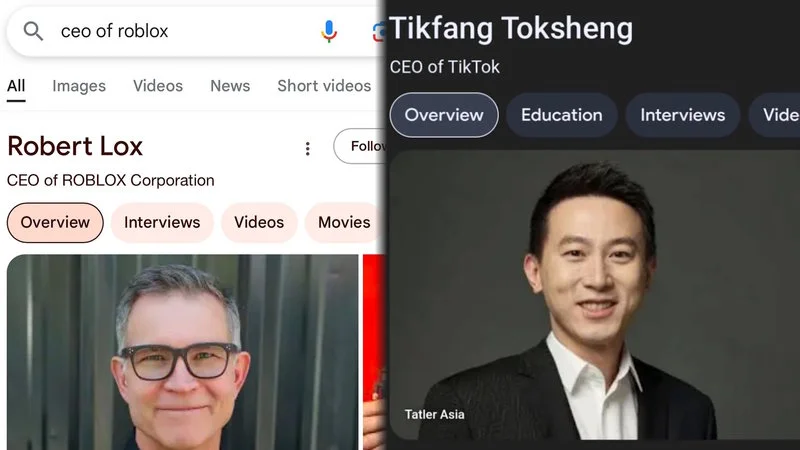
Matching CEO Names is a meme format where users create fake Google Knowledge panels showing that the CEOs of major companies have names suspiciously matching their corporations. Think "Robert Lox" as CEO of ROBLOX or "Tikfang Toksheng" leading TikTok. The joke took off on X/Twitter in January 2025, building on the older Real Name Google Searches format, and racked up tens of millions of views within a single day1.

Overview

The format works on a dead-simple premise: edit a Google Knowledge panel to replace a real CEO's name with a fake one that sounds like a broken-apart version of the company name. The humor comes from the absurdity of the coincidence and the straight-faced presentation of obviously fabricated information as though it were a real Google result2.

The joke plays on nominative determinism, the real (if tongue-in-cheek) hypothesis that people gravitate toward careers that match their names. A dentist named Dr. Fang, a judge named Justice. The Matching CEO Names meme takes this idea and cranks it past the point of plausibility into pure comedy2.

The exact original creator of the format is unknown, but the meme developed out of the Real Name Google Searches format, which involved editing Google search results for comedic effect2. The Matching CEO Names variant zeroed in specifically on corporate leadership, faking Knowledge panels to show founders and CEOs with on-the-nose names.

The format hit critical mass on January 20th, 2025, when X user @LocalBateman reposted one of these fake panels. That single repost pulled in over 8.5 million views, 10,000 reposts, and 307,000 likes in one day2.

Origin & Background

Platform
X / Twitter (viral spread)
Key People
Unknown, @LocalBateman, @EverythingOOC
Date
2025

The exact original creator of the format is unknown, but the meme developed out of the Real Name Google Searches format, which involved editing Google search results for comedic effect2. The Matching CEO Names variant zeroed in specifically on corporate leadership, faking Knowledge panels to show founders and CEOs with on-the-nose names.

The format hit critical mass on January 20th, 2025, when X user @LocalBateman reposted one of these fake panels. That single repost pulled in over 8.5 million views, 10,000 reposts, and 307,000 likes in one day2.

How It Spread

The same day @LocalBateman's post blew up, the format spread rapidly across X as other users jumped in to create their own versions2.

One of the biggest posts came from @EverythingOOC, who shared a version claiming TikTok's CEO was named "Tikfang Toksheng." That post outperformed even the original, hitting 9.3 million views, 19,000 reposts, and 310,000 likes within 24 hours2. The ROBLOX version, claiming the company was led by "Robert Lox," was another widely shared example2.

The speed of adoption was notable. Because the format is simple to execute (screenshot a Knowledge panel, swap the name, post) and infinitely extensible (every company is a potential target), users could churn out new versions faster than most template memes allow. Any recognizable brand name could be reverse-engineered into a plausible-sounding human name.

How to Use This Meme

The Matching CEO Names format typically follows a few steps:

1

Pick a well-known company or platform

2

Break the company name into syllable chunks that could pass as a first and last name (e.g., ROBLOX → Robert Lox, TikTok → Tikfang Toksheng)

3

Edit or mock up a Google Knowledge panel showing this fake name as the CEO/founder

4

Post it without commentary, letting the deadpan presentation do the work

Cultural Impact

Matching CEO Names tapped into a broader trend of "credible misinformation" humor on social media, where the joke depends on presenting obviously false information in a format people instinctively trust (Google's Knowledge panel). The format's massive engagement numbers, with individual posts clearing 8-9 million views in a single day, showed the appetite for low-effort, high-concept visual gags on X in early 20252.

The meme also highlighted how easily Google's authoritative-looking Knowledge panels could be spoofed. While the fakes were clearly jokes, they demonstrated the gap between how much people trust Google's formatting and how simple it is to fabricate.

Fun Facts

The combined view count of just the @LocalBateman and @EverythingOOC posts exceeded 17 million within 24 hours2

The meme is rooted in nominative determinism, a concept that has been studied academically since the term was coined by New Scientist magazine in 19942

The TikTok version ("Tikfang Toksheng") actually outperformed the post that kicked off the trend, with nearly double the reposts2

Frequently Asked Questions

References (2)

  1. 1
    EDX Marketsencyclopedia
  2. 2