No Homo

Catchphrase / slang expressionsemi-active

Also known as: Pause · No Homo Though

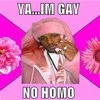
No Homo is a slang phrase originating in early-1990s East Harlem that became hip-hop mainstream through Cam'ron and Lil Wayne in the mid-2000s, used as a disclaimer to assert heterosexuality.

"No homo" is a slang phrase appended to statements that could be interpreted as having homosexual undertones, used as a disclaimer to assert the speaker's heterosexuality. The expression originated among youth in East Harlem, New York, in the early 1990s and spread into mainstream hip-hop culture through rappers like Cam'ron and Lil Wayne during the mid-2000s7. It became one of the most debated catchphrases at the intersection of hip-hop, masculinity, and LGBTQ+ discourse, sparking fines in professional sports and academic study alike1.

TL;DR

"No homo" is a slang phrase appended to statements that could be interpreted as having homosexual undertones, used as a disclaimer to assert the speaker's heterosexuality.

Overview

"No homo" works as a verbal disclaimer, tacked onto the end of any sentence that might carry an unintended homoerotic reading. Someone might say "That guy looks great in that suit, no homo" or "I love spending time with you, no homo." The phrase functions as both a shield and, depending on the speaker, a punchline1.

In hip-hop, rappers began inserting "no homo" into lyrics to preempt any attacks on their masculinity. As scholar Joshua Brown explained in the *Journal of Homosexuality*, the phrase "arose in Hip-Hop lyrics of the 1990s as a discourse interjection to negate supposed sexual and gender transgressions"7. Rappers treated it as a defensive maneuver on the "musical battlefield," aware that any lyric deemed "inadvertently gay" could become ammunition for rivals7.

Online, the phrase mutated into meme territory. Image macros, tweets, and social media posts used "no homo" with increasingly absurd or overtly homoerotic setups, pushing the disclaimer into satirical territory4. The gap between the statement and the disclaimer became the joke itself.

The roots of "no homo" trace back to East Harlem in the early 1990s, where it circulated as local slang among young men1. The phrase sat in relative obscurity until Harlem rapper Cam'ron and his Diplomats crew brought it into hip-hop recordings in the early 2000s1. Cam'ron, born Cameron Giles and raised in East Harlem, was among the first artists to use the phrase on record6. He incorporated it into lyrics and song titles, including naming a track "Silky (No Homo)"1.

The first Urban Dictionary definition for "no homo" appeared on October 21, 20034. By December 2004, the phrase was showing up on message boards and rap blog comment sections4. Google search interest started registering in March 20054.

Origin & Background

Platform
East Harlem street slang, hip-hop lyrics (popularization)
Key People
Unknown, Cam'ron
Date
Early 1990s (popularized mid-2000s)

The roots of "no homo" trace back to East Harlem in the early 1990s, where it circulated as local slang among young men. The phrase sat in relative obscurity until Harlem rapper Cam'ron and his Diplomats crew brought it into hip-hop recordings in the early 2000s. Cam'ron, born Cameron Giles and raised in East Harlem, was among the first artists to use the phrase on record. He incorporated it into lyrics and song titles, including naming a track "Silky (No Homo)".

The first Urban Dictionary definition for "no homo" appeared on October 21, 2003. By December 2004, the phrase was showing up on message boards and rap blog comment sections. Google search interest started registering in March 2005.

How It Spread

Lil Wayne brought "no homo" to a mass audience. He sprinkled the phrase across cameos, mixtapes, and his 2008 album *Tha Carter III*, which was that year's best-selling record. One of his more notable uses came in 2007: "Just shot a video with R. Kelly, but no homo though," a line that doubled as both a disclaimer and a joke about Kelly's sex tape scandal. Jay-Z used the related term "pause" in a similar way.

Kanye West's relationship with the phrase captured the tension perfectly. In August 2005, West publicly called out hip-hop's homophobia on MTV, telling rappers to stop discriminating against gay people. He revisited the topic that November, discussing his openly gay cousin and his interior decorator. But by 2009, West rapped on Jay-Z's "Run This Town": "It's crazy how you can go from being Joe Blow / to everybody on your dick, no homo".

The phrase hit Urban Dictionary's "Word of the Day" on November 8, 2010. On Tumblr, the "no homo" tag became a space for users to criticize others who used the expression unironically.

The Boondocks dedicated an entire episode to the concept. "Pause," which aired on Adult Swim on June 20, 2010, revolved around the practice of disclaiming double entendres. Riley Freeman advised his grandfather Granddad to say "no homo" after anything that "sounds gay". The episode also parodied Tyler Perry through a character named Winston Jerome, drawing Perry's fury and leading him to contact Turner Broadcasting executives.

How to Use This Meme

The basic formula: make any statement, then append "no homo" to neutralize potential homoerotic readings. Common patterns include:

1

Complimenting another man's appearance: "Bro, you look good today, no homo"

2

Expressing affection toward a male friend: "I love you, man. No homo"

3

Describing something with unintended sexual overtones: "I'm going hard on this project, no homo"

4

Comedic escalation (meme version): Make an increasingly blatant homoerotic statement, then add "no homo" as if that resolves everything

Cultural Impact

The phrase crossed from hip-hop slang into mainstream American English, driven by the same cultural pipeline that brought "bling," "hype," and dozens of other AAVE terms into broader use. Scholar Deborah Cameron argued that "no homo" demonstrated how "gender has constantly to be reaffirmed and publicly displayed by repeatedly performing particular acts in accordance to cultural norms".

Fox News commentator Marc Lamont Hill urged the hip-hop community to abandon the phrase. GLSEN, the education advocacy organization, included "no homo" alongside "that's so gay" and anti-LGBTQ slurs as language that normalizes prejudice, regardless of the speaker's intent.

The NBA's escalating fines, from $75,000 for Hibbert in 2013 to $100,000 for Ball in 2024, tracked the phrase's declining social acceptability in professional settings. Each incident generated its own news cycle, reinforcing both the phrase's persistence and the growing institutional pushback against it.

The Lonely Island parodied the expression in their 2011 song "No Homo" on the album *Turtleneck & Chain*. The track started with standard usage and escalated to statements like "I've been thinking about fucking a dude (no homo)," satirizing the absurd logic of the disclaimer through comedic escalation.

Nicki Minaj used the phrase in "Baddest Bitch" from her 2008 *Sucka Free* mixtape, one of the relatively rare female deployments of "no homo". Joshua Brown noted that women "can and do use 'no homo,' although the instances are markedly less in frequency" because displays of femininity between women carry less social penalty.

Full History

The story of "no homo" is really the story of hip-hop slowly, awkwardly reckoning with its own relationship to homosexuality. The genre's default setting for decades was aggressive heteronormativity. In 1989, Big Daddy Kane declared "The Big Daddy law is anti-faggot". When DMX insulted rivals by fantasizing about rooms full of men fellating him, nobody in the audience found anything contradictory about it. As Method Man once told an interviewer, bluntly: "You can't be fuckin' people in the ass and say you're gangsta".

"No homo" cracked that framework open, even if it did so sideways. The phrase allowed, for the first time, an implicit acknowledgment that something a rapper said *could* be read as gay. Slate columnist Jonah Weiner argued that the phrase "tweaks this dynamic because it allows, implicitly, that rap is a place where gayness can in fact be expressed by the guy on the mic, not just scorned in others". The tag had to "contaminate" a statement with gayness before it could deny it, making it "both a denial and a flashing neon arrow".

The irony ran deep. Cam'ron and the Diplomats, the phrase's biggest evangelists, were among hip-hop's most homoerotic acts. They wore pink and purple furs. In the music video for "Pop Champagne," Jim Jones and Juelz Santana doused each other with frothy white geysers of champagne. Lil Wayne had been photographed kissing his mentor, the rapper Baby, on the lips. These artists used "no homo" as a kind of permission slip to push boundaries while technically maintaining plausible deniability.

Vulture's response to Weiner's analysis raised a counterpoint: "Getting playful with gay-sounding phrases isn't the same as winking at gays". Cam'ron's pink wardrobe and creative use of language were "innovations *and* ways of announcing that he's such a man, he can get away with dressing 'gay' or saying 'gay' things". The phrase could expand self-expression while still functioning as a lid on any real conversation about sexuality.

The broader hip-hop industry's relationship with homosexuality was more complicated than its public face suggested. In 2008, former MTV executive Terrance Dean published a memoir describing a thriving gay subculture within the industry. Dean portrayed a world where executives and artists led secret gay lives, obvious to insiders but never discussed openly. He hoped a major artist would come out within a year. That prediction proved optimistic.

Professional sports became another flashpoint. In June 2013, Indiana Pacers center Roy Hibbert used "no homo" in a post-game press conference while discussing LeBron James, and the NBA fined him $75,000. In 2018, Denver Nuggets center Nikola Jokic received a $25,000 fine for the same phrase. Brooklyn Nets guard Cam Thomas was fined $40,000 in 2023. And in 2024, LaMelo Ball's use of the phrase in a post-game interview cost him $100,000, the steepest penalty yet.

A 2018 academic study analyzing 396 tweets containing "no homo" found something surprising. While the phrase was sometimes wielded as an insult against non-heteronormative behavior, its most common use appeared in positive emotional contexts: expressions of pleasure, desire, affection, and friendship between men. The researchers concluded that "no homo" functioned as a "gendered epithet that conveys cultural norms about masculinity," primarily allowing men to express positive emotions in a "particularly masculinized" way. Male tweeters used it far more often than female tweeters.

The LGBTQ+ community developed its own responses. Some gay people adopted "no homo" ironically, particularly when complimenting straight men, using it as either a protective measure or commentary on the phrase's absurdity. The counter-phrase "no hetero" emerged online, flipping the formula to highlight how ridiculous the original sounded. The "Fellas, is it gay?" meme, which satirized the extreme lengths some men go to avoid anything perceived as feminine, grew directly out of the same cultural anxiety that "no homo" represented.

Fun Facts

Lil Wayne's "no homo" usage on *Tha Carter III* reached the widest audience possible for the phrase in 2008, since the album was that year's top seller across all genres.

Tyler Perry was so angry about The Boondocks' "Pause" episode that he threatened to pull his two TBS shows from Turner Broadcasting.

A 2018 Twitter study found that "no homo" was used more often in positive emotional contexts (expressing friendship, pleasure, and affection) than as an insult.

The NBA's fine for using "no homo" in press conferences increased from $75,000 in 2013 to $100,000 in 2024, a 33% increase over eleven years.

Cam'ron named a song "Silky (No Homo)," leaving critics unsure whether he was disavowing the emotion of sadness in the lyrics or the tactile sensation of silkiness itself.

Derivatives & Variations

"Pause":

An alternate disclaimer used identically to "no homo," popularized by Jay-Z and featured as the title of a 2010 Boondocks episode[8][1].

"No hetero":

A counter-phrase adopted by LGBTQ+ communities online, flipping the formula to call attention to how absurd the original sounds[10].

"Fellas, is it gay?":

A meme format that grew from the same cultural anxiety, satirizing men who label mundane activities as homosexual[11].

"Full homo":

An ironic inversion used by both LGBTQ+ people and allies, affirming the homoerotic reading instead of denying it[10].

The Lonely Island's "No Homo" (2011):

A comedy song that pushed the phrase to its logical extreme, treating escalating gay statements with the same deadpan disclaimer[7].

Frequently Asked Questions

NoHomo

Catchphrase / slang expressionsemi-active

Also known as: Pause · No Homo Though

No Homo is a slang phrase originating in early-1990s East Harlem that became hip-hop mainstream through Cam'ron and Lil Wayne in the mid-2000s, used as a disclaimer to assert heterosexuality.

"No homo" is a slang phrase appended to statements that could be interpreted as having homosexual undertones, used as a disclaimer to assert the speaker's heterosexuality. The expression originated among youth in East Harlem, New York, in the early 1990s and spread into mainstream hip-hop culture through rappers like Cam'ron and Lil Wayne during the mid-2000s. It became one of the most debated catchphrases at the intersection of hip-hop, masculinity, and LGBTQ+ discourse, sparking fines in professional sports and academic study alike.

TL;DR

"No homo" is a slang phrase appended to statements that could be interpreted as having homosexual undertones, used as a disclaimer to assert the speaker's heterosexuality.

Overview

"No homo" works as a verbal disclaimer, tacked onto the end of any sentence that might carry an unintended homoerotic reading. Someone might say "That guy looks great in that suit, no homo" or "I love spending time with you, no homo." The phrase functions as both a shield and, depending on the speaker, a punchline.

In hip-hop, rappers began inserting "no homo" into lyrics to preempt any attacks on their masculinity. As scholar Joshua Brown explained in the *Journal of Homosexuality*, the phrase "arose in Hip-Hop lyrics of the 1990s as a discourse interjection to negate supposed sexual and gender transgressions". Rappers treated it as a defensive maneuver on the "musical battlefield," aware that any lyric deemed "inadvertently gay" could become ammunition for rivals.

Online, the phrase mutated into meme territory. Image macros, tweets, and social media posts used "no homo" with increasingly absurd or overtly homoerotic setups, pushing the disclaimer into satirical territory. The gap between the statement and the disclaimer became the joke itself.

The roots of "no homo" trace back to East Harlem in the early 1990s, where it circulated as local slang among young men. The phrase sat in relative obscurity until Harlem rapper Cam'ron and his Diplomats crew brought it into hip-hop recordings in the early 2000s. Cam'ron, born Cameron Giles and raised in East Harlem, was among the first artists to use the phrase on record. He incorporated it into lyrics and song titles, including naming a track "Silky (No Homo)".

The first Urban Dictionary definition for "no homo" appeared on October 21, 2003. By December 2004, the phrase was showing up on message boards and rap blog comment sections. Google search interest started registering in March 2005.

Origin & Background

Platform
East Harlem street slang, hip-hop lyrics (popularization)
Key People
Unknown, Cam'ron
Date
Early 1990s (popularized mid-2000s)

The roots of "no homo" trace back to East Harlem in the early 1990s, where it circulated as local slang among young men. The phrase sat in relative obscurity until Harlem rapper Cam'ron and his Diplomats crew brought it into hip-hop recordings in the early 2000s. Cam'ron, born Cameron Giles and raised in East Harlem, was among the first artists to use the phrase on record. He incorporated it into lyrics and song titles, including naming a track "Silky (No Homo)".

The first Urban Dictionary definition for "no homo" appeared on October 21, 2003. By December 2004, the phrase was showing up on message boards and rap blog comment sections. Google search interest started registering in March 2005.

How It Spread

Lil Wayne brought "no homo" to a mass audience. He sprinkled the phrase across cameos, mixtapes, and his 2008 album *Tha Carter III*, which was that year's best-selling record. One of his more notable uses came in 2007: "Just shot a video with R. Kelly, but no homo though," a line that doubled as both a disclaimer and a joke about Kelly's sex tape scandal. Jay-Z used the related term "pause" in a similar way.

Kanye West's relationship with the phrase captured the tension perfectly. In August 2005, West publicly called out hip-hop's homophobia on MTV, telling rappers to stop discriminating against gay people. He revisited the topic that November, discussing his openly gay cousin and his interior decorator. But by 2009, West rapped on Jay-Z's "Run This Town": "It's crazy how you can go from being Joe Blow / to everybody on your dick, no homo".

The phrase hit Urban Dictionary's "Word of the Day" on November 8, 2010. On Tumblr, the "no homo" tag became a space for users to criticize others who used the expression unironically.

The Boondocks dedicated an entire episode to the concept. "Pause," which aired on Adult Swim on June 20, 2010, revolved around the practice of disclaiming double entendres. Riley Freeman advised his grandfather Granddad to say "no homo" after anything that "sounds gay". The episode also parodied Tyler Perry through a character named Winston Jerome, drawing Perry's fury and leading him to contact Turner Broadcasting executives.

How to Use This Meme

The basic formula: make any statement, then append "no homo" to neutralize potential homoerotic readings. Common patterns include:

1

Complimenting another man's appearance: "Bro, you look good today, no homo"

2

Expressing affection toward a male friend: "I love you, man. No homo"

3

Describing something with unintended sexual overtones: "I'm going hard on this project, no homo"

4

Comedic escalation (meme version): Make an increasingly blatant homoerotic statement, then add "no homo" as if that resolves everything

Cultural Impact

The phrase crossed from hip-hop slang into mainstream American English, driven by the same cultural pipeline that brought "bling," "hype," and dozens of other AAVE terms into broader use. Scholar Deborah Cameron argued that "no homo" demonstrated how "gender has constantly to be reaffirmed and publicly displayed by repeatedly performing particular acts in accordance to cultural norms".

Fox News commentator Marc Lamont Hill urged the hip-hop community to abandon the phrase. GLSEN, the education advocacy organization, included "no homo" alongside "that's so gay" and anti-LGBTQ slurs as language that normalizes prejudice, regardless of the speaker's intent.

The NBA's escalating fines, from $75,000 for Hibbert in 2013 to $100,000 for Ball in 2024, tracked the phrase's declining social acceptability in professional settings. Each incident generated its own news cycle, reinforcing both the phrase's persistence and the growing institutional pushback against it.

The Lonely Island parodied the expression in their 2011 song "No Homo" on the album *Turtleneck & Chain*. The track started with standard usage and escalated to statements like "I've been thinking about fucking a dude (no homo)," satirizing the absurd logic of the disclaimer through comedic escalation.

Nicki Minaj used the phrase in "Baddest Bitch" from her 2008 *Sucka Free* mixtape, one of the relatively rare female deployments of "no homo". Joshua Brown noted that women "can and do use 'no homo,' although the instances are markedly less in frequency" because displays of femininity between women carry less social penalty.

Full History

The story of "no homo" is really the story of hip-hop slowly, awkwardly reckoning with its own relationship to homosexuality. The genre's default setting for decades was aggressive heteronormativity. In 1989, Big Daddy Kane declared "The Big Daddy law is anti-faggot". When DMX insulted rivals by fantasizing about rooms full of men fellating him, nobody in the audience found anything contradictory about it. As Method Man once told an interviewer, bluntly: "You can't be fuckin' people in the ass and say you're gangsta".

"No homo" cracked that framework open, even if it did so sideways. The phrase allowed, for the first time, an implicit acknowledgment that something a rapper said *could* be read as gay. Slate columnist Jonah Weiner argued that the phrase "tweaks this dynamic because it allows, implicitly, that rap is a place where gayness can in fact be expressed by the guy on the mic, not just scorned in others". The tag had to "contaminate" a statement with gayness before it could deny it, making it "both a denial and a flashing neon arrow".

The irony ran deep. Cam'ron and the Diplomats, the phrase's biggest evangelists, were among hip-hop's most homoerotic acts. They wore pink and purple furs. In the music video for "Pop Champagne," Jim Jones and Juelz Santana doused each other with frothy white geysers of champagne. Lil Wayne had been photographed kissing his mentor, the rapper Baby, on the lips. These artists used "no homo" as a kind of permission slip to push boundaries while technically maintaining plausible deniability.

Vulture's response to Weiner's analysis raised a counterpoint: "Getting playful with gay-sounding phrases isn't the same as winking at gays". Cam'ron's pink wardrobe and creative use of language were "innovations *and* ways of announcing that he's such a man, he can get away with dressing 'gay' or saying 'gay' things". The phrase could expand self-expression while still functioning as a lid on any real conversation about sexuality.

The broader hip-hop industry's relationship with homosexuality was more complicated than its public face suggested. In 2008, former MTV executive Terrance Dean published a memoir describing a thriving gay subculture within the industry. Dean portrayed a world where executives and artists led secret gay lives, obvious to insiders but never discussed openly. He hoped a major artist would come out within a year. That prediction proved optimistic.

Professional sports became another flashpoint. In June 2013, Indiana Pacers center Roy Hibbert used "no homo" in a post-game press conference while discussing LeBron James, and the NBA fined him $75,000. In 2018, Denver Nuggets center Nikola Jokic received a $25,000 fine for the same phrase. Brooklyn Nets guard Cam Thomas was fined $40,000 in 2023. And in 2024, LaMelo Ball's use of the phrase in a post-game interview cost him $100,000, the steepest penalty yet.

A 2018 academic study analyzing 396 tweets containing "no homo" found something surprising. While the phrase was sometimes wielded as an insult against non-heteronormative behavior, its most common use appeared in positive emotional contexts: expressions of pleasure, desire, affection, and friendship between men. The researchers concluded that "no homo" functioned as a "gendered epithet that conveys cultural norms about masculinity," primarily allowing men to express positive emotions in a "particularly masculinized" way. Male tweeters used it far more often than female tweeters.

The LGBTQ+ community developed its own responses. Some gay people adopted "no homo" ironically, particularly when complimenting straight men, using it as either a protective measure or commentary on the phrase's absurdity. The counter-phrase "no hetero" emerged online, flipping the formula to highlight how ridiculous the original sounded. The "Fellas, is it gay?" meme, which satirized the extreme lengths some men go to avoid anything perceived as feminine, grew directly out of the same cultural anxiety that "no homo" represented.

Fun Facts

Lil Wayne's "no homo" usage on *Tha Carter III* reached the widest audience possible for the phrase in 2008, since the album was that year's top seller across all genres.

Tyler Perry was so angry about The Boondocks' "Pause" episode that he threatened to pull his two TBS shows from Turner Broadcasting.

A 2018 Twitter study found that "no homo" was used more often in positive emotional contexts (expressing friendship, pleasure, and affection) than as an insult.

The NBA's fine for using "no homo" in press conferences increased from $75,000 in 2013 to $100,000 in 2024, a 33% increase over eleven years.

Cam'ron named a song "Silky (No Homo)," leaving critics unsure whether he was disavowing the emotion of sadness in the lyrics or the tactile sensation of silkiness itself.

Derivatives & Variations

"Pause":

An alternate disclaimer used identically to "no homo," popularized by Jay-Z and featured as the title of a 2010 Boondocks episode[8][1].

"No hetero":

A counter-phrase adopted by LGBTQ+ communities online, flipping the formula to call attention to how absurd the original sounds[10].

"Fellas, is it gay?":

A meme format that grew from the same cultural anxiety, satirizing men who label mundane activities as homosexual[11].

"Full homo":

An ironic inversion used by both LGBTQ+ people and allies, affirming the homoerotic reading instead of denying it[10].

The Lonely Island's "No Homo" (2011):

A comedy song that pushed the phrase to its logical extreme, treating escalating gay statements with the same deadpan disclaimer[7].

Frequently Asked Questions