Nobody Wants To Work Anymore
Published March 30, 2026
Also known as: "No One Wants to Work Anymore" · "We Are Short-Staffed"
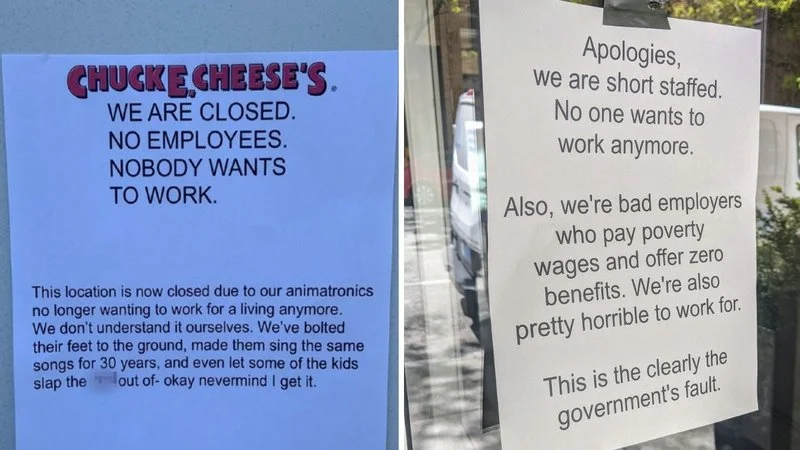
"Nobody Wants to Work Anymore" started as handwritten signs posted by short-staffed American businesses in spring 2021 and became one of the defining memes of pandemic-era labor discourse. The phrase took on a second life in 2022 when researcher Paul Fairie compiled newspaper clippings proving that people have been saying the exact same thing since 1894, turning a tired employer complaint into a punchline about the cyclical nature of blaming workers.
Overview
The meme operates on two levels. On the surface, it's the actual signs that appeared at restaurants and businesses across the United States in 2021, pleading for customer patience while blaming staffing shortages on people who supposedly don't want to work. On a deeper level, it's the compiled evidence that this complaint is at least 130 years old, showing up in newspaper editorials, reader letters, and political speeches across every decade. The gap between the sign-posters' belief that they're describing something new and the historical record proving otherwise is where the humor lives.
Gallery
Origin & Background
How It Spread
How to Use This Meme
The meme works in two main formats:
Sign parody format: Take the template "We are closed because nobody wants to work anymore" and swap in an absurd, fictional, or satirical reason for the closure. The joke typically lands harder when the replacement reason is obviously ridiculous, drawing a parallel to how silly the original complaint sounds.
Historical compilation format: Share the newspaper clippings (or excerpts from them) in response to anyone complaining about modern work ethic. The implied point: if people have been saying this for over a century, maybe it's not today's workers who are the problem.
Both formats are most commonly deployed to challenge employers, business owners, or commentators who frame staffing shortages as a moral failing of workers rather than a reflection of wages and conditions.
Cultural Impact
Fun Facts
The oldest documented use of the phrase in the viral compilation is from 1894 in the Rooks County Record, written during a coal miners' strike7.
In 1940, Wisconsin Governor Julius Heil used the phrase in a public statement about legislation, saying "The trouble is everybody is on relief or a pension, nobody wants to work anymore"1.
A 1946 Virginia bill literally proposed abolishing work because "nobody wants to work"4.
In 1979, a New Orleans dry cleaner permanently closed his business and told a reporter that a job applicant had laughed at his $3/hour offer because she could clear $106 a week on welfare1.
Isaac Furman, a former line cook, described discovering that subsidized health insurance through restaurant work cost him $500/month on wages that barely covered his living expenses. "There's absolutely no safety net," he told Eater3.
Derivatives & Variations
"No One Wants to X Anymore" snowclone:
The template extended beyond work into dating, gaming, and everyday complaints, always used ironically to mock someone treating a universal phenomenon as a novel crisis[1].
Lady Dimitrescu labor shortage parody:
A tweet blaming the Resident Evil Village character for staff shortages gained over 23,000 likes on Twitter[5].
Lord of the Rings parody sign:
A version incorporating LOTR dialogue earned over 2,400 retweets[5].
Quiet quitting crossover:
The 2022 compilation wave overlapped with and fed into the quiet quitting discourse, with the meme used to deflate claims that modern workers were uniquely lazy[6].
Frequently Asked Questions
References (9)
- 1
- 2
- 3
- 4Nobody Wants to Work Anymore - Know Your Memeencyclopedia
- 5List of Fast & Furious charactersencyclopedia
- 6
- 7
- 8
- 9