Ranked Lists

2018Phrasal template / text memesemi-active

Also known as: "You Can't Rank Them" meme · Ranking Meme

Ranked Lists is a text-based Twitter meme format where creators fill numbered slots with words forming a hidden sentence, revealing their actual favorite or least favorite item at position #1, popularized in June 2018.

Ranked Lists is a text-based meme format where someone pretends to rank a group of things (movies, songs, characters) but fills most of the numbered slots with words forming a sentence like "You can't rank them because they're all so different." The punchline sits at position #1, revealing the poster's actual favorite or least favorite pick. The format blew up on Twitter in late June 2018 and spread rapidly thanks to its dead-simple, copy-paste-friendly structure1.

TL;DR

Ranked Lists is a text-based meme format where someone pretends to rank a group of things (movies, songs, characters) but fills most of the numbered slots with words forming a sentence like "You can't rank them because they're all so different." The punchline sits at position #1, revealing the poster's actual favorite or least favorite pick.

Overview

The Ranked Lists meme takes the familiar format of a numbered ranking and subverts it. Instead of actually ordering items from worst to best, the poster fills positions with individual words that, read together, spell out a statement about why ranking is pointless. Something like: "15. You 14. Can't 13. Rank 12. Them 11. Because 10. They're 9. All 8. So 7. Diverse..." and so on. The twist comes at position #1, where the poster drops the act and names a specific pick as the best (or worst), undercutting their own argument1.

The humor works on two levels. First, there's the meta-joke about how ranked lists are everywhere online yet rarely feel satisfying because they flatten nuance2. Second, there's the punchline reveal, where the poster admits they actually do have a strong opinion despite claiming otherwise. It's a format built for stan culture, where people are deeply invested in their favorites but want to appear diplomatic about it1.

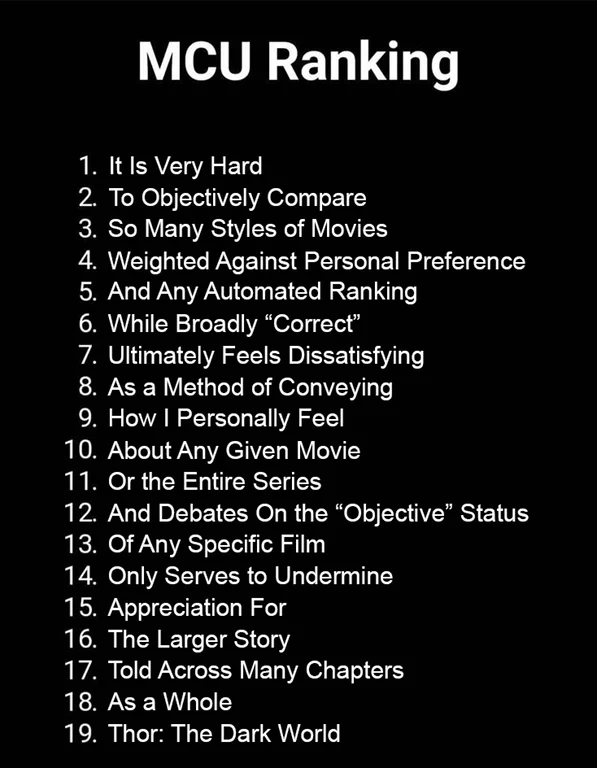
The earliest known version of the format appeared on Reddit, posted by user u/ocentertainment in the /r/MarvelStudios subreddit. The post presented a mock ranking of Marvel Cinematic Universe films, with each numbered entry forming a sentence about how ranking these movies is essentially pointless since they're all so different. The punchline landed on *Thor: The Dark World*, implying that regardless of any philosophical objections to ranking, that film is clearly the worst in the franchise. The post pulled in over 18,000 points and 1,100 comments within a month3.

Origin & Background

Platform
Reddit (earliest known version), Twitter (viral spread)
Key People
u/ocentertainment, @WaltsFrzenHead, @harleivy
Date
2018

The earliest known version of the format appeared on Reddit, posted by user u/ocentertainment in the /r/MarvelStudios subreddit. The post presented a mock ranking of Marvel Cinematic Universe films, with each numbered entry forming a sentence about how ranking these movies is essentially pointless since they're all so different. The punchline landed on *Thor: The Dark World*, implying that regardless of any philosophical objections to ranking, that film is clearly the worst in the franchise. The post pulled in over 18,000 points and 1,100 comments within a month.

How It Spread

The format jumped to Twitter in June 2018 and immediately took off. On June 22, user @WaltsFrzenHead posted a "ranking" of top Pixar films that spelled out a similar message about the difficulty of comparing films across different directors and genres. The #1 and #2 spots went to *Cars 2* and *The Good Dinosaur*, landing the joke that those two are clearly bottom-tier despite the philosophical objections to ranking. That tweet pulled more than 20,000 retweets and 122,000 likes.

The next day, @yngjstice applied the template to X-Men characters, spelling out "You can't rank them because they're all so diverse and loveable in their own" before dropping "Storm" at #1. That tweet picked up 700 retweets and 2,200 likes.

But the real breakout came on June 24, when @harleivy posted a Disney princess ranking using the same structure. That single tweet racked up over 100,000 retweets and 352,000 likes in just three days, turning the format from a niche joke into a timeline-dominating trend.

By June 25, the format was everywhere. @nighttimemytime applied it to Lorde songs (landing on "Supercut" as #1), earning 24,000 retweets and 100,000 likes in two days. People used it for everything: sports teams, dog breeds, college courses, fast food items, and increasingly niche subjects like farmers' workloads.

The meme's rapid spread appears to trace back partly to K-pop stan communities on Twitter. The oldest popular tweet using the "you can't rank them" phrasing appeared on June 20, 2018, from within K-pop stan circles, with scores of other stans adopting the format over the following week. This fits a broader pattern where stan communities on Twitter and Tumblr incubate text-based formats before a relatable, non-fandom version pushes them into the mainstream.

Brands inevitably got involved. Netflix used the format in its own tweets, because, as Inverse put it, "nothing is sacred". Several media outlets covered the trend, including Mashable and PopBuzz.

How to Use This Meme

The format is straightforward:

1

Pick a category with multiple entries (movies, songs, characters, foods, anything).

2

Write a numbered list from highest to lowest (e.g., 20 down to 1).

3

Fill positions with individual words that form a sentence about why ranking this category is unfair or impossible. Common phrases: "You can't rank them because they're all unique" or "It's hard to rank things spanning different genres."

4

At position #1 (or the last couple spots), break the pattern and name your actual pick, typically a controversial or consensus "worst" or "best" choice.

Cultural Impact

The Ranked Lists meme tapped into a deeper internet truth: people love ranking things, but rankings always feel incomplete. The format gave users a way to participate in ranking culture while simultaneously mocking it, which made it feel smarter than a standard "hot take" list.

The trend also showed how quickly K-pop and fandom stan communities could incubate and launch meme formats into the mainstream. Most of the early adopters were stans ranking members of their favorite groups, and the crossover into general pop culture happened only after someone posted a universally relatable version.

Media coverage from outlets like Mashable and Inverse helped document the trend in real time, with both publications creating their own ranked-list-of-ranked-lists content.

Fun Facts

The Reddit origin post used *Thor: The Dark World* as the punchline, making it one of the earliest "everyone agrees this is the worst MCU movie" jokes in meme format.

The @harleivy Disney princess tweet was the single biggest accelerant for the trend, gaining over 352,000 likes in three days and essentially making the format inescapable on Twitter.

Mashable leaned fully into the meta-humor by publishing a ranked list of the best ranked list memes.

The oldest popular K-pop version predated the mainstream breakout by about two days, showing how stan communities were the true incubator.

Derivatives & Variations

Sports rankings:

Some of the most popular iterations ranked athletes, teams, or sports moments, with football and basketball versions gaining heavy traction on sports Twitter[1].

Appearance-based rankings:

At least two viral tweets ranked women by hair color, with brunettes and blondes going "head to head." These drew some criticism for their shallow premise[1].

Brand participation:

Companies like Netflix adopted the format for promotional tweets, applying it to their own content libraries[1].

Gender-flipped versions:

After several tweets ranked women by physical traits, counter-versions flipped the format to rank men, pushing back on the gendered dynamic[1].

Frequently Asked Questions

RankedLists

2018Phrasal template / text memesemi-active

Also known as: "You Can't Rank Them" meme · Ranking Meme

Ranked Lists is a text-based Twitter meme format where creators fill numbered slots with words forming a hidden sentence, revealing their actual favorite or least favorite item at position #1, popularized in June 2018.

Ranked Lists is a text-based meme format where someone pretends to rank a group of things (movies, songs, characters) but fills most of the numbered slots with words forming a sentence like "You can't rank them because they're all so different." The punchline sits at position #1, revealing the poster's actual favorite or least favorite pick. The format blew up on Twitter in late June 2018 and spread rapidly thanks to its dead-simple, copy-paste-friendly structure.

TL;DR

Ranked Lists is a text-based meme format where someone pretends to rank a group of things (movies, songs, characters) but fills most of the numbered slots with words forming a sentence like "You can't rank them because they're all so different." The punchline sits at position #1, revealing the poster's actual favorite or least favorite pick.

Overview

The Ranked Lists meme takes the familiar format of a numbered ranking and subverts it. Instead of actually ordering items from worst to best, the poster fills positions with individual words that, read together, spell out a statement about why ranking is pointless. Something like: "15. You 14. Can't 13. Rank 12. Them 11. Because 10. They're 9. All 8. So 7. Diverse..." and so on. The twist comes at position #1, where the poster drops the act and names a specific pick as the best (or worst), undercutting their own argument.

The humor works on two levels. First, there's the meta-joke about how ranked lists are everywhere online yet rarely feel satisfying because they flatten nuance. Second, there's the punchline reveal, where the poster admits they actually do have a strong opinion despite claiming otherwise. It's a format built for stan culture, where people are deeply invested in their favorites but want to appear diplomatic about it.

The earliest known version of the format appeared on Reddit, posted by user u/ocentertainment in the /r/MarvelStudios subreddit. The post presented a mock ranking of Marvel Cinematic Universe films, with each numbered entry forming a sentence about how ranking these movies is essentially pointless since they're all so different. The punchline landed on *Thor: The Dark World*, implying that regardless of any philosophical objections to ranking, that film is clearly the worst in the franchise. The post pulled in over 18,000 points and 1,100 comments within a month.

Origin & Background

Platform
Reddit (earliest known version), Twitter (viral spread)
Key People
u/ocentertainment, @WaltsFrzenHead, @harleivy
Date
2018

The earliest known version of the format appeared on Reddit, posted by user u/ocentertainment in the /r/MarvelStudios subreddit. The post presented a mock ranking of Marvel Cinematic Universe films, with each numbered entry forming a sentence about how ranking these movies is essentially pointless since they're all so different. The punchline landed on *Thor: The Dark World*, implying that regardless of any philosophical objections to ranking, that film is clearly the worst in the franchise. The post pulled in over 18,000 points and 1,100 comments within a month.

How It Spread

The format jumped to Twitter in June 2018 and immediately took off. On June 22, user @WaltsFrzenHead posted a "ranking" of top Pixar films that spelled out a similar message about the difficulty of comparing films across different directors and genres. The #1 and #2 spots went to *Cars 2* and *The Good Dinosaur*, landing the joke that those two are clearly bottom-tier despite the philosophical objections to ranking. That tweet pulled more than 20,000 retweets and 122,000 likes.

The next day, @yngjstice applied the template to X-Men characters, spelling out "You can't rank them because they're all so diverse and loveable in their own" before dropping "Storm" at #1. That tweet picked up 700 retweets and 2,200 likes.

But the real breakout came on June 24, when @harleivy posted a Disney princess ranking using the same structure. That single tweet racked up over 100,000 retweets and 352,000 likes in just three days, turning the format from a niche joke into a timeline-dominating trend.

By June 25, the format was everywhere. @nighttimemytime applied it to Lorde songs (landing on "Supercut" as #1), earning 24,000 retweets and 100,000 likes in two days. People used it for everything: sports teams, dog breeds, college courses, fast food items, and increasingly niche subjects like farmers' workloads.

The meme's rapid spread appears to trace back partly to K-pop stan communities on Twitter. The oldest popular tweet using the "you can't rank them" phrasing appeared on June 20, 2018, from within K-pop stan circles, with scores of other stans adopting the format over the following week. This fits a broader pattern where stan communities on Twitter and Tumblr incubate text-based formats before a relatable, non-fandom version pushes them into the mainstream.

Brands inevitably got involved. Netflix used the format in its own tweets, because, as Inverse put it, "nothing is sacred". Several media outlets covered the trend, including Mashable and PopBuzz.

How to Use This Meme

The format is straightforward:

1

Pick a category with multiple entries (movies, songs, characters, foods, anything).

2

Write a numbered list from highest to lowest (e.g., 20 down to 1).

3

Fill positions with individual words that form a sentence about why ranking this category is unfair or impossible. Common phrases: "You can't rank them because they're all unique" or "It's hard to rank things spanning different genres."

4

At position #1 (or the last couple spots), break the pattern and name your actual pick, typically a controversial or consensus "worst" or "best" choice.

Cultural Impact

The Ranked Lists meme tapped into a deeper internet truth: people love ranking things, but rankings always feel incomplete. The format gave users a way to participate in ranking culture while simultaneously mocking it, which made it feel smarter than a standard "hot take" list.

The trend also showed how quickly K-pop and fandom stan communities could incubate and launch meme formats into the mainstream. Most of the early adopters were stans ranking members of their favorite groups, and the crossover into general pop culture happened only after someone posted a universally relatable version.

Media coverage from outlets like Mashable and Inverse helped document the trend in real time, with both publications creating their own ranked-list-of-ranked-lists content.

Fun Facts

The Reddit origin post used *Thor: The Dark World* as the punchline, making it one of the earliest "everyone agrees this is the worst MCU movie" jokes in meme format.

The @harleivy Disney princess tweet was the single biggest accelerant for the trend, gaining over 352,000 likes in three days and essentially making the format inescapable on Twitter.

Mashable leaned fully into the meta-humor by publishing a ranked list of the best ranked list memes.

The oldest popular K-pop version predated the mainstream breakout by about two days, showing how stan communities were the true incubator.

Derivatives & Variations

Sports rankings:

Some of the most popular iterations ranked athletes, teams, or sports moments, with football and basketball versions gaining heavy traction on sports Twitter[1].

Appearance-based rankings:

At least two viral tweets ranked women by hair color, with brunettes and blondes going "head to head." These drew some criticism for their shallow premise[1].

Brand participation:

Companies like Netflix adopted the format for promotional tweets, applying it to their own content libraries[1].

Gender-flipped versions:

After several tweets ranked women by physical traits, counter-versions flipped the format to rank men, pushing back on the gendered dynamic[1].

Frequently Asked Questions