Rent Free

1988Catchphrase / slang expression / exploitable imageactive

Published March 10, 2026 · Updated March 17, 2026

Also known as: Living in Your Head Rent Free · Living Rent Free in Your Head · Brain Squatter

"Rent free," short for "living in your head rent free," is a slang expression used to mock someone for being unable to stop thinking about a person or topic. The phrase originated in print as early as 1988 in Rabbi Abraham J. Twerski's book *Living Each Day* and was popularized by advice columnist Ann Landers in 19907. It migrated online as both a text-based insult and an MS Paint exploitable format, hitting peak usage during the hyper-polarized political climate of 20182.

Overview

"Rent free" works on a simple metaphor: your mind is real estate, and the person or thing you can't stop obsessing over is an unwanted tenant who isn't even paying for the privilege. The phrase functions as a dismissal tactic, shifting any argument away from its actual substance and toward a meta-commentary about the arguer's fixation3. It says: *you think about me, but I don't think about you.*

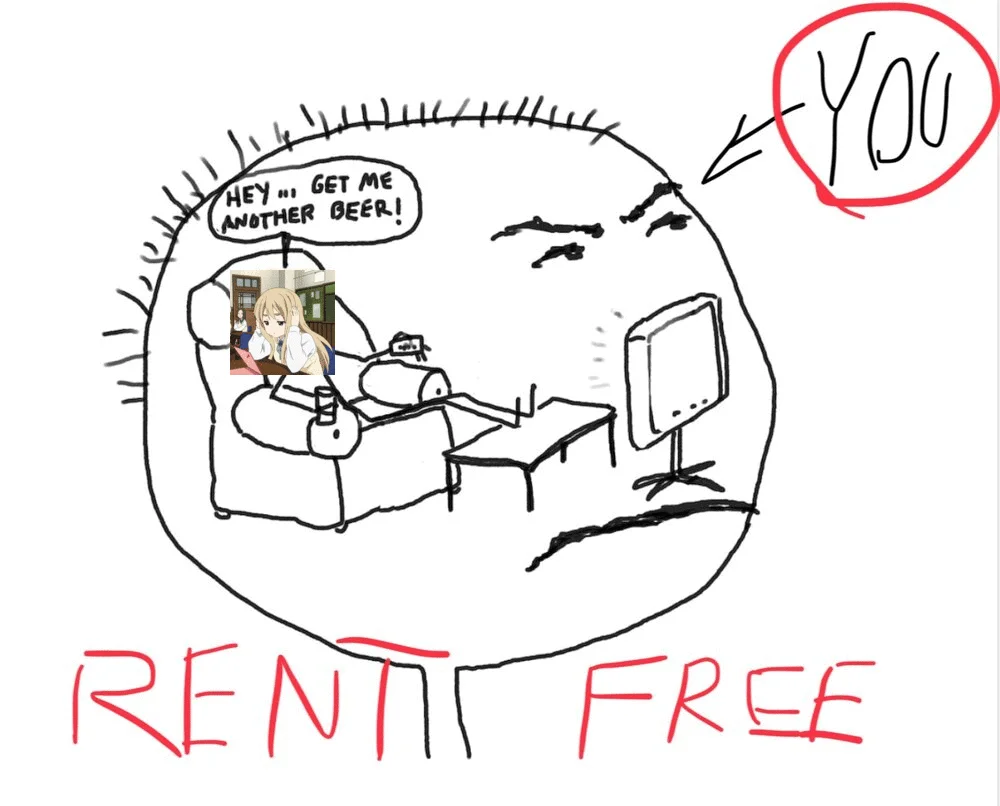
The meme also has a visual component. An MS Paint-style exploitable depicts a simple character with an oversized head, inside which another figure or image sits comfortably. Users swap in whatever subject they claim is "living rent free" in someone's mind4. Outside the exploitable format, the phrase appears constantly in Twitter arguments, sports trash talk, political commentary, and everyday roasting.

The earliest documented print appearance of the phrase comes from Rabbi Abraham J. Twerski's 1988 devotional book *Living Each Day*, published by ArtScroll. In it, Twerski writes: "A wise man said, 'Hanging on to resentments is letting someone you don't like live rent-free inside your head'"7. This predates the more commonly cited source by two years.

That better-known source is Eppie Lederer, who wrote under the pen name Ann Landers. In her syndicated "Ask Ann Landers" column on March 8, 1990, she included the line in her "Gem of the Day" segment: "Hanging onto resentment is letting someone you despise live rent-free in your head"7. Landers' massive syndication network brought the phrase to a mainstream American audience, and it floated around self-help blogs and motivational circles for years afterward2. A cultural waypoint came in 1996 when Scottish musician Nicolette titled her album *Let No-One Live Rent Free in Your Head*7.

The phrase's jump to meme format happened much later. The earliest known instance of the exploitable image paired with the expression dates to May 19, 2010, when a cartoon appeared on the Pithless Thoughts Blogspot4. This crude MS Paint drawing established the visual template that would spread across forums and social media over the following decade.

Origin & Background

Platform
Print media (source phrase), Pithless Thoughts Blogspot (earliest known meme format)[4]
Key People
Rabbi Abraham J. Twerski, Ann Landers[7]
Date
1988 (print), ~2010 (online meme format)

The earliest documented print appearance of the phrase comes from Rabbi Abraham J. Twerski's 1988 devotional book *Living Each Day*, published by ArtScroll. In it, Twerski writes: "A wise man said, 'Hanging on to resentments is letting someone you don't like live rent-free inside your head'"7. This predates the more commonly cited source by two years.

That better-known source is Eppie Lederer, who wrote under the pen name Ann Landers. In her syndicated "Ask Ann Landers" column on March 8, 1990, she included the line in her "Gem of the Day" segment: "Hanging onto resentment is letting someone you despise live rent-free in your head"7. Landers' massive syndication network brought the phrase to a mainstream American audience, and it floated around self-help blogs and motivational circles for years afterward2. A cultural waypoint came in 1996 when Scottish musician Nicolette titled her album *Let No-One Live Rent Free in Your Head*7.

The phrase's jump to meme format happened much later. The earliest known instance of the exploitable image paired with the expression dates to May 19, 2010, when a cartoon appeared on the Pithless Thoughts Blogspot4. This crude MS Paint drawing established the visual template that would spread across forums and social media over the following decade.

How It Spread

The exploitable format resurfaced on the Nairaland forum on April 28, 2017, during a heated political thread where a user deployed "living rent free in your head" as a comeback in a flame war about American politics1. Around the same time, the phrase began picking up steam on Twitter, especially in political contexts.

By July 18, 2018, "rent free" had been added to Urban Dictionary by user PajamaBoy914. The entry defined it as living in the head of someone who can't stop thinking about you5. But the real explosion came in late 2018.

On October 1, 2018, BuzzFeed News published Joseph Bernstein's article calling "living in your head rent-free" the "perfect insult of our times"2. Bernstein traced the phrase back to Ann Landers and documented how it had been weaponized across the political spectrum. Alexandria Ocasio-Cortez was supposedly living rent free in Fox News' heads. Michael Avenatti was in Trump's head. Steve Bannon was in H.R. McMaster's head. Donald Trump Jr. had tweeted about his father's "best deal ever... Living rent free for 2 years in the media's heads"2.

A month later, on November 2, 2018, Deadspin's Albert Burneko published a scathing reaction piece calling the phrase "one of the most bone-crushingly dumb phrases in common internet parlance"3. Burneko connected it to NBA trash talk, noting how Joel Embiid had told Andre Drummond "I feel like I own a lot of real estate in his head" after a game against the Pistons3. Deadspin followed up in March 2019 with a running column tracking who was living in whose head rent free at any given moment6.

The exploitable image format continued spreading separately. On September 15, 2019, a 4chan user on the /vp/ board edited the template with Pokemon characters4. On November 10, 2020, the Facebook page Banter King posted a rent free meme that pulled over 7,700 likes and 8,600 shares4. The following month, Instagram account hoodclips posted a rent free meme on December 19, 2020, which racked up over 1.5 million views and 217,000 likes in 11 days4.

Platforms

TwitterRedditTwitter

Timeline

2023-01-01

Meme keeps see steady use

2024-01-01

Rent Free reached mainstream popularity and media coverage

View on Google Trends

How to Use This Meme

As a text comeback: When someone is clearly fixated on a topic, person, or argument, respond with "rent free" or "living in your head rent free." The implication is that their obsession is embarrassing and unprofitable. This works best as a dismissal in an argument you don't want to engage with seriously.

As a self-deprecating admission: Say something like "this song lives rent free in my head" to describe a thought, memory, or piece of media you can't stop thinking about. This usage is typically lighthearted.

As the exploitable image: Take the MS Paint head template, insert an image of whatever subject is supposedly occupying someone's mental real estate, and post it in response to someone's fixation. The format is flexible enough to work for political commentary, sports rivalries, or everyday jokes.

Common variations: "Rearranging the furniture in your head," "nice piece of real estate," and "I own real estate in your head" are all riffs on the same core metaphor1.

Create Your Own

Cultural Impact

The phrase broke through from internet slang into mainstream media coverage in 2018, with both BuzzFeed News and Deadspin publishing long-form analyses of its cultural weight23. Deadspin went on to create a recurring feature tracking the latest "rent free" dynamics across politics and sports6.

Professional athletes adopted the language openly. Joel Embiid's use of real estate metaphors during the 2018 NBA season brought the concept into sports broadcasting and post-game analysis3. The phrase fit naturally into trash talk culture, where getting inside an opponent's head is already a foundational concept.

In political discourse, "rent free" became one of the defining put-downs of the Trump era. Both supporters and opponents of various political figures used it to dismiss their rivals' preoccupation2. Donald Trump Jr. explicitly invoked it to boast about media coverage of his father2.

The phrase also illustrates what Columbia Law professor Tim Wu described as the battle for attention being "primary to a lot of other battles"2. In a media environment where attention is currency, calling someone a freeloader in your mental space carries both emotional and economic implications.

Full History

The journey of "rent free" from self-help wisdom to internet weapon spans nearly four decades. Twerski's 1988 usage framed it as spiritual advice about the emotional danger of clinging to resentment7. Ann Landers' 1990 column did the same, positioning it as practical wisdom for letting go of grudges9. For most of the 1990s and 2000s, the phrase lived in motivational posters, recovery literature, and advice columns. It was earnest. It was helpful. Nobody was using it to win arguments on the internet.

That changed gradually as the phrase migrated online. The 2010 Pithless Thoughts cartoon was an early signal, but the format didn't catch fire immediately4. Through the mid-2010s, the expression popped up sporadically in forum arguments and Twitter spats, usually in political contexts where partisans wanted to dismiss their opponents' fixation on a particular figure.

The 2018 breakout was driven by two forces: the Trump-era polarization of American politics and the growing awareness of attention as a commodity. As Tim Wu, author of *The Attention Merchants*, told NPR: "Donald Trump through *The Apprentice* understood deeply the power of capturing and using human attention... Even if people are resisting you they are still paying attention to you"2. The phrase became the perfect shorthand for this dynamic. When someone tells you a politician or celebrity is "living rent free in your head," they're saying your outrage is itself a form of tribute.

BuzzFeed's Bernstein articulated why the phrase hit so hard in 2018 specifically. Americans were starting to realize their attention was a valuable commodity, one that social media platforms had been extracting for years at a steep discount2. "Someone or something that lives rent-free in your head is causing you agita without paying for it," he wrote. "They're getting something for nothing"2. The real estate metaphor clicked perfectly with an audience that understood gig economics and platform exploitation.

Deadspin's Burneko offered the counter-argument: that "rent free" was intellectually bankrupt, a phrase that abandoned the pretense of actual argument in favor of pointing out that an argument was happening at all3. "The user of the phrase is conceding that the argument isn't the point," he wrote3. It was, in his view, the rhetorical equivalent of sticking your fingers in your ears. Yet even Burneko admitted the phrase had lodged itself firmly in his own brain: "hell yes, 'rent-free in your head' was living rent-free in my head"3.

Sports culture adopted the phrase enthusiastically. Joel Embiid's repeated use of the "real estate in your head" variation during the 2018 NBA season gave it a jock credibility that pure internet slang rarely achieves3. When Embiid pointed at his own head after a confrontation with Marcus Morris during the Eastern Conference semifinals, mouthing "I'm in your head," he was performing the meme in real time3. Morris' response was eloquent in its simplicity: he held up three fingers, then made a zero. The Sixers were down 3-0.

By 2020, the phrase had shed much of its political edge and become a general-purpose expression. People used it to describe songs stuck in their heads, embarrassing memories that wouldn't fade, and crushes they couldn't shake8. The connotation shifted from purely negative (resentment, obsession) to something more flexible. Saying a funny TikTok "lives rent free in my head" became a compliment, meaning it was so good you couldn't forget it8. This broadened usage pushed the phrase even further into the mainstream.

The visual meme format saw its own evolution. The crude MS Paint original gave way to increasingly elaborate edits, with users inserting specific characters, celebrities, or images into the "head space" of the template character4. The format worked because it was dead simple: anyone with basic image editing skills could make their own version.

Fun Facts

The phrase appeared in print two years earlier than commonly believed. Rabbi Abraham J. Twerski's 1988 book *Living Each Day* contains the metaphor, predating Ann Landers' more famous 1990 usage7.

Deadspin writer Albert Burneko, who called "rent free" one of the dumbest phrases on the internet, openly admitted the phrase itself was living rent free in his own head3.

When Joel Embiid taunted Marcus Morris by pointing at his head during the 2018 playoffs, Morris responded by silently holding up three fingers and a zero, referencing the Celtics' 3-0 series lead3.

Scottish musician Nicolette used the phrase as an album title in 1996, making *Let No-One Live Rent Free in Your Head* one of the earliest pop culture references to the expression7.

Ann Landers readers voted the resentment quote among the best chestnuts of her 47-year career in a 1999 poll2.

Derivatives & Variations

Rent Free Variations

Different takes on the Rent Free format with modified content

(2022)

Rent Free Mashups

Combinations of Rent Free with other popular memes

(2023)

Rent Free Remixes

Updated versions with current events and references

(2023)

Frequently Asked Questions