Subtweet

2009catchphraseclassic

Published September 30, 2026

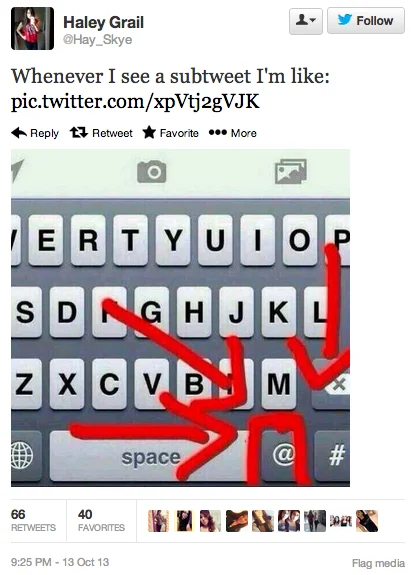
Subtweet, short for 'subliminal tweet,' describes a Twitter post that talks about someone without tagging their handle. The term first surfaced in late 2009 among frustrated users, then blew up between 2011 and 2013 as celebrity feuds and gossip blogs turned the practice into one of Twitter's most gossiped-about social behaviors.

Overview

A subtweet is a Twitter post covertly aimed at a specific person without using their @handle, letting the poster air a grievance or joke without directly summoning the target into the thread3. The practice is closely tied to the hashtag #OOMF, meaning 'one of my followers,' which lets people gesture at someone in their circle while keeping plausible deniability3.

BuzzFeed writer Hillary Reinsberg framed the appeal and the ick factor of the format in a 2013 explainer, describing subtweeting as 'the online version of talking behind someone's back' and noting how it deliberately breaks Twitter's @-reply conversational structure so the subject can't easily track what's being said about them1. Urban Dictionary users boiled the same idea down more bluntly, calling it 'talking about someone behind their back but sort of in their face'4.

Origin & Background

Platform
Twitter
Date
2009

One of the earliest documented uses of the word 'subtweet' in this sense came from Twitter user @iChelz on December 2nd, 2009, in a post venting about mutuals who stopped texting or calling but still posted vague tweets3. The word is a shortening of 'subliminal tweet,' framing the post as a coded message the target is meant to notice4.

The term picked up steam in mid-2010. On August 9th, 2010, 'subtweet' was added to Urban Dictionary, defined as 'talking about someone behind there back but sort of in their face'4. About a week later the #subtweet hashtag was catalogued in the Twitter hashtag database Tagdef, and on September 4th, 2010, the longer phrase 'subliminal tweeting' also got its own Urban Dictionary entry3.

How It Spread

Between 2010 and 2011 the subtweet moved from personal blog territory into celebrity gossip coverage, with entertainment sites documenting apparent subtweets between Drake, Rihanna and Chris Brown3. In July 2011 the dedicated account @SubtweetSpotter launched to try to redirect subtweets to their probable targets, turning the guessing game into its own micro-genre3. In February 2012 YouTuber qiasomar released a comedy video acting out a passive-aggressive subtweet exchange between two friends, which racked up further views for the concept5.

Mainstream tech and lifestyle press caught up next. Business Insider ran a straightforward 'What is subtweeting?' explainer in December 2012, and 2013 brought coverage from BuzzFeed, the Huffington Post, xoJane, Digital Trends, Geek Sugar and Complex, the last of which rounded up celebrity offenders including Nicki Minaj and Kim Kardashian3. According to Topsy Analytics numbers cited by Know Your Meme, 'subtweet' was used on Twitter more than 665,000 times between September and October 2013 alone3.

By October 2013 the backlash cycle had started. BuzzFeed writer Myles Tanzer declared 'the subtweet is dead' in a piece arguing that Twitter's media-elite users had stopped bothering with the format and that anyone with a grievance should just name names2. Tanzer pointed to Drake, of all people, telling an NYU audience 'Twitter isn't real' when asked how he felt about his lyrics being repurposed for subtweets against exes2.

Frequently Asked Questions