The Creation Of Adam Parodies
Published March 31, 2026
Also known as: Sistine Steal · Sistine Chapel Parody · Creation of Adam Meme · AI Creation Meme
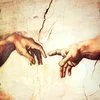
The Creation of Adam Parodies are photoshopped, redrawn, and live-action remakes of Michelangelo's iconic Sistine Chapel fresco, replacing God, Adam, or both with pop culture figures, products, or absurd objects. One of the internet's longest-running visual meme formats, these parodies trace back to at least the 1982 E.T. movie poster and exploded across forums, blogs, and social media through the 2010s3. The format's power lies in its instant recognizability: two outstretched hands, fingers almost touching, the spark of creation repurposed to bestow anything from a sandwich to a cell phone2.
Overview
The original *Creation of Adam* was painted between 1511 and 1512 as one of nine frescoes on the Sistine Chapel ceiling in Vatican City3. It depicts a bearded God figure floating in the air, reaching out with his right hand to touch the fingertip of a nude Adam3. That single gesture, two index fingers nearly meeting across a gap, became one of the most recognizable compositions in Western art.
The parody format works because the pose is so simple. Replace God with a corporate mascot, swap Adam for a cartoon character, stick a beer can between the fingertips, and the joke lands instantly. People don't need to know art history to get it. The composition has been recreated in photoshops, oil paintings, cosplay photographs, tattoos, paperclip sculptures, and embroidered jean patches5. TV Tropes catalogued the format under "Sistine Steal," noting that the recognizable two-figure arrangement makes it perfect for allusion and parody across comic books, webcomics, political cartoons, and animated shows2.
Gallery
Origin & Background
How It Spread
How to Use This Meme
The basic format involves replacing one or both figures in the composition:
Start with the original painting or a simplified version showing the two reaching hands
Replace God with whatever is "creating" or "bestowing" something (a brand, a character, a concept)
Replace Adam with the recipient (a consumer, a fan, a creation)
Optionally, place an object between the fingertips (a product, a meme, food)
Cultural Impact
Fun Facts
Niklas Jansson's original FSM painting was only 500 pixels high because the reference photo of the Sistine Chapel was so small. He later upscaled it to 5,000 pixels and started designing wooden teapot-shaped spaceships crewed by "Diligent Noodlings" in the FSM universe1.
TsaoShin acknowledged that several character attributions in "The Creation of Mario" are inaccurate (not all characters were created by Miyamoto) but chose to include Nintendo's most recognizable cast for visual impact4.
The *Record of Ragnarok* manga placed Michelangelo himself in the audience watching the Creation of Adam pose happen live with the actual Biblical Adam2.
In *Doonesbury*, when J.J. paints the ceiling of the S.S. Trump Princess, Trump complains she put his face on Adam instead of God2.
Beth Singler's 2020 academic study found that the "spark of life" motif added between fingers in AI versions draws from Luigi Galvani's 18th-century experiments animating dead frogs with electricity5.
Derivatives & Variations
Flying Spaghetti Monster version
— Niklas Jansson's 2005 edit replacing God with the FSM, released into public domain in 2016[1]
The Creation of Mario
— TsaoShin's 2010 DeviantArt illustration with Shigeru Miyamoto as God and Mario as Adam[4]
AI Creation Meme
— A distinct sub-genre where a human hand reaches toward a robotic or digital hand, widely used in tech and business media[5]
Sistine Steal variations
— TV Tropes documented parodies across anime (*Death Note*, *Record of Ragnarok*, *Nichijou*), film (*Brave*, *Moana*), comics (*The Sandman*, *Doonesbury*), and video games[2]
Photo recreations
— People physically staging the finger-touch pose, compiled in Reddit galleries[3]
COVID-era edits
— Versions showing God squirting hand sanitizer into Adam's hand[5]
Simpsons parody
— Homer as God reaching toward a golden remote control[5]
Frequently Asked Questions
References (7)
- 1FSMarticle
- 2
- 3Sistine Steal - TV Tropesarticle
- 4The Creation of Adam Parodies - Know Your Memeencyclopedia
- 5List of Internet phenomenaencyclopedia
- 6
- 7