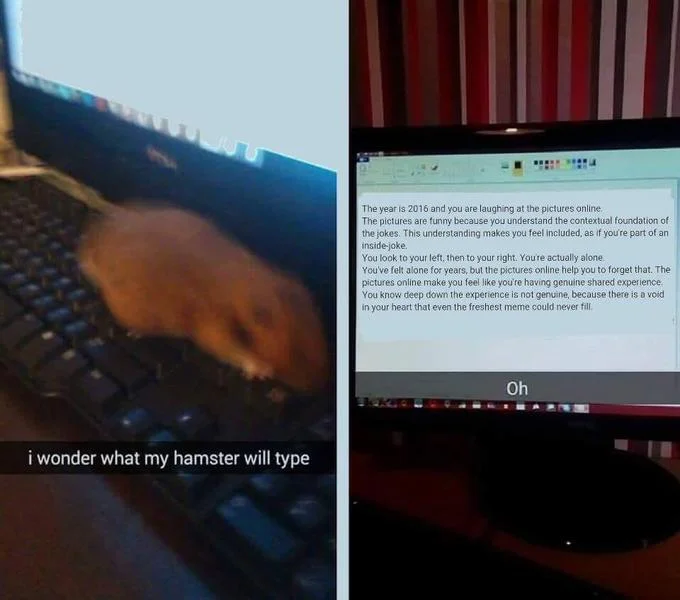
The Year Is 2016 And You Are Laughing At The Pictures Online

2016Copypastasemi-active
The Year Is 2016 And You Are Laughing At The Pictures Online is a 2016 copypasta expressing internet loneliness masked by shared meme consumption, spawning image-macro edits throughout me_irl and copypasta communities.

"The Year Is 2016 And You Are Laughing At The Pictures Online" is a copypasta that wraps bleak self-awareness about internet loneliness inside the format of a meme-about-memes. First posted in mid-2016, it describes the experience of laughing at pictures online while recognizing that the sense of community they provide is an illusion masking genuine isolation. The text struck a nerve with the me_irl and copypasta communities, spawning image macro edits and platform-specific remixes through 2017.

TL;DR

"The Year Is 2016 And You Are Laughing At The Pictures Online" is a copypasta that wraps bleak self-awareness about internet loneliness inside the format of a meme-about-memes.

Overview

The copypasta is a short, melancholy paragraph written in second person. It walks the reader through the experience of browsing memes: you laugh at the pictures because you understand the jokes, and that understanding makes you feel like you belong to something. Then the text pulls the rug out. You look around and realize you're alone. You've been alone for years. The memes create the feeling of a shared experience, but the feeling is fake, because "there is a void in your heart that even the freshest meme could never fill xDDDD"1.

The punchline, that exaggerated "xDDDD" at the end, is what gives the copypasta its specific flavor. It mirrors the very behavior it describes: deflecting real emotional weight with internet humor. The text works as both sincere confession and ironic shitpost, which made it a perfect fit for communities like r/me_irl and 4chan's [s4s] board that thrive on that ambiguity3.

The earliest known version of the copypasta appeared on July 25, 2016, when Google Plus user Tigerlily Maynard posted it to their account3. Maynard noted that the text was "originally posted by" someone else, with the original author's name censored or lost. The true creator of the text is unknown.

The copypasta reads, in part: "the pictures are funny because you understand the contextual foundation of the jokes. This understanding makes you feel included, as if you're part of an inside-joke. You look to your left, then to your right. You're actually alone"1. The writing style, with its deliberate shift from warm belonging to cold recognition, reads like a parody of introspective blog posts but hits close enough to home that people couldn't tell if it was serious.

Origin & Background

Platform
Google Plus (earliest known post), 4chan / Reddit (viral spread)
Creator
Unknown; Tigerlily Maynard
Date
2016

The earliest known version of the copypasta appeared on July 25, 2016, when Google Plus user Tigerlily Maynard posted it to their account. Maynard noted that the text was "originally posted by" someone else, with the original author's name censored or lost. The true creator of the text is unknown.

The copypasta reads, in part: "the pictures are funny because you understand the contextual foundation of the jokes. This understanding makes you feel included, as if you're part of an inside-joke. You look to your left, then to your right. You're actually alone". The writing style, with its deliberate shift from warm belonging to cold recognition, reads like a parody of introspective blog posts but hits close enough to home that people couldn't tell if it was serious.

How It Spread

The copypasta moved quickly across platforms in the summer and fall of 2016. On August 12, 2016, someone uploaded an image to Imgur pairing the text with a photo of a hamster running across a keyboard, creating the meme's most iconic visual format.

A week later, on August 19, the text landed on r/copypasta, where it found a natural home among other self-aware internet texts. Three days after that, on August 22, it showed up on 4chan repackaged as a greentext story. The text also circulated on 4chan's [s4s] (Sh*t 4chan Says) board, a community known for ironic meta-humor about meme culture itself.

By early 2017, the copypasta was being remixed for specific communities. On February 1, 2017, a Twitch-themed edit appeared on r/forsen, swapping out generic meme references for streaming culture. Later that month, FIFA forums user vLaDz posted their own version. On May 7, 2017, an edit featuring a dog was uploaded to meirl.

The meme saw a second spike on October 30, 2017, when the hamster keyboard image was posted to r/me_irl and picked up over 1,600 upvotes. The following day, the copypasta resurfaced on 4chan's /bant/ board.

How to Use This Meme

The copypasta works two ways. The simplest approach is to post the raw text in a comment section or group chat, usually in response to someone sharing a meme. The text itself does the work: it makes the reader briefly confront why they're laughing at pictures on the internet.

The more common format pairs the copypasta with an image of a small, relatable animal (typically a hamster or dog) sitting at a computer. The animal adds a layer of sad-cute energy to the text. To make your own version:

1

Find an image of a small animal near a computer or phone screen

2

Place the copypasta text in an adjacent panel or as a caption

3

The contrast between the cute animal and the existential dread of the text is the joke

Cultural Impact

The copypasta tapped into a strain of internet self-awareness that was gaining momentum in the mid-2010s. Subreddits like r/me_irl and r/2meirl4meirl had built entire communities around the idea that meme consumption is both a coping mechanism and a symptom of isolation. This text gave that feeling a specific, quotable form.

The meme also sits in a broader tradition of internet culture turning inward to examine itself. As described in academic research on meme culture, internet memes often function as in-jokes that foster a sense of collective identity within online communities. This copypasta is unusual because it names that dynamic explicitly, then questions whether the sense of belonging is real. It's a meme that deconstructs what memes do to people, and it does so while being, itself, a meme.

Fun Facts

The original author's identity was already lost by the time Tigerlily Maynard reposted the text on Google Plus, making the copypasta's creator as anonymous as the loneliness it describes.

The hamster-at-keyboard image became so closely associated with the copypasta that many people think the hamster IS the meme, not just a visual pairing.

The exaggerated "xDDDD" at the end mirrors early 2010s chatroom laughter, adding another layer of self-referential internet nostalgia.

The copypasta crossed into at least five distinct online communities (Reddit, 4chan, Imgur, Twitch, FIFA forums) within its first year.

Frequently Asked Questions

TheYearIs2016AndYouAreLaughingAtThePicturesOnline

2016Copypastasemi-active
The Year Is 2016 And You Are Laughing At The Pictures Online is a 2016 copypasta expressing internet loneliness masked by shared meme consumption, spawning image-macro edits throughout me_irl and copypasta communities.

"The Year Is 2016 And You Are Laughing At The Pictures Online" is a copypasta that wraps bleak self-awareness about internet loneliness inside the format of a meme-about-memes. First posted in mid-2016, it describes the experience of laughing at pictures online while recognizing that the sense of community they provide is an illusion masking genuine isolation. The text struck a nerve with the me_irl and copypasta communities, spawning image macro edits and platform-specific remixes through 2017.

TL;DR

"The Year Is 2016 And You Are Laughing At The Pictures Online" is a copypasta that wraps bleak self-awareness about internet loneliness inside the format of a meme-about-memes.

Overview

The copypasta is a short, melancholy paragraph written in second person. It walks the reader through the experience of browsing memes: you laugh at the pictures because you understand the jokes, and that understanding makes you feel like you belong to something. Then the text pulls the rug out. You look around and realize you're alone. You've been alone for years. The memes create the feeling of a shared experience, but the feeling is fake, because "there is a void in your heart that even the freshest meme could never fill xDDDD".

The punchline, that exaggerated "xDDDD" at the end, is what gives the copypasta its specific flavor. It mirrors the very behavior it describes: deflecting real emotional weight with internet humor. The text works as both sincere confession and ironic shitpost, which made it a perfect fit for communities like r/me_irl and 4chan's [s4s] board that thrive on that ambiguity.

The earliest known version of the copypasta appeared on July 25, 2016, when Google Plus user Tigerlily Maynard posted it to their account. Maynard noted that the text was "originally posted by" someone else, with the original author's name censored or lost. The true creator of the text is unknown.

The copypasta reads, in part: "the pictures are funny because you understand the contextual foundation of the jokes. This understanding makes you feel included, as if you're part of an inside-joke. You look to your left, then to your right. You're actually alone". The writing style, with its deliberate shift from warm belonging to cold recognition, reads like a parody of introspective blog posts but hits close enough to home that people couldn't tell if it was serious.

Origin & Background

Platform
Google Plus (earliest known post), 4chan / Reddit (viral spread)
Creator
Unknown; Tigerlily Maynard
Date
2016

The earliest known version of the copypasta appeared on July 25, 2016, when Google Plus user Tigerlily Maynard posted it to their account. Maynard noted that the text was "originally posted by" someone else, with the original author's name censored or lost. The true creator of the text is unknown.

The copypasta reads, in part: "the pictures are funny because you understand the contextual foundation of the jokes. This understanding makes you feel included, as if you're part of an inside-joke. You look to your left, then to your right. You're actually alone". The writing style, with its deliberate shift from warm belonging to cold recognition, reads like a parody of introspective blog posts but hits close enough to home that people couldn't tell if it was serious.

How It Spread

The copypasta moved quickly across platforms in the summer and fall of 2016. On August 12, 2016, someone uploaded an image to Imgur pairing the text with a photo of a hamster running across a keyboard, creating the meme's most iconic visual format.

A week later, on August 19, the text landed on r/copypasta, where it found a natural home among other self-aware internet texts. Three days after that, on August 22, it showed up on 4chan repackaged as a greentext story. The text also circulated on 4chan's [s4s] (Sh*t 4chan Says) board, a community known for ironic meta-humor about meme culture itself.

By early 2017, the copypasta was being remixed for specific communities. On February 1, 2017, a Twitch-themed edit appeared on r/forsen, swapping out generic meme references for streaming culture. Later that month, FIFA forums user vLaDz posted their own version. On May 7, 2017, an edit featuring a dog was uploaded to meirl.

The meme saw a second spike on October 30, 2017, when the hamster keyboard image was posted to r/me_irl and picked up over 1,600 upvotes. The following day, the copypasta resurfaced on 4chan's /bant/ board.

How to Use This Meme

The copypasta works two ways. The simplest approach is to post the raw text in a comment section or group chat, usually in response to someone sharing a meme. The text itself does the work: it makes the reader briefly confront why they're laughing at pictures on the internet.

The more common format pairs the copypasta with an image of a small, relatable animal (typically a hamster or dog) sitting at a computer. The animal adds a layer of sad-cute energy to the text. To make your own version:

1

Find an image of a small animal near a computer or phone screen

2

Place the copypasta text in an adjacent panel or as a caption

3

The contrast between the cute animal and the existential dread of the text is the joke

Cultural Impact

The copypasta tapped into a strain of internet self-awareness that was gaining momentum in the mid-2010s. Subreddits like r/me_irl and r/2meirl4meirl had built entire communities around the idea that meme consumption is both a coping mechanism and a symptom of isolation. This text gave that feeling a specific, quotable form.

The meme also sits in a broader tradition of internet culture turning inward to examine itself. As described in academic research on meme culture, internet memes often function as in-jokes that foster a sense of collective identity within online communities. This copypasta is unusual because it names that dynamic explicitly, then questions whether the sense of belonging is real. It's a meme that deconstructs what memes do to people, and it does so while being, itself, a meme.

Fun Facts

The original author's identity was already lost by the time Tigerlily Maynard reposted the text on Google Plus, making the copypasta's creator as anonymous as the loneliness it describes.

The hamster-at-keyboard image became so closely associated with the copypasta that many people think the hamster IS the meme, not just a visual pairing.

The exaggerated "xDDDD" at the end mirrors early 2010s chatroom laughter, adding another layer of self-referential internet nostalgia.

The copypasta crossed into at least five distinct online communities (Reddit, 4chan, Imgur, Twitch, FIFA forums) within its first year.

Frequently Asked Questions