You Shall Not Pass

2001Catchphrase / Image Macroclassic

Also known as: YSNP · You Cannot Pass

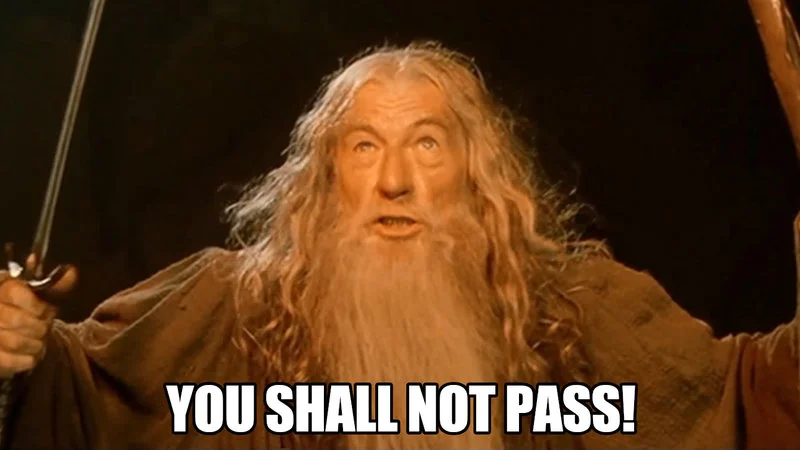
You Shall Not Pass is a 2001 image-macro meme based on Gandalf's iconic line as he confronts the Balrog on the Bridge of Khazad-dûm in The Lord of the Rings: The Fellowship of the Ring.

"You Shall Not Pass" is a catchphrase and image macro meme based on Gandalf's iconic line from *The Lord of the Rings: The Fellowship of the Ring* (2001). The scene where Ian McKellen's wizard confronts the Balrog on the Bridge of Khazad-dûm became one of the most quoted moments in movie history, spawning countless image macros, YTMND pages, and video parodies across the internet from the early 2000s onward.

TL;DR

"You Shall Not Pass" is a catchphrase and image macro meme based on Gandalf's iconic line from *The Lord of the Rings: The Fellowship of the Ring* (2001).

Overview

The meme draws from the climactic Mines of Moria sequence in *The Fellowship of the Ring*, where Gandalf the Grey plants his staff on a narrow stone bridge and shouts "You shall not pass!" at a Balrog demon pursuing the Fellowship. The bridge crumbles, the Balrog falls, and Gandalf gets dragged down with it. The raw emotion of the delivery, combined with the dramatic stakes, made the line instantly quotable1.

As a meme, it typically takes the form of an image macro with Gandalf mid-shout, staff raised, overlaid with the catchphrase or a variation of it. The format gets applied to any situation involving denial of access, blocking, or refusing entry3.

The line originates from J.R.R. Tolkien's 1954 novel *The Fellowship of the Ring*, though the book version reads "You cannot pass"1. Screenwriter Philippa Boyens deliberately changed the wording for the 2001 Peter Jackson film adaptation. In an interview with Jake's Takes, Boyens explained her reasoning: changing "cannot" to "shall" gave the line the weight of an invocation rather than a simple statement of fact1.

"'You shall not pass' has the same sense of commitment to a thought that you would put into a spell," Boyens said. "It's almost like he's trying to create an invisible force field. And also, 'shall' as a word carries a quality of time to it. A quality of: this shall never happen"1.

Ian McKellen initially questioned the change. Boyens recalled McKellen carrying a copy of the novel on set: "He would look at you and say, 'you know it's not actually "you shall not pass?"' and I was like 'yes, yes, I know.'" After hearing her explanation, McKellen performed the line and decided to keep it1.

The phrase may also echo the historical slogan "They shall not pass!" (*Ils ne passeront pas*), which gained wide use during World War I when French General Robert Nivelle rallied his troops at the 1916 Battle of Verdun2. The slogan appeared on French war propaganda posters and later became an anti-fascist rallying cry during the Spanish Civil War2. Know Your Meme notes this possible historical connection, though no direct link between the military phrase and Tolkien's original line has been confirmed3.

Origin & Background

Platform
YTMND, forums (viral spread)
Key People
Philippa Boyens, Ian McKellen, J.R.R. Tolkien
Date
2001

The line originates from J.R.R. Tolkien's 1954 novel *The Fellowship of the Ring*, though the book version reads "You cannot pass". Screenwriter Philippa Boyens deliberately changed the wording for the 2001 Peter Jackson film adaptation. In an interview with Jake's Takes, Boyens explained her reasoning: changing "cannot" to "shall" gave the line the weight of an invocation rather than a simple statement of fact.

"'You shall not pass' has the same sense of commitment to a thought that you would put into a spell," Boyens said. "It's almost like he's trying to create an invisible force field. And also, 'shall' as a word carries a quality of time to it. A quality of: this shall never happen".

Ian McKellen initially questioned the change. Boyens recalled McKellen carrying a copy of the novel on set: "He would look at you and say, 'you know it's not actually "you shall not pass?"' and I was like 'yes, yes, I know.'" After hearing her explanation, McKellen performed the line and decided to keep it.

The phrase may also echo the historical slogan "They shall not pass!" (*Ils ne passeront pas*), which gained wide use during World War I when French General Robert Nivelle rallied his troops at the 1916 Battle of Verdun. The slogan appeared on French war propaganda posters and later became an anti-fascist rallying cry during the Spanish Civil War. Know Your Meme notes this possible historical connection, though no direct link between the military phrase and Tolkien's original line has been confirmed.

How It Spread

After *The Fellowship of the Ring* hit theaters in December 2001, the quote spread rapidly through early internet culture. YTMND became one of the first major hubs for "You Shall Not Pass" content, with users creating audio-visual pages built around the scene. The line also found a natural home in forum culture, where it was applied as a reaction to gatekeeping, access denial, or any situation where someone was stopping something from getting through.

The image macro format took off as meme culture matured in the mid-2000s. Users would place Gandalf's image (or just the quote) over unrelated photos of people, animals, or objects blocking a path. Teachers standing in doorways, cats refusing to let owners pass, security guards at events, road barriers: anything could become a "You Shall Not Pass" setup.

The meme also crossed into video parody territory, with the scene being spoofed in other films, TV shows, and fan edits. The Urban Dictionary entry notes the line's connection to both the *Lord of the Rings* scene and the Black Knight sequence from *Monty Python and the Holy Grail*, where a similar "none shall pass" gag plays out.

How to Use This Meme

The format is straightforward. Find or create an image where someone or something is blocking access, denying entry, or standing firm against an approaching force. Overlay the text "YOU SHALL NOT PASS" (typically in Impact font, all caps). The humor comes from applying Gandalf's life-or-death stand against a demon to mundane situations like a locked bathroom door or a cat sitting in a hallway.

Common variations include: - Screenshots of the film scene with altered captions - Photos of real-world barriers (gates, fences, puddles) with the quote - Video edits inserting Gandalf into unrelated footage - The quote used as a text response in comment sections and forums

The delivery works best when the "blocker" looks either absurdly serious about a trivial barrier or completely unfit for the heroic framing.

Cultural Impact

The line became one of cinema's most recognized quotes, regularly appearing in lists of greatest movie lines alongside "I'll be back" and "Here's looking at you, kid." Boyens' single-word change from "cannot" to "shall" turned a piece of high-fantasy prose into something people shout at each other in parking lots.

The historical lineage of the phrase adds an unexpected layer. The same "shall not pass" construction was used on French war propaganda posters after the Allied victory at the Second Battle of the Marne. It was later adopted by Dolores Ibárruri during the Spanish Civil War as "¡No pasarán!" and became an anti-fascist slogan used everywhere from the 1936 Battle of Cable Street to the 2024 Ukrainian 155th Mechanized Brigade. The meme version strips away the military gravity and replaces it with internet absurdism, but the underlying emotional structure (defiance against an overwhelming force) stays the same.

Fun Facts

Tolkien's original 1954 line reads "You cannot pass," not "You shall not pass." The change was entirely Philippa Boyens' decision for the screenplay.

Ian McKellen carried a physical copy of the Tolkien novel on set and would approach the screenwriters whenever something differed from the source material.

The WWI-era French phrase "Ils ne passeront pas" appeared on propaganda posters by artist Maurice Neumont, most notably after the 1918 Allied victory at the Second Battle of the Marne.

The Spanish Civil War version "¡No pasarán!" became so iconic that Francisco Franco responded with "Ya hemos pasao" ("We have already passed") after taking Madrid.

Derivatives & Variations

"None Shall Pass" crossovers

Mashups combining Gandalf's scene with the Black Knight from *Monty Python and the Holy Grail*, who delivers a similar ultimatum before losing all his limbs[4].

YTMND edits

Audio-visual pages remixing the Gandalf scene with music, sound effects, and other film clips[3].

Reaction GIF/image

A widely shared GIF of the exact moment Gandalf slams his staff, used as a reaction to blocked content, denied requests, or failed login attempts[3].

Frequently Asked Questions

YouShallNotPass

2001Catchphrase / Image Macroclassic

Also known as: YSNP · You Cannot Pass

You Shall Not Pass is a 2001 image-macro meme based on Gandalf's iconic line as he confronts the Balrog on the Bridge of Khazad-dûm in The Lord of the Rings: The Fellowship of the Ring.

"You Shall Not Pass" is a catchphrase and image macro meme based on Gandalf's iconic line from *The Lord of the Rings: The Fellowship of the Ring* (2001). The scene where Ian McKellen's wizard confronts the Balrog on the Bridge of Khazad-dûm became one of the most quoted moments in movie history, spawning countless image macros, YTMND pages, and video parodies across the internet from the early 2000s onward.

TL;DR

"You Shall Not Pass" is a catchphrase and image macro meme based on Gandalf's iconic line from *The Lord of the Rings: The Fellowship of the Ring* (2001).

Overview

The meme draws from the climactic Mines of Moria sequence in *The Fellowship of the Ring*, where Gandalf the Grey plants his staff on a narrow stone bridge and shouts "You shall not pass!" at a Balrog demon pursuing the Fellowship. The bridge crumbles, the Balrog falls, and Gandalf gets dragged down with it. The raw emotion of the delivery, combined with the dramatic stakes, made the line instantly quotable.

As a meme, it typically takes the form of an image macro with Gandalf mid-shout, staff raised, overlaid with the catchphrase or a variation of it. The format gets applied to any situation involving denial of access, blocking, or refusing entry.

The line originates from J.R.R. Tolkien's 1954 novel *The Fellowship of the Ring*, though the book version reads "You cannot pass". Screenwriter Philippa Boyens deliberately changed the wording for the 2001 Peter Jackson film adaptation. In an interview with Jake's Takes, Boyens explained her reasoning: changing "cannot" to "shall" gave the line the weight of an invocation rather than a simple statement of fact.

"'You shall not pass' has the same sense of commitment to a thought that you would put into a spell," Boyens said. "It's almost like he's trying to create an invisible force field. And also, 'shall' as a word carries a quality of time to it. A quality of: this shall never happen".

Ian McKellen initially questioned the change. Boyens recalled McKellen carrying a copy of the novel on set: "He would look at you and say, 'you know it's not actually "you shall not pass?"' and I was like 'yes, yes, I know.'" After hearing her explanation, McKellen performed the line and decided to keep it.

The phrase may also echo the historical slogan "They shall not pass!" (*Ils ne passeront pas*), which gained wide use during World War I when French General Robert Nivelle rallied his troops at the 1916 Battle of Verdun. The slogan appeared on French war propaganda posters and later became an anti-fascist rallying cry during the Spanish Civil War. Know Your Meme notes this possible historical connection, though no direct link between the military phrase and Tolkien's original line has been confirmed.

Origin & Background

Platform
YTMND, forums (viral spread)
Key People
Philippa Boyens, Ian McKellen, J.R.R. Tolkien
Date
2001

The line originates from J.R.R. Tolkien's 1954 novel *The Fellowship of the Ring*, though the book version reads "You cannot pass". Screenwriter Philippa Boyens deliberately changed the wording for the 2001 Peter Jackson film adaptation. In an interview with Jake's Takes, Boyens explained her reasoning: changing "cannot" to "shall" gave the line the weight of an invocation rather than a simple statement of fact.

"'You shall not pass' has the same sense of commitment to a thought that you would put into a spell," Boyens said. "It's almost like he's trying to create an invisible force field. And also, 'shall' as a word carries a quality of time to it. A quality of: this shall never happen".

Ian McKellen initially questioned the change. Boyens recalled McKellen carrying a copy of the novel on set: "He would look at you and say, 'you know it's not actually "you shall not pass?"' and I was like 'yes, yes, I know.'" After hearing her explanation, McKellen performed the line and decided to keep it.

The phrase may also echo the historical slogan "They shall not pass!" (*Ils ne passeront pas*), which gained wide use during World War I when French General Robert Nivelle rallied his troops at the 1916 Battle of Verdun. The slogan appeared on French war propaganda posters and later became an anti-fascist rallying cry during the Spanish Civil War. Know Your Meme notes this possible historical connection, though no direct link between the military phrase and Tolkien's original line has been confirmed.

How It Spread

After *The Fellowship of the Ring* hit theaters in December 2001, the quote spread rapidly through early internet culture. YTMND became one of the first major hubs for "You Shall Not Pass" content, with users creating audio-visual pages built around the scene. The line also found a natural home in forum culture, where it was applied as a reaction to gatekeeping, access denial, or any situation where someone was stopping something from getting through.

The image macro format took off as meme culture matured in the mid-2000s. Users would place Gandalf's image (or just the quote) over unrelated photos of people, animals, or objects blocking a path. Teachers standing in doorways, cats refusing to let owners pass, security guards at events, road barriers: anything could become a "You Shall Not Pass" setup.

The meme also crossed into video parody territory, with the scene being spoofed in other films, TV shows, and fan edits. The Urban Dictionary entry notes the line's connection to both the *Lord of the Rings* scene and the Black Knight sequence from *Monty Python and the Holy Grail*, where a similar "none shall pass" gag plays out.

How to Use This Meme

The format is straightforward. Find or create an image where someone or something is blocking access, denying entry, or standing firm against an approaching force. Overlay the text "YOU SHALL NOT PASS" (typically in Impact font, all caps). The humor comes from applying Gandalf's life-or-death stand against a demon to mundane situations like a locked bathroom door or a cat sitting in a hallway.

Common variations include: - Screenshots of the film scene with altered captions - Photos of real-world barriers (gates, fences, puddles) with the quote - Video edits inserting Gandalf into unrelated footage - The quote used as a text response in comment sections and forums

The delivery works best when the "blocker" looks either absurdly serious about a trivial barrier or completely unfit for the heroic framing.

Cultural Impact

The line became one of cinema's most recognized quotes, regularly appearing in lists of greatest movie lines alongside "I'll be back" and "Here's looking at you, kid." Boyens' single-word change from "cannot" to "shall" turned a piece of high-fantasy prose into something people shout at each other in parking lots.

The historical lineage of the phrase adds an unexpected layer. The same "shall not pass" construction was used on French war propaganda posters after the Allied victory at the Second Battle of the Marne. It was later adopted by Dolores Ibárruri during the Spanish Civil War as "¡No pasarán!" and became an anti-fascist slogan used everywhere from the 1936 Battle of Cable Street to the 2024 Ukrainian 155th Mechanized Brigade. The meme version strips away the military gravity and replaces it with internet absurdism, but the underlying emotional structure (defiance against an overwhelming force) stays the same.

Fun Facts

Tolkien's original 1954 line reads "You cannot pass," not "You shall not pass." The change was entirely Philippa Boyens' decision for the screenplay.

Ian McKellen carried a physical copy of the Tolkien novel on set and would approach the screenwriters whenever something differed from the source material.

The WWI-era French phrase "Ils ne passeront pas" appeared on propaganda posters by artist Maurice Neumont, most notably after the 1918 Allied victory at the Second Battle of the Marne.

The Spanish Civil War version "¡No pasarán!" became so iconic that Francisco Franco responded with "Ya hemos pasao" ("We have already passed") after taking Madrid.

Derivatives & Variations

"None Shall Pass" crossovers

Mashups combining Gandalf's scene with the Black Knight from *Monty Python and the Holy Grail*, who delivers a similar ultimatum before losing all his limbs[4].

YTMND edits

Audio-visual pages remixing the Gandalf scene with music, sound effects, and other film clips[3].

Reaction GIF/image

A widely shared GIF of the exact moment Gandalf slams his staff, used as a reaction to blocked content, denied requests, or failed login attempts[3].

Frequently Asked Questions