Be Like Bill

2015Exploitable comic / image macrosemi-active

Also known as: Sii come Bill · Sé como José · Be Like Bilal

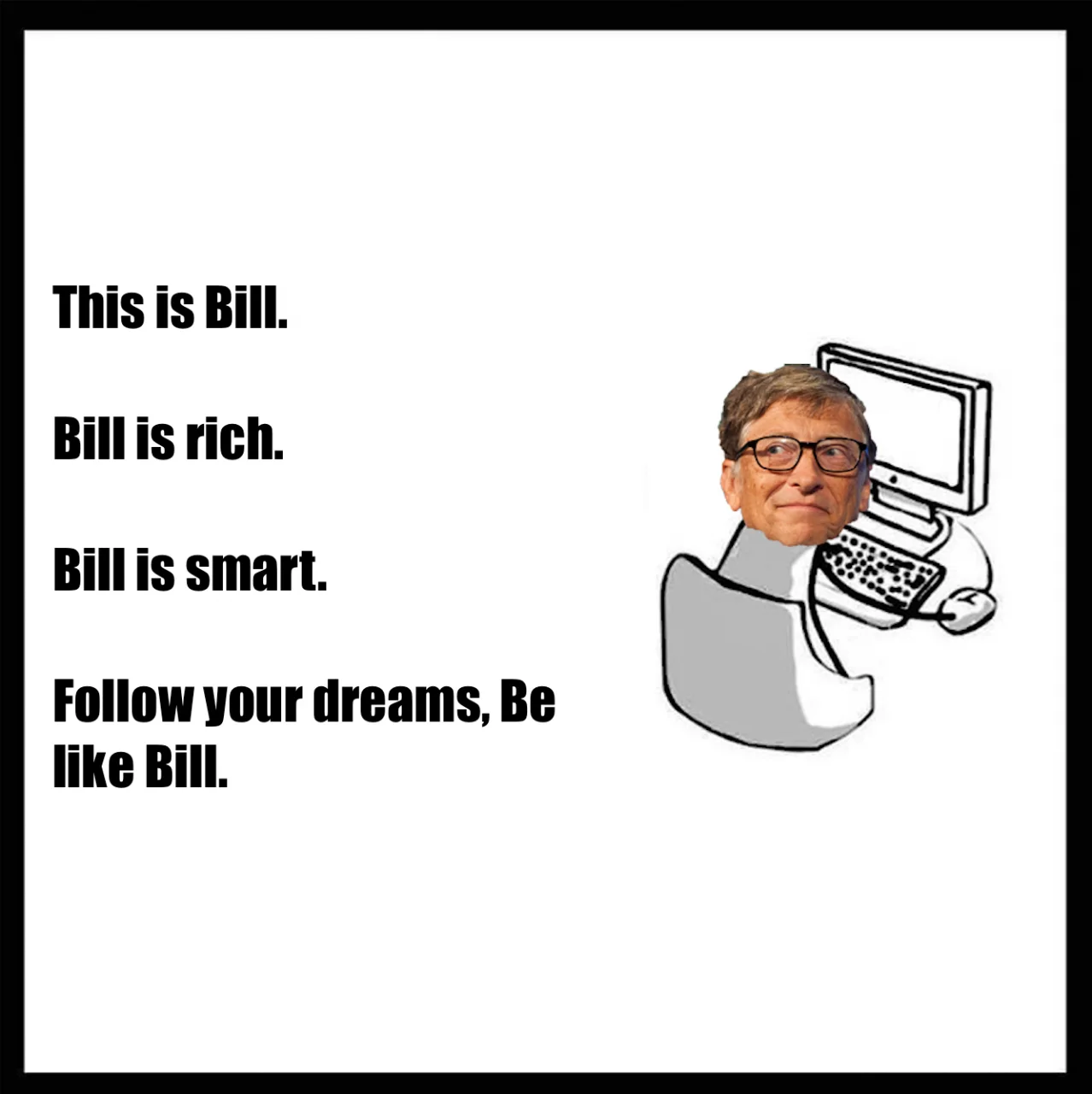
Be Like Bill is a stick figure meme that uses a character named "Bill" to passive-aggressively point out annoying social media habits and breaches of modern etiquette. The format first appeared on English-language forums in late 2015 and exploded on Facebook in January 2016, spawning international variants in Italian, Spanish, Arabic, Malaysian, and other languages. It became one of the first major memes of 2016 and drew both massive popularity and significant backlash for its preachy tone.

Overview

The meme follows a simple four-line structure. A stick figure wearing a knitted beanie hat is introduced as "Bill." The text describes a situation where Bill encounters something annoying online or in real life. Bill chooses not to engage or do the annoying thing. The meme concludes with "Bill is smart. Be like Bill."2

The format works as a passive-aggressive public service announcement, calling out behaviors like posting gym selfies, sharing spoilers, sending Candy Crush invites, or taking duck-faced photos10. The stick figure art style is deliberately crude and easy to replicate, which helped the meme spread rapidly and spawn countless user-generated variations12.

The earliest known version of the stick figure format dates back to March 2010 on Joyreactor, where a character named "Tim" was shown ignoring offensive content on the internet10. The drawing also appeared on Funnyjunk and Reddit in October 2015, initially framed as an ironic jab at online outrage culture4.

The meme's viral life really began on December 21, 2015, when an Italian Facebook page called "Sii come Bill" launched and quickly picked up over 226,000 likes in under three weeks4. On January 2, 2016, a Spanish-language version called "Sé como José" appeared and gained more than 405,000 followers within four days4. The anonymous Spanish page admin said he translated the meme from Italian after seeing its popularity there4.

The main English-language Facebook page, simply called "Be like Bill," posted its first meme on January 7, 20162. It was created by Eugeniu Croitoru, a 23-year-old Moldovan living in Milan who described himself as an "internet entrepreneur"10. Croitoru had previously run the gaming comedy site Videogamemes, and he enlisted his friend Debabrata Nath to help manage the page10.

Origin & Background

Platform
Joyreactor / Funnyjunk (early versions), Facebook (viral spread)
Key People
Eugeniu Croitoru, Debabrata Nath
Date
2015

The earliest known version of the stick figure format dates back to March 2010 on Joyreactor, where a character named "Tim" was shown ignoring offensive content on the internet10. The drawing also appeared on Funnyjunk and Reddit in October 2015, initially framed as an ironic jab at online outrage culture4.

The meme's viral life really began on December 21, 2015, when an Italian Facebook page called "Sii come Bill" launched and quickly picked up over 226,000 likes in under three weeks4. On January 2, 2016, a Spanish-language version called "Sé como José" appeared and gained more than 405,000 followers within four days4. The anonymous Spanish page admin said he translated the meme from Italian after seeing its popularity there4.

The main English-language Facebook page, simply called "Be like Bill," posted its first meme on January 7, 20162. It was created by Eugeniu Croitoru, a 23-year-old Moldovan living in Milan who described himself as an "internet entrepreneur"10. Croitoru had previously run the gaming comedy site Videogamemes, and he enlisted his friend Debabrata Nath to help manage the page10.

How It Spread

The English Facebook page hit 1.3 million likes within weeks of its January 7 launch6. Croitoru told the BBC that the concept was straightforward: "'Bill' can be anyone who is smart and has common sense and doesn't do annoying things"8. The page churned out memes targeting everything from vague-posting to chain emails to posting photos of lattes on Instagram10.

The meme's simple template made it easy to localize. In Arabic, Bill became "Bilal" or "Bashir." In Malaysia, he was "Rashid." In Russian, "Petya." In Dari and Pashto, "Qodos." In Tagalog, "Juan"5. A female variant named "Emily" also appeared, with her own Instagram account12. Most of these international versions popped up independently of Croitoru's page8.

Spanish-language press declared it one of the first "virales" of 20164. BuzzFeed, BBC, Mashable, The Independent, and New York Magazine all covered the meme in January 20161821012. The coverage was mixed. Mashable called it "the passive aggressive meme dividing Facebook"2. New York Magazine went harder, declaring it "the worst thing on Facebook" and arguing that Bill represented "social media's worst impulse: the claim to moral superiority wrapped in nagging, passive-aggressive complaint"12.

Platforms

RedditTwitterTikTokInstagramYouTube

Timeline

2014-01-01

Be Like Bill begins gaining traction

2015-01-01

Be Like Bill started spreading across social media platforms

2016-01-01

Be Like Bill reached mainstream popularity and media coverage

2017-01-01

Brands and companies started using Be Like Bill in marketing

2019-01-01

Be Like Bill entered the broader pop culture conversation

2025-01-01

Be Like Bill is still actively used and shared across platforms

View on Google Trends

How to Use This Meme

The Be Like Bill format follows a simple template:

1

Open with "This is [Name]." The character is typically shown as a basic stick figure with a knitted beanie hat.

2

Describe a situation where [Name] encounters something potentially annoying. This often involves social media, like someone posting spoilers, gym selfies, or chain messages.

3

Show [Name] making the "smart" choice, usually by not engaging with or perpetuating the annoying behavior.

4

Close with "[Name] is smart. Be like [Name]."

Create Your Own

Cultural Impact

The meme drew coverage from BBC, Mashable, BuzzFeed, The Independent, The Mirror, Mic, and New York Magazine, all within the first few weeks of January 2016821109612. This media blitz both fueled and documented the meme's rapid spread.

Boston city officials used the format in an official capacity to discourage parking space savers5. Bored Panda compiled collections of the best examples, and the meme generated significant comment section debates about whether passive-aggressive etiquette policing was helpful or obnoxious7.

The Independent's deep-dive article included academic analysis from Professor Janet Sayers, who studied the meme as an example of how social norms get enforced through humor online10. The conversation around Be Like Bill touched on broader questions about who gets to dictate online etiquette and whether memes can meaningfully change behavior.

Full History

The stick figure that would become Bill had a quiet first life on forums and image boards. The Joyreactor post from March 2010 featured a character named "Tim" browsing the internet, seeing something offensive, and choosing to move on with his life11. The joke was aimed squarely at people who got outraged online, and the crude art style was part of the punchline. Similar versions floated around Funnyjunk and Reddit throughout 2015, mostly in geek and gaming communities4.

Everything changed in late December 2015 when the Italian page Sii come Bill launched on Facebook. The Italian version struck a nerve, racking up hundreds of thousands of likes and inspiring translations almost immediately4. The Spanish "Sé como José" page followed on January 2, 2016, and its rapid growth caught the attention of Spanish-language media, who called it the year's first viral hit3.

When Croitoru launched the English page on January 7, 2016, he was already an experienced meme page operator. He ran Videogamemes and had a knack for spotting formats with viral potential. He tested Bill with a Star Wars spoiler joke on his existing audience, and the response was immediate enough to justify a dedicated page10. With Nath handling co-creation duties, the two men cranked out memes covering everything from vegans who won't stop talking about being vegan to people who reshare seven-year-old Facebook memories10.

The meme's appeal was rooted in something deeply relatable. A 2013 Bing poll had found that 40 percent of surveyed adults were sick of boring Facebook statuses, and 25 percent said their friends posted too many selfies10. Bill gave people a socially acceptable way to vent about these annoyances while signaling their own good behavior. As one typical post read: "Bill knows that if he doesn't click like, or say amen, people won't die, orphaned children won't get cancer and his luck won't be good or bad"10.

But the backlash was swift. Critics pointed out the hypocrisy of policing other people's posting habits by posting a meme about posting habits12. A rival page called "Don't be like Bill" emerged, flipping the format to mock Bill's smugness2. Some users turned the template political. One version featured Syrian President Bashar al-Assad with the caption "Don't be like this," while others pushed arguments about immigration, feminism, and security screenings810. Janet Sayers, a professor at New Zealand's Massey University who researched political discourse online, noted that "the claim that the Bill figure is not political is dissemblance" and called the meme "a replication, perhaps even a hyper-replication, of social life"10.

Croitoru responded to the criticism with the same good humor he built the page on. When someone commented "Bill is fucktard," the page replied in character: "Bill sees someone call him a fucktard over the internet, Bill laughs to himself thinking how miserable the guy must be, But Bill doesn't reply back offensively"6. He told reporters he wasn't bothered by the parodies or political uses: "I'm not annoyed. All I can say is that I made the idea popular with the intention of making something positive"8.

Boston city officials adopted the meme to discourage the use of space savers in parking spots, one of the format's few real-world institutional uses5. The meme also generated a generator tool that let users create custom Be Like Bill images with their own names and pet peeves9.

By mid-2016, the format had largely burned through its viral cycle. New York Magazine's take proved somewhat prophetic: Bill was "a bit of Internet ephemera" that served as "a sort of bellwether of social attitudes"12. The meme's trajectory from geek-forum in-joke to global viral sensation to backlash target played out in roughly eight weeks, a textbook case of the Facebook meme lifecycle in the mid-2010s.

Fun Facts

The earliest known ancestor of the format appeared on Joyreactor in March 2010, nearly six years before the meme went viral10.

The Spanish "Sé como José" page gained over 405,000 followers in just four days4.

Croitoru admitted he was nothing like Bill: "No, Bill is much better than me"8.

A 2013 Bing poll cited by The Independent found 40% of adults were tired of boring Facebook statuses, helping explain why the meme's message hit so hard10.

The meme's co-creator Nath acknowledged that some fans took Bill to "dictatorial extremes" they didn't agree with10.

Derivatives & Variations

Sii come Bill

— The Italian original that kicked off the international spread in December 2015[1].

Sé como José

— The Spanish version, which grew even faster than the English page[6].

Be Like Bilal / Bashir

— Arabic-language versions with localized humor[11].

Be Like Rashid

— Malaysian adaptation targeting local cultural behaviors[2].

Be Like Emily

— A female version of the meme with its own Instagram presence[16].

Don't Be Like Bill

— A counter-page mocking Bill's preachy tone[5].

Don't Be Like Bashar

— A Syrian political protest version targeting President Assad[16].

Kill Bill parody

— "This is Uma Thurman. She killed Bill. Be like Uma"[14].

Frequently Asked Questions