Becky

1992catchphraseclassic

Published August 16, 2026

Becky is a slang term for a stereotypical white woman, popularized by the 1992 Sir Mix-a-Lot song "Baby Got Back" and revived in 2016 when Beyoncé referenced "Becky with the good hair" on her album Lemonade. The name doubles as both a shorthand for basic white-girl culture and, in hip-hop slang, a euphemism for oral sex.

Overview

Becky is a slang label for a stereotypical white woman, usually pictured as suburban, valley-accented, and out of step with Black cultural references1. Depending on context it can be affectionate, dismissive, or borderline insulting, and in hip-hop lyrics from the late 2000s onward it doubles as a euphemism for oral sex2.

The name carries two overlapping meanings that keep it in circulation. As a character type, a "Becky" is the Starbucks-and-Uggs archetype mocked in countless jokes and Urban Dictionary entries3. As a lyrical shorthand, it shows up in tracks by artists like Plies and Beyoncé, where the name stands in for a specific white woman rather than a person actually called Becky2.

Origin & Background

Platform
Music (Sir Mix-a-Lot single) / Twitter (2016 viral spread)
Creator
Sir Mix-a-Lot
Date
1992

The name entered pop culture on May 7th, 1992, when Sir Mix-a-Lot released "Baby Got Back." The song opens with two white Valley girls critiquing a Black woman's body, and one delivers the line "Oh my god, Becky, look at her butt," which fixed the name to the stereotype1.

The first widely cited written definition came on September 4th, 2006, when Urban Dictionary user rich3000 posted an entry describing "beckys" as "hot white girls, or snobish women"3. Later Urban Dictionary submissions expanded the meaning to include the oral-sex slang and the basic-white-girl caricature3.

How It Spread

Rap kept the name alive through the late 2000s. On June 19th, 2009, Plies released a track literally titled "Becky," repeating "Gimmie that Becky" as a reference to oral sex from a white woman1. That November, a BoxDen Forums thread asked why Plies used the name, with commenters pointing back to the Sir Mix-a-Lot line as the source1. Around the same period, blogs like ClutchMagOnline and Made Woman published pieces unpacking why Black audiences used "Becky" as shorthand for a certain type of white woman1.

The term hit its biggest cultural moment in April 2016, when Beyoncé dropped Lemonade. The song "Sorry" contains the line "He better call Becky with the good hair," widely read as a jab at a woman Jay-Z had allegedly cheated with1. Fans immediately began guessing the identity of Becky, and on April 25th, 2016, rapper Iggy Azalea tweeted "don't ever call me a becky," pushing back on the label while clarifying she wasn't aiming at Beyoncé4.

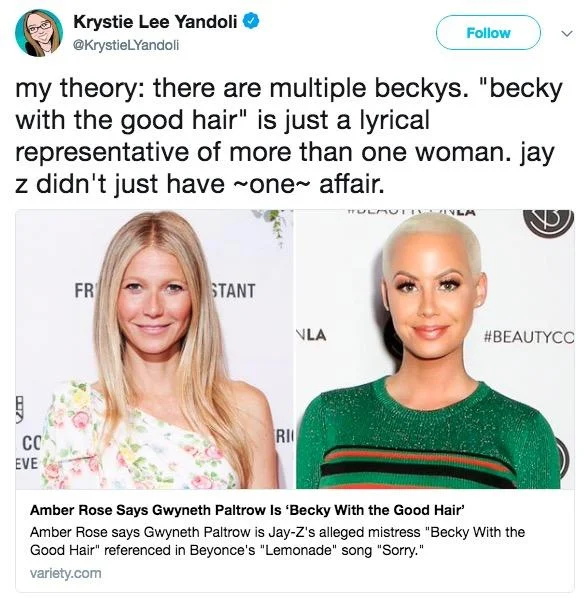
The guessing game kept going for years. On a podcast with Spencer Pratt and Heidi Montag, Amber Rose floated Gwyneth Paltrow as a candidate for "Becky with the good hair"5. Rose later said she was joking, and Paltrow told People magazine the claim was "100% false"6. The back-and-forth kept the phrase in tabloid headlines long after Lemonade's release.

How to Use This Meme

Becky is typically deployed as a noun aimed at a specific person ("look at this Becky") or as a general stand-in for a stereotypical suburban white woman in captions, tweets, and reaction posts. In music and lyric-quoting jokes, "Becky with the good hair" is often reused as a template for calling out a suspected romantic rival, with users swapping in their own descriptors.

Frequently Asked Questions