Emoticons
Published March 23, 2026
Also known as: Smileys · Text Faces · Emotikons
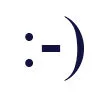
Emoticons are pictorial representations of facial expressions built from punctuation marks, letters, and keyboard characters. Pioneered on September 19, 1982, when computer scientist Scott Fahlman proposed:-) and:-( on a Carnegie Mellon University bulletin board, emoticons became the first widely adopted system for conveying tone and emotion in text-based digital communication. From Western sideways smileys to Japanese kaomoji, these typed-out faces shaped how billions of people express themselves online and laid the groundwork for modern emoji.
Overview
An emoticon is a glyph made from standard keyboard characters, arranged to look like a facial expression when read sideways (in the Western style) or straight-on (in the Eastern style)3. The word itself is a portmanteau of "emotion" and "icon"3. The most basic and famous example,:-), uses a colon for eyes, a hyphen for a nose, and a closing parenthesis for a smiling mouth. Read with your head tilted left, it looks like a happy face.
Western emoticons are read at a 90-degree angle. A colon typically represents the eyes, a semicolon indicates a wink, and the mouth character determines the mood: ) for happy, ( for sad, D for laughing, P for a tongue sticking out5. Eastern emoticons, known as kaomoji (顔文字, literally "face characters"), are read horizontally and tend to emphasize the eyes over the mouth, drawing on the larger character sets available in Japanese writing systems6. Examples like (^_^), T_T, and ಠ_ಠ became internet staples without requiring any head tilting4.
Emoticons were the original way to solve one of online communication's biggest problems: the total absence of body language and vocal tone. Without a raised eyebrow or sarcastic voice, a joke could easily read as a serious threat, and sarcasm could start flame wars13.
Gallery
Origin & Background
How It Spread
How to Use This Meme
Emoticons work by typing standard keyboard characters in sequence to form a face or expression. Western-style emoticons are typically read by tilting your head to the left.
Common Western emoticons: -:-) or:) — happy, joking -:-( or:( — sad, serious -;-) or;) — winking, flirtatious -:-D or:D — laughing, very happy -:-P or:P — tongue out, playful -:-O or:O — surprised - >:-( — angry -:'( — crying
Common Eastern emoticons (kaomoji): - (^_^) — happy - (T_T) — crying - (-_-) — unimpressed or sleeping - (ಠ_ಠ) — disapproval - ¯\_(ツ)_/¯ — shrug - (╯°□°)╯︵ ┻━┻ — table flip (frustration)
People typically drop them at the end of a message to signal tone. A simple "thanks:)" reads differently from "thanks" alone. The colon-parenthesis combo is the most common, and the nose (hyphen) is increasingly dropped in casual use. Most modern platforms auto-convert common emoticons into graphical emoji, though some communities still prefer the typed originals.
Cultural Impact
Full History
Fun Facts
Fahlman's original 1982 message was lost for nearly 20 years before being recovered from ancient backup tapes in a project he nicknamed the "Digital Coelacanth Project"13.
The transcript of an 1862 Abraham Lincoln speech appears to contain a;-) emoticon, though linguists believe it was likely a typesetting error6.
In 2021, the original digital smiley sold at an NFT auction for $237,50010.
Microsoft had to deny that the Wingdings rendering of "NYC" as a skull, Star of David, and thumbs up was an antisemitic message. The arrangement was coincidental9.
James Marshall's canonical smiley list, compiled starting in 1992, grew to 2,231 unique emoticons and was named a Links2Go Key Resource in 199912.
Derivatives & Variations
Emoji:
Pictographic character sets that evolved from emoticons, created by Japanese mobile companies in the 1990s and standardized by Unicode. Emoji replaced typed character sequences with colorful images and expanded beyond faces to include objects, food, animals, and flags[8].
Kaomoji (顔文字):
Japanese-style horizontal emoticons using wider character sets, including (^_^), (ಠ_ಠ), and elaborate multi-character compositions. These developed semi-independently from Western emoticons starting in the mid-1980s[4].
Wingdings:
Microsoft's 1990 dingbat font series that turned letters into symbols. While not designed as emoticons, AOL users adopted Wingdings to decorate their profiles and express themselves visually[9].
Graphical smileys:
Yellow-faced image replacements for typed emoticons, introduced by AOL's base set of 16 smileys and expanded by Yahoo! Messenger, MSN Messenger, Skype, and others through the 2000s[4].
Stickers:
Larger, more detailed illustrated images used in messaging apps like Line, Kakao Talk, and WeChat. Line's sticker system launched in 2011 and drew directly from emoticon culture[10].
ಠ_ಠ (Look of Disapproval):
A kaomoji using Kannada script characters that became a standalone meme on Reddit and other platforms, representing judgment or disbelief[4].
Frequently Asked Questions
References (31)
- 1
- 2
- 3
- 4Emoticons - Know Your Memeencyclopedia
- 5List of emoticonsencyclopedia
- 6Emoticons - Urban Dictionarydictionary
- 7Puck (magazine)encyclopedia
- 8Emoticonencyclopedia
- 9Scott Fahlmanencyclopedia
- 10Emojiencyclopedia
- 11Dingbatencyclopedia
- 12Urban Dictionary: emoticondictionary
- 13Puck (magazine) - Wikipediaencyclopedia
- 14Wingdings - Wikipediaencyclopedia
- 15
- 16Kaomoji: Japanese Emoticonsarticle
- 17emoticon – Lost in Blog.article
- 18Canonical Smiley Listarticle
- 19
- 20Smiley Lore :-)article
- 21kigou no imiarticle
- 22
- 23
- 24
- 25
- 26
- 27
- 28
- 29FAQ - Emoji & Pictographsarticle
- 30
- 31