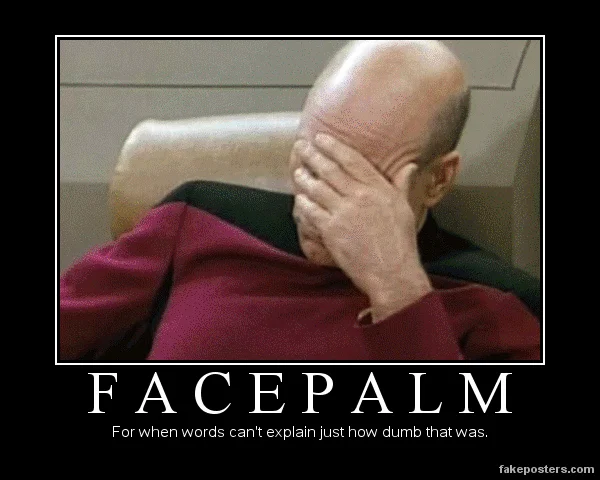
Facepalm
Published March 10, 2026 · Updated March 14, 2026
Also known as: Facepalming · Face Palm · Face-Palm
Facepalm is both a universal human gesture and one of the internet's most enduring reaction memes, depicting someone pressing their palm against their face to express frustration, embarrassment, or disbelief. The gesture dates back centuries in art and culture, but the term "facepalm" emerged online in the mid-1990s and exploded into meme status in the 2000s, largely thanks to a screenshot of Captain Jean-Luc Picard from *Star Trek: The Next Generation*. By 2011, "facepalm" had been added to the Oxford English Dictionary, and in 2016, Unicode gave it an official emoji (🤦), making it a permanent fixture of digital communication.
Overview
The facepalm is a gesture where someone places the palm of their hand against their face, covering their eyes or forehead4. It signals dismay, exasperation, embarrassment, or sheer disbelief at someone else's stupidity or one's own mistake3. Online, people share reaction images, GIFs, and videos of the gesture as shorthand for "I cannot believe this is happening"7.
The most iconic facepalm image comes from Patrick Stewart as Captain Picard in *Star Trek: The Next Generation*, but the meme extends far beyond a single image. Stock photos of stressed-out businesspeople, anime characters, and the 🤦 emoji all serve the same purpose8. The word itself functions as a noun ("that was a total facepalm"), a verb ("I facepalmed so hard"), and an interjection ("*facepalm*"), often written between asterisks in chat to indicate the physical gesture2.
Gallery
Origin & Background
How It Spread
How to Use This Meme
The facepalm works in nearly any context where someone does or says something baffling. Common approaches:
Reaction image: Post the Picard facepalm (or any facepalm photo) in response to a bad take, a fail video, or a cringe moment.
Text gesture: Type \*facepalm\* or (facepalm) between other text to indicate you're performing the gesture in response to what was just said.
Emoji: Drop a 🤦 in reply to a message. Often paired with text like "🤦 how is this real" or used solo as a complete response.
Image macro: Use the Picard Facepalm template on a meme generator. Top text typically sets up the situation; the image delivers the reaction.
Cultural Impact
Full History
Fun Facts
Mandrill monkeys at Colchester Zoo were observed using a facepalm-like gesture to signal they want to be left alone, making the facepalm one of the few meme gestures with a documented cross-species equivalent4.
The earliest written use of "facepalm" was in a roleplaying fiction post on Usenet in 1996, used as a verb to describe a character's reaction2.
"Facepalm" was added to the Oxford English Dictionary in August 2011, just 15 years after its first known written appearance4.
The word was recognized by Macmillan Dictionary even earlier, in 20068.
Henri Vidal's 1896 sculpture "Caïn" is often cited as the oldest famous depiction of the facepalm gesture, but a Roman relief on Trajan's Column (circa 113 A.D.) predates it by nearly 1,800 years8.
Derivatives & Variations
Picard Facepalm:
The most iconic version, using the Star Trek: The Next Generation screenshot. Generated over 23,000 captioned memes on Meme Generator alone.
Double Facepalm:
The gesture performed with both hands, used for situations that are twice as stupid as a regular facepalm[2].
🤦 Emoji:
The Unicode facepalm emoji added in 2016, available in gendered and gender-neutral versions across platforms[5].
Head Desk / Face Desk:
A more extreme variant where the forehead strikes a desk or wall repeatedly to emphasize frustration[2].
ASCII Art Facepalm:
Text-based recreations of a person doing the gesture using periods, parentheses, and other symbols, popular in forum comments[3].
SMH (Shaking My Head):
A related expression and emoji used in similar contexts to convey disapproval[2].
Frequently Asked Questions
References (14)
- 1
- 2
- 3
- 4Facepalm - Know Your Memeencyclopedia
- 5Facepalmencyclopedia
- 6Facepalm - Urban Dictionarydictionary
- 7Urban Dictionary: facepalmdictionary
- 8
- 9
- 10
- 11facepalmarticle
- 12
- 13
- 14