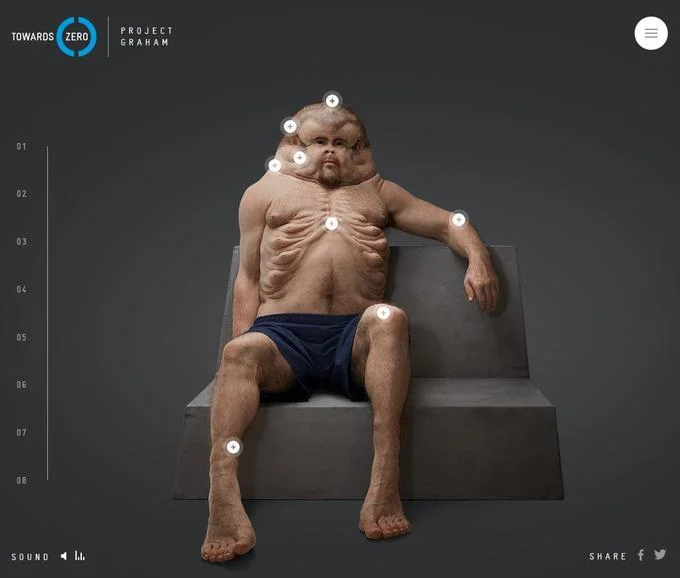
Graham
Published August 26, 2026
Graham is a lifelike sculpture of a mutated humanoid designed to survive a car crash, unveiled by Australia's Transport Accident Commission in July 2016. Sculptor Patricia Piccinini built him with a trauma surgeon and a crash engineer, giving him an inflated skull, no neck and airbag-style padding between the ribs. His disturbing look turned a Victorian road safety campaign into one of the most photoshopped viral oddities of the year.
Overview
The Graham memes almost entirely trade on the sculpture's unsettling appearance. Users paste his cratered head into normal photographs, pair straight-on portraits with punchy captions about horror movies and awkward family reunions, and lean on adoption gags like the "Welcome home son" reply that first blew up on Twitter6. Reaction posts swung between honest disgust at his flattened face and extra nipples and darker jokes about what evolution would actually build if humans had to survive head-on collisions3.
Tumblr artists ran with the reverse angle, redrawing Graham as an anime bishonen and a dreamy Disney prince, playing his ugliness as a punchline about how thirst posts really work6. The joke never had to reach far because Patricia Piccinini and the Transport Accident Commission genuinely wanted people to stare at him, so the meme mostly amplified the campaign's own premise into absurdity1. BuzzFeed captured the initial mood with a headline about people "freaking out" over the sculpture on the same afternoon it went live5.
Gallery
Origin & Background
How It Spread
How to Use This Meme
The typical Graham meme is either a straight photograph of the sculpture with a punchline caption or a photoshop that drops him into an unrelated scene, family portrait or dating-app screenshot6. Captions often lean on the "Welcome home son" adoption joke first popularized by @KeklePop, or play the reverse angle by writing him up as a heartthrob, boyfriend or celebrity crush6. Because the TAC published high-resolution 360-degree shots of the sculpture as part of the MeetGraham launch, creators had unusually clean source imagery to work from, which helped the earliest photoshops look polished1.
Fun Facts
Piccinini spent about six months building Graham out of fiberglass, silicone and real human hair3.
His rib cage contains airbag-style sacks between each rib so his heart survives a frontal impact, and his knees bend in every direction so a pedestrian version of him would not break a leg on being hit3.
Graham was designed as the public face of the TAC's Towards Zero initiative, a $1.1 billion plan aimed at cutting Victoria road deaths by 20% and serious injuries by 15% in five years1.
Live Science covered the piece straight as a look at what a crash-proof human might actually need to look like, alongside all the joke coverage7.
Urban Dictionary entries define "Graham" as a stereotypically handsome, popular guy, an ironic contrast with the actual sculpture's design8.
Frequently Asked Questions
References (8)
- 1
- 2
- 3
- 4
- 5
- 6
- 7
- 8