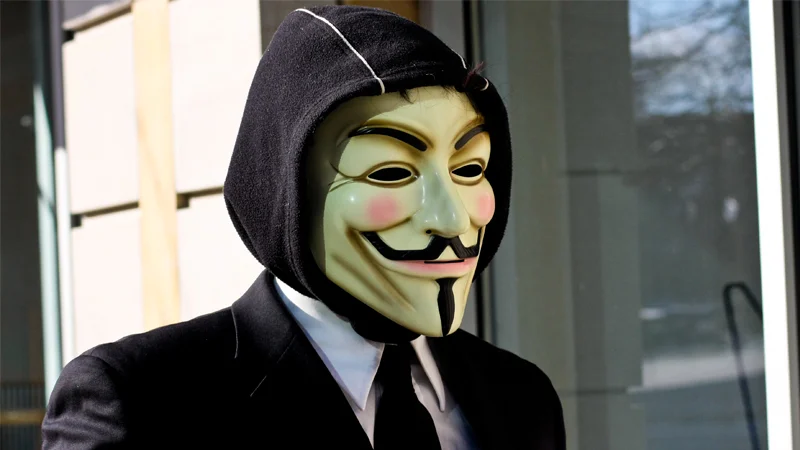
Guy Fawkes Mask

1982symbolclassic

The Guy Fawkes Mask is a stylized white face with a curled mustache and pointed beard that started as a 17th-century effigy prop and became the global face of digital dissent. Popularized by the 1982 comic V for Vendetta and its 2006 film adaptation, the mask was adopted by 4chan, Anonymous, and Occupy protesters, turning a failed British conspirator into the defining icon of online hacktivism.

Overview

The Guy Fawkes Mask is a smirking white face with rosy cheeks, a thin upturned mustache and a narrow pointed beard, based on the 17th-century English conspirator who tried to blow up the House of Lords3. Its modern look was drawn by artist David Lloyd for the 1982 comic V for Vendetta, where the anarchist protagonist wears it as a symbol of violent resistance against a fascist British state1.

After the 2006 Warner Bros. film adaptation directed by James McTeigue, the mask jumped off the page and into street protests, image boards and news broadcasts2. It works less as a joke format and more as a visual shorthand: whenever an anonymous figure appears on camera in the white grinning mask, the reference is instantly to leaderless dissent, hacker collectives and anti-establishment politics3.

Origin & Background

Platform
Print comic (V for Vendetta) / 4chan (viral spread)
Creator
David Lloyd and Alan Moore
Date
1982

The character of Guy Fawkes dates to November 5th, 1605, when a group of Catholic conspirators were caught attempting to detonate gunpowder beneath the British House of Lords and assassinate King James VI, an event later marked by Bonfire Night effigies3. The visual template used today, however, was invented in 1982 when V for Vendetta began serialization in the British anthology comic Warrior, written by Alan Moore and illustrated by David Lloyd3.

Lloyd explicitly pitched the mask as a rehabilitation of Fawkes, writing that a papier-mâché mask, cape and conical hat would let the character 'look really bizarre' and celebrate the attempt to blow up Parliament rather than burn its instigator in effigy each year3.

How It Spread

The mask reached a wide film audience on March 17th, 2006, when the Wachowskis' feature adaptation of V for Vendetta, co-written with David Lloyd, opened after a four-month delay and went on to gross over $130 million worldwide12. That mainstream visibility set the stage for its adoption online.

On September 30th, 2006, a 4chan comic thread introduced Epic Fail Guy pulling a Guy Fawkes mask out of a trash can, and the stick figure kept wearing it in subsequent posts, embedding the mask in image board culture3. In January 2008, users from 4chan and 711chan launched Project Chanology against the Church of Scientology, and on February 10th, 2008, more than 7,000 protesters gathered in over 100 cities, many wearing the mask to hide their identity, the first offline action of Anonymous3.

From there the mask became the standard prop of Anonymous videos, including a December 3rd, 2011 upload by YouTube user anonymous04210 titled 'Anonymous - Message to the American People,' which passed 12 million views6. A Spanish-language message posted on April 11th, 2012 by the official Anonymous YouTube channel used the same masked format7, and by then the mask was also visible at Occupy Wall Street encampments and other anti-government demonstrations worldwide3.

How to Use This Meme

The mask is typically worn, not remixed as an image macro. Common convention at protests and in videos is to keep the face fully covered so no individual identity is visible, reinforcing the leaderless, collective posture associated with Anonymous. In video statements, speakers often pair the mask with a distorted voice and a plain backdrop, a format popularized by early Anonymous uploads6.

Frequently Asked Questions