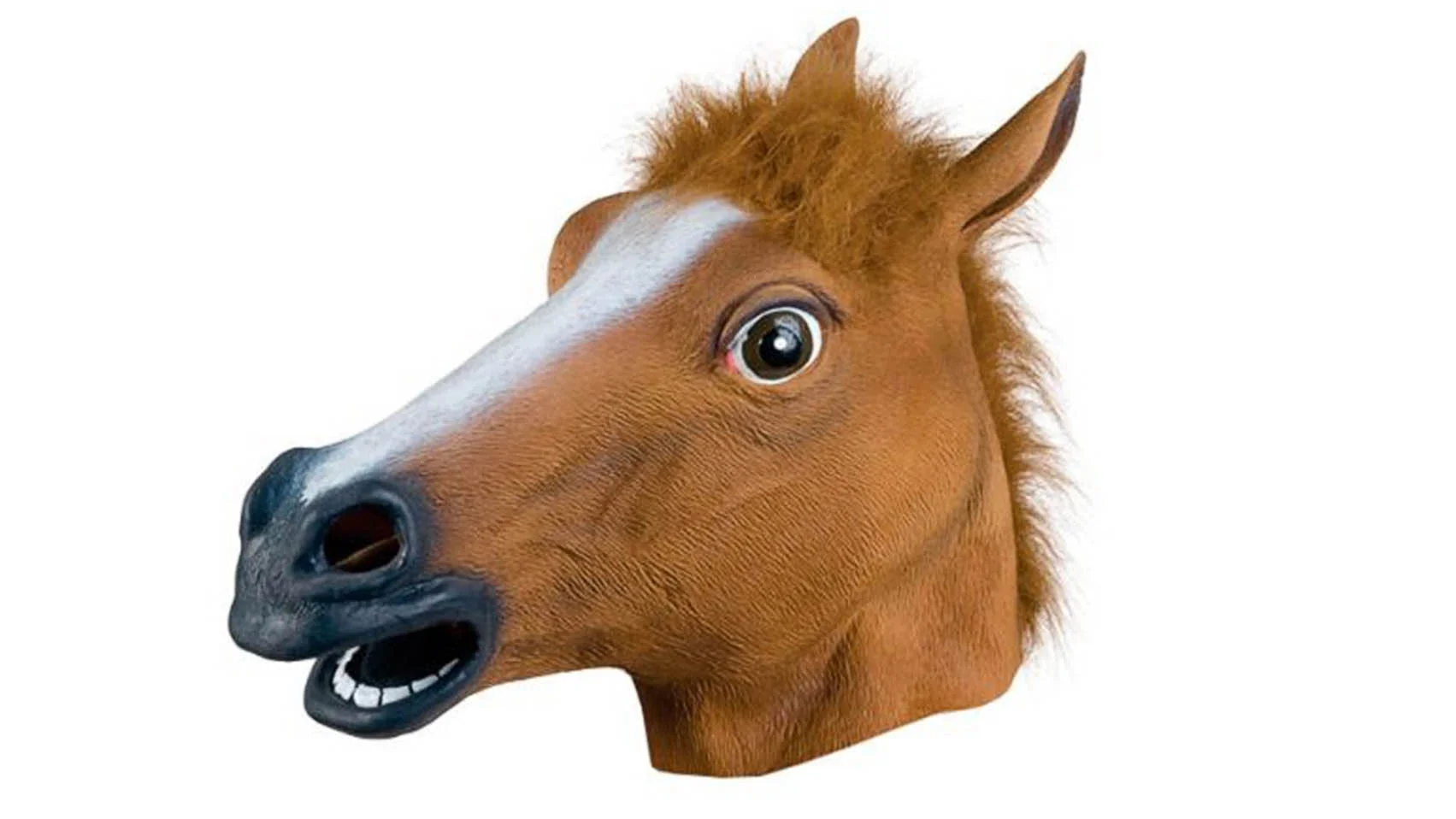
Horse Head Mask

2002prop / costume memeclassic

Published August 28, 2026

The Horse Head Mask is a brown and white latex novelty prop sold by Seattle company Archie McPhee since 2002 that became the go-to disguise for anonymous Japanese video uploaders. A 2008 dancing performer clip and a 2010 Google Street View sighting in Aberdeen pushed it worldwide, turning it into one of the defining prop memes of the late 2000s.

Overview

The mask covers the wearer's entire head with an unblinking, wide-eyed equine face, and the humor lands because that frozen expression sits on top of an ordinary human body doing ordinary human things. It shows up across stunt clips, street-prank photos, festival crowds and wedding shots, and the fact that it hides the wearer's identity completely made it a favorite for anyone who wanted screen time without showing their face1.

On the Japanese video site Nico Nico Douga, anonymous uploaders adopted the mask alongside the Scream Mask and the Darth Vader helmet, and it spread there through spontaneous mass adoption rather than one landmark clip, likely nudged along by performance artist Wotaken. YouTube creators outside Japan later built recurring bits around it, including TomSka's white-nightdress character 'Mrs Johnson', described in his sketches as a hyper-intelligent horse person banished from a parallel universe called Equestrion3.

Origin & Background

Platform
Nico Nico Douga / YouTube (viral spread)
Creator
Archie McPhee & Co.
Date
2002

The mask was manufactured by Seattle-based novelty dealer Archie McPhee & Co. and offered for sale online as early as February 1st, 2002. Its first documented use outside Halloween costuming appeared in The Lonely Planet Guide to Experimental Travel, published June 29th, 2005, in a group activity called 'Horse Head Adventure' where one traveler wore the mask while the rest of the group toured3.

Early web appearances included a Tom Green talk-show bit where the Canadian host thrashed on camera in the mask, and scattered anonymous uploads on Japanese video sites that gradually normalized the equine face as an identity-hiding costume for online performers4.

How It Spread

The mask's biggest English-language breakout came on January 9th, 2008, when YouTuber mrhorseshoe uploaded a mirror of a Wotaken clip titled 'Dancing Japanese Man Wearing a Horse Mask Cooks Wild Mushrooms', showing the performer flailing around a kitchen while preparing food2. The video collected write-ups on BuzzFeed and Urlesque, picked up its own Facebook fan group, and later landed on a PC World roundup of the most disturbing YouTube videos of all time3.

On June 24th, 2010, a Scotsman named Dobbin Horsome pulled the mask on the moment he spotted a Google Street View car turning down Hardgate in Aberdeen, and the camera caught him mid-transformation across several frames. BBC News picked up the sighting, and the story crossed one million hits within two days as readers across Europe wrote in with false identifications of 'Horse Boy'1. Horsome rode the attention with a personal blog, Twitter account and YouTube channel under the Horse Boy handle1.

Similar dance, prank and stunt clips involving the mask kept surfacing on YouTube through the years that followed, keeping the format in rotation long after its initial 2008 to 2010 peak4.

How to Use This Meme

People typically pair the full-head latex mask with completely normal clothing so the horse face is the only thing off, then film themselves doing an everyday activity such as cooking, walking a dog, dancing, or posing for photos. The frozen equine expression does the comedic work on its own, so the common convention is understatement rather than exaggerated acting.

Frequently Asked Questions