Home›Memes›Infinite Monkey Theorem

Contents

  • Overview
  • Gallery
  • Origin
  • How It Spread
  • How to Use
  • FAQ
  • References
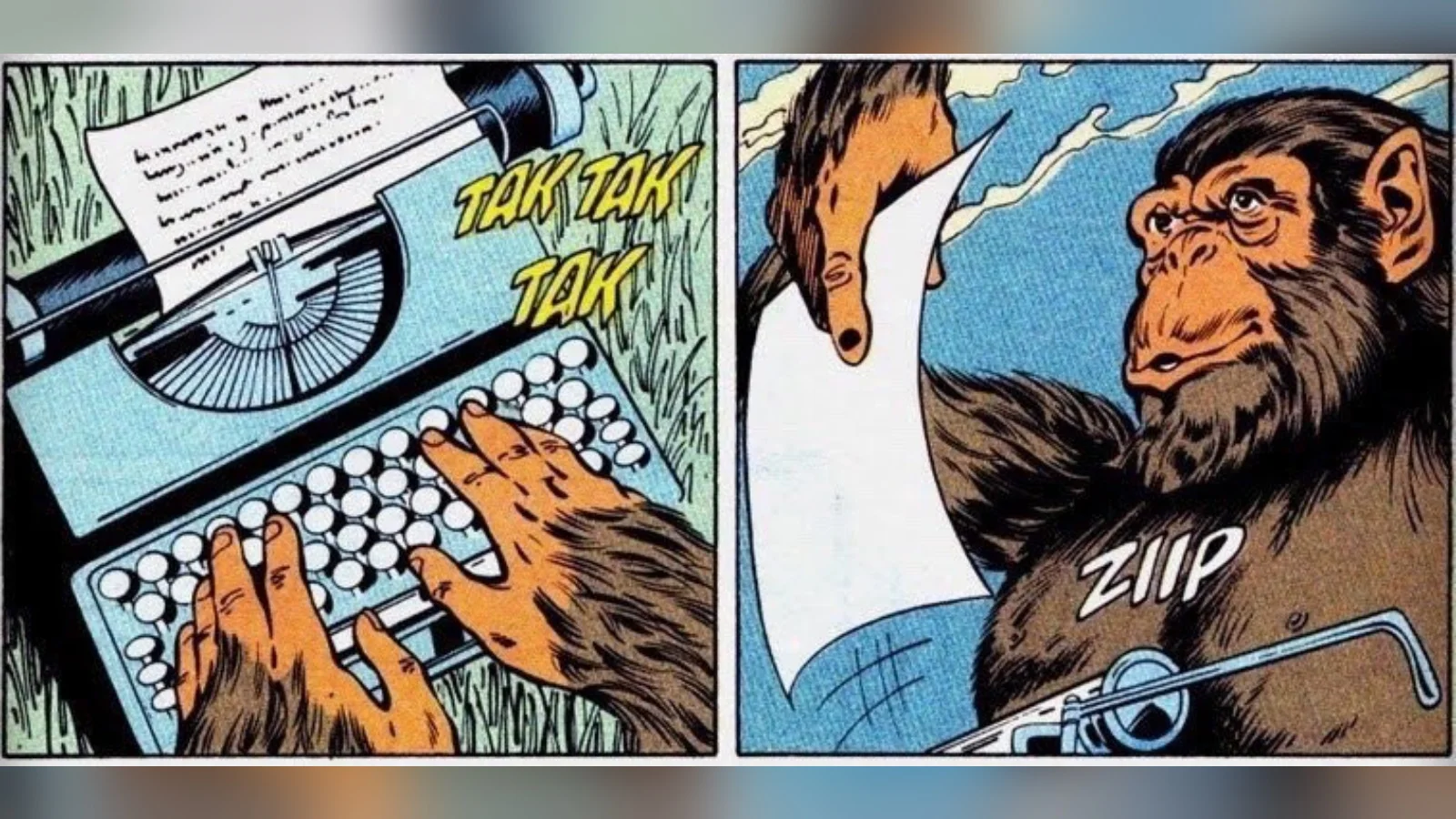
Infinite Monkey Theorem — Comic panels of a monkey typing on a typewriter and pulling out a finished page.

Infinite Monkey Theorem

2007reaction imageclassic

Published November 10, 2026

Infinite Monkey Theorem is a probability idea stating that monkeys hitting random typewriter keys for infinite time will eventually produce the works of Shakespeare. After its 20th-century math origin and nods in Hitchhiker's Guide and The Simpsons, webcomic jokes appeared online in 2007, and by 2019 two panels from a 1990 Animal Man comic were being used on image boards as a reaction to nonsensical posts.

thought experiment memes comic book panel memes reaction memes pre digital memes primate memes

Overview

Infinite Monkey Theorem jokes online tend to split into two shapes. One is the setup-punchline webcomic, where a monkey at a typewriter hands over not Hamlet but something mundane, like a Danielle Steel romance novel in the 2007 IRK Works strip3. The other, more recent format is a cropped reaction image made from two panels of Grant Morrison's July 1990 issue of Animal Man, which show a monkey slowly tapping out a page while a caption pokes fun at the odds against it1.

The reaction panels get posted under confusing threads or incoherent replies, serving the same job as the Jesse, What the Fuck Are You Talking About image: an implicit 'you are the random-key monkey'1. Twitter and Tumblr accounts also run the gag straight, with Ricky Gervais tweeting a one-liner about the math in 2013 and a didyouknowblog Tumblr post summarizing the theorem picking up thousands of reblogs in 20141. The humor leans on the gap between the clean math and the obvious uselessness of real monkeys.

Gallery

Origin & Background

Platform
Webcomics (IRK Works) / image boards (viral spread)
Date
2007

The theorem itself traces back to French mathematician Émile Borel's 1913 paper on statistical mechanics and his 1914 book Le Hasard, where random-typing animals illustrate probability over infinite trials2. Douglas Adams' 1978 radio play The Hitchhiker's Guide to the Galaxy and the 1993 Simpsons episode 'Last Exit to Springfield' later pushed the idea into general pop culture, and Grant Morrison worked it into Animal Man #25 in July 19901.

As a web joke, the earliest known documented example is a June 26, 2007 IRK Works strip archived on the Wayback Machine, in which the monkey finishes a book but it is a Danielle Steel novel instead of Shakespeare3. A second webcomic by Kudelka Cartoons went up in November 2010 with its own spin on the premise1. The Animal Man reaction crop came much later, archived on Know Your Meme by user Dioxin Jimmy on June 5, 20191.

How It Spread

Before the web format caught on, researchers tried the theorem in real life. In May 2003, the Guardian reported that six Sulawesi crested macaques at Paignton Zoo, working with Plymouth University's MediaLab on a £2,000 Arts Council project, produced five pages mostly filled with the letter S and nothing resembling an English word4. Lead researcher Geoff Cox called it less an experiment than a performance piece about the gap between animals and random processes4.

In August 2011, Reno programmer Jesse Anderson ran a virtual version on Amazon servers, and on September 23, 2011 he announced his simulated monkeys had reproduced A Lover's Complaint5. CNET's Daniel Terdiman pushed back days later, pointing out the program was matching nine-character blocks rather than generating the poem in sequence, which he argued was not the theorem as commonly understood6. The debate kept the idea circulating on tech blogs through the early 2010s6.

The meme layer grew on top of that coverage. Comedian Ricky Gervais tweeted a joke using the theorem on July 18, 2013, and a didyouknowblog Tumblr post on April 2, 2014 ran up thousands of reblogs; an r/gaming Redditor also used it in an October 2014 GamerGate post about Kotaku1. Starting mid-2019, the Animal Man two-panel crop took hold as a reaction image for nonsensical threads, with the Know Your Meme archive entry added that June1.

Timeline

1913

Émile Borel publishes the probability argument that becomes the Infinite Monkey Theorem[2].

1990-07

Grant Morrison's Animal Man #25 includes the typing-monkey page later cropped into a reaction image[1].

2003-05-09

The Guardian reports on the Paignton Zoo macaques typing mostly the letter S for Plymouth University's MediaLab[4].

2007-06-26

IRK Works posts the earliest known webcomic riff, in which the monkey produces a Danielle Steel novel[3].

2011-09-23

Jesse Anderson announces his virtual monkeys reproduced A Lover's Complaint on Amazon servers[5].

2011-09-28

CNET disputes Anderson's claim, saying the simulation matched nine-character blocks rather than the full poem[6].

2013-07-18

Ricky Gervais tweets a joke built on the theorem that picks up over 1,100 retweets[1].

2019-06-05

Know Your Meme user Dioxin Jimmy archives the Animal Man two-panel reaction image[1].

How to Use This Meme

Posters typically drop the two Animal Man panels as a silent reply to a baffling or word-salad post, implying the original poster is the typewriter monkey. For the straight joke version, people often quote the premise and swap Shakespeare for a modern book, a bad tweet or a company's PR copy.

Frequently Asked Questions

It is a probability theorem stating that monkeys typing randomly for infinite time will almost surely produce any given text, like Shakespeare's complete works, and online it is used as a joke template and a reaction image sourced from Animal Man #2521.

The math goes back to Émile Borel's 1913 paper and 1914 book Le Hasard2. The internet joke took off with an IRK Works webcomic on June 26, 2007 and a reaction crop from the 1990 comic Animal Man that caught on in mid-201931.

Mathematically it means that with infinite random trials, any finite text will eventually appear2. As a meme it means the opposite in practice, since real tests like the 2003 Paignton Zoo macaque run produced only pages of the letter S4.

People post the two Animal Man panels as a silent reply to baffling or incoherent posts, or they quote the premise and swap Shakespeare for whatever text they want to mock, like Ricky Gervais did in a July 2013 tweet1.

It is a classic that still turns up, with the Animal Man reaction image staying in circulation on image boards since 2019 and older webcomic riffs still getting reposted1.

References (6)

  1. 1
    https://www.theguardian.com/uk/2003/may/09/science.arts
  2. 2
    https://en.wikipedia.org/wiki/Infinite_monkey_theorem
  3. 3
    https://web.archive.org/web/20071011001149/http://www.irkworks.com/Comics/034_inifinite_monkey_theorem.htm
  4. 4
    https://www.jesse-anderson.com/2011/09/a-few-million-monkeys-randomly-recreate-shakespeare/
  5. 5
    https://www.cnet.com/culture/virtual-monkeys-recreate-shakespeare-methinks-not/
  6. 6
    https://knowyourmeme.com/memes/infinite-monkey-theorem-monkey-typing

Quick Info

Year
2007
Origin
Webcomics (IRK Works) / image boards (viral spread)
Type
reaction image
Status
classic

More like this

Black Cat Clapping
Black Cat Clapping
Coughing Cat
Coughing Cat
Guy Pointing At Himself
Comic Strips
Comic Strips
Nikola Tesla And Albert Einstein
I Forgor
I Forgor
Nice Guys
Nice Guys
Does TikTok Connect To The WiFi In My House?
Brat Summer
Brat Summer
Tai Lung Looking At Computer
Cocaine Is A Hell Of A Drug
Cocky Want Boing Boing

Tags

reaction imagewebcomicanimal manshakespeareprobabilitytypewriter

Related Memes

1M

100-men-vs-gorilla

100 men vs gorilla

TG

the-game

the game

TS

the-scream

the scream

1M

100-men-vs-1-gorilla

100 men vs 1 gorilla

EC

eren-crying-erens-confession

eren crying erens confession

CS

comic-strips

comic strips

Browse MemesTopicsCreatorsTrendingPlayAboutAdvertiseLegalPrivacy

© 2026 meme.com