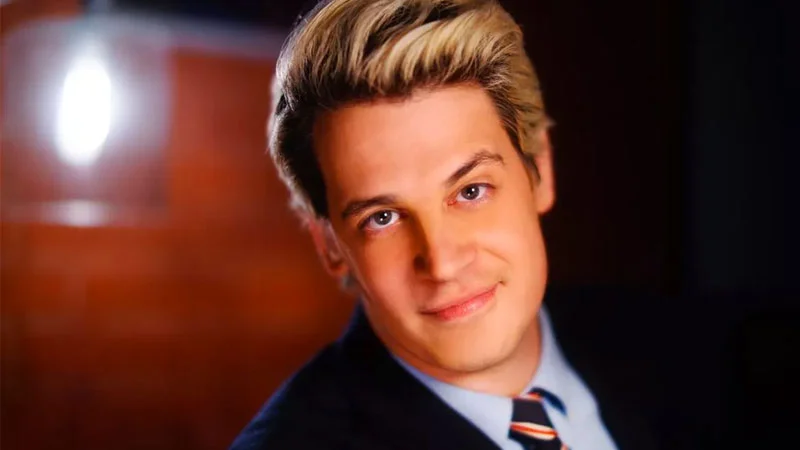
Milo Yiannopoulos

2014person / internet personalitydeclining

Published September 6, 2026

Milo Yiannopoulos is a British commentator and former Breitbart technology editor who became a lightning rod in mid-2010s internet culture wars after championing Gamergate in September 2014 with an article attacking developer Zoe Quinn4. His January 2016 Twitter verification removal and July 2016 permanent ban over the Leslie Jones pile-on turned his face into a mass profile-picture protest symbol behind the #JeSuisMilo and #FreeMilo hashtags3.

Overview

Yiannopoulos operated online as a self-described 'supervillain,' mixing British tabloid prose, staged provocations and a bleached-blonde look that made him instantly recognizable in screenshots and reaction shots1. The meme dimension of his fame is less a single image or catchphrase than a set of running visual and hashtag rituals, most obviously the January 2016 protest where thousands of Twitter users swapped in his headshot as their avatar to make any suspension impossible to enforce cleanly6. Branded 'Dangerous Faggot' college tour posters, the Breitbart 'you deserve to be harassed' screenshot, and photos from the burning UC Berkeley protest all became stock illustrations for the wider argument over deplatforming that shaped 2016 and 20173.

His online voice leaned hard into stunt journalism: leaking the membership of a private games-journalism mailing list, staging on-camera Sky News debates about fat acceptance and Tim Hunt, and picking fights with celebrities on Twitter until the platform pushed back5. That tabloid rhythm is what put him in meme territory rather than just op-ed territory. Every escalation produced its own screenshotable moment, from the verification-removed email he tweeted himself7 to a Twitter executive publicly guessing he was punished over a 'you deserve to be harassed' line1.

Origin & Background

Platform
Breitbart (source) / Twitter (viral spread)
Date
2014

Yiannopoulos launched his @Nero Twitter handle in May 2007 and co-founded the online tabloid The Kernel in November 2011 with David Rosenberg, David Haywood Smith, Stephen Pritchard and Adrian McShane; the magazine was later sold to The Daily Dot in 201410. His breakout as an internet figure came on September 1, 2014, when Breitbart published his article 'Lying, Greedy, Promiscuous Feminist Bullies Are Tearing the Video Game Industry Apart,' attacking developer Zoe Quinn and framing Gamergate as a rebellion against political policing of games coverage4.

He followed up that month with a series of pieces exposing GameJournoPros, a private Google Groups mailing list he described as roughly 150 gaming journalists coordinating story angles across outlets like Polygon, Ars Technica and Kotaku5. A week later Breitbart published the full membership list, extending the story to freelancers writing for the Associated Press, CNBC and USA Today6. Those articles built the audience that carried him through 2015 as a regular Sky News guest defending biochemist Tim Hunt and debating fat acceptance10. In October 2015 the University of Manchester Students' Union barred him from a free-speech debate over 'comments lambasting rape survivors and trans people,' adding to the deplatforming storyline he ran with for the next two years10.

How It Spread

The first mass Milo Yiannopoulos meme moment landed on January 8, 2016, when he tweeted a screenshot of a Twitter email stripping his blue check for unspecified 'recent violations of the Twitter Rules'7. Fans changed their display names and avatars to his headshot and pushed #JeSuisMilo, a riff on the Charlie Hebdo 'Je Suis Charlie' slogan, to the number one U.S. trend and number three globally within hours2. Twitter's Head of Commerce Nathan Hubbard publicly speculated the badge pull was over Yiannopoulos telling another user 'you deserve to be harassed,' a line Yiannopoulos said was a joke to a friend1.

The next escalation came on July 19, 2016, when Twitter permanently suspended his account a day after he helped whip up a racist and sexist tweet campaign against Ghostbusters actor Leslie Jones3. The company told BuzzFeed News the ban was for 'inciting or engaging in the targeted abuse or harassment of others' rather than the content of the tweets. Supporters answered with #FreeMilo, which trended nationwide and was picked up the next day by The New York Times and others3.

Momentum peaked and then collapsed in early 2017. Protesters set fires and tore down barricades to shut down a scheduled Berkeley talk in February10. On February 19, the @ReaganBattalion Twitter feed surfaced a Drunken Peasants podcast clip in which Yiannopoulos seemed to defend sexual relationships between adult men and teenage boys8. Within 48 hours, CPAC pulled his speaking slot, Simon & Schuster canceled the autobiography Dangerous that had briefly topped Amazon after its December 2016 announcement, and he resigned from Breitbart on February 2110. An October 2017 BuzzFeed News investigation later published leaked emails showing him consulting Andrew Auernheimer, Curtis Yarvin and American Renaissance's Devin Saucier while shaping a Breitbart 'guide to the alt-right,' along with footage of him singing 'America the Beautiful' as Richard Spencer and others made Nazi salutes in the audience10.

How to Use This Meme

The main participatory template around Milo Yiannopoulos was the January 2016 avatar swap: Twitter users changed their profile picture to his bleached-blonde headshot and their display name to some variant of 'Milo' so any suspension would be functionally useless without banning thousands of accounts6. The hashtag half of the pattern reappeared after the July 2016 permanent ban as #FreeMilo, again used both by sincere supporters and by trolls3. Beyond his own accounts, the visual grammar of that 'unverified' email screenshot is still recycled as a template whenever a right-leaning user gets a Twitter or X moderation notice7.

Frequently Asked Questions