Montauk Monster

2008Viral photo / cryptid hoaxclassic

Also known as: Montauk Beast · Montauk Creature

Montauk Monster is a July 2008 viral photograph of an unidentified, hairless carcass washed ashore in Montauk, New York, sparking conspiracy theories and cryptid folklore.

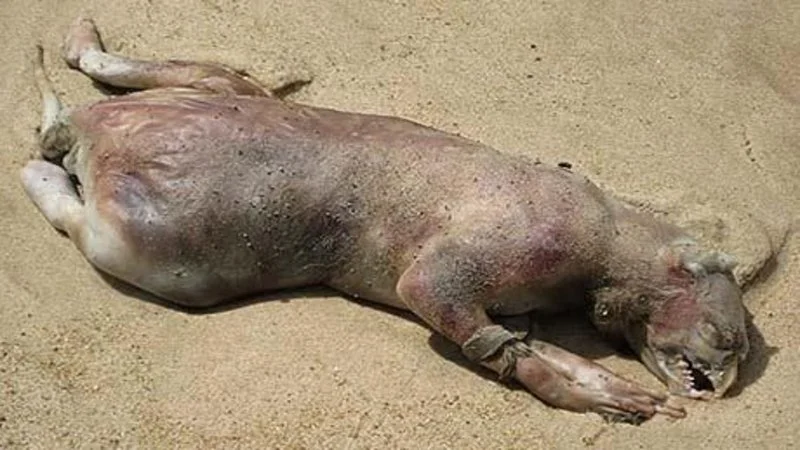
The Montauk Monster is a mysterious animal carcass that washed ashore at Ditch Plains beach in Montauk, New York, in July 2008. A single photograph of the bloated, hairless creature sparked a viral internet sensation, conspiracy theories about government experiments, and heated debate among experts and armchair zoologists alike. Most scientists who examined the photo concluded it was a decomposed raccoon, but the body was never formally recovered for study, leaving the mystery open enough to fuel years of online folklore.

TL;DR

The Montauk Monster is a mysterious animal carcass that washed ashore at Ditch Plains beach in Montauk, New York, in July 2008.

Overview

The Montauk Monster refers to a photograph of a strange animal carcass found on a Long Island beach during the summer of 2008. The creature appeared hairless and bloated, with leathery gray skin, clawed limbs, and a face that looked like it had a beak instead of a snout. Without fur or recognizable features, the corpse looked alien enough to convince casual observers it was something unknown to science1. The photo lacked any object for scale, which made it even harder to identify3.

What made the image so compelling was the sheer ambiguity. Experts couldn't agree. Was it a dog? A turtle without its shell? A raccoon? A latex fake? The lack of consensus, combined with the creature's proximity to a government animal testing facility, turned the photo into a perfect storm of internet speculation6.

On July 12, 2008, Montauk resident Jenna Hewitt, then 26, was walking Ditch Plains beach with friends Rachel Goldberg and Courtney Fruin when they spotted the carcass8. Hewitt borrowed a friend's digital camera and snapped several photos. "We didn't know what it was," Hewitt later told Newsday. "We joked that maybe it was something from Plum Island"1.

The first media coverage came on July 23, 2008, when the East Hampton Independent ran Hewitt's photo in black and white under the headline "The Hound of Bonacville," a pun on the local "Bonackers" nickname for East Hampton natives and Arthur Conan Doyle's *The Hound of the Baskervilles*1. The article was deliberately lighthearted, floating theories from Satan to mutant turtle before noting that Larry Penny, East Hampton's director of Natural Resources, believed it was simply a raccoon missing its upper jaw5.

Origin & Background

Platform
East Hampton Independent (first publication), Gawker (viral spread)
Key People
Jenna Hewitt, Loren Coleman
Date
2008

On July 12, 2008, Montauk resident Jenna Hewitt, then 26, was walking Ditch Plains beach with friends Rachel Goldberg and Courtney Fruin when they spotted the carcass. Hewitt borrowed a friend's digital camera and snapped several photos. "We didn't know what it was," Hewitt later told Newsday. "We joked that maybe it was something from Plum Island".

The first media coverage came on July 23, 2008, when the East Hampton Independent ran Hewitt's photo in black and white under the headline "The Hound of Bonacville," a pun on the local "Bonackers" nickname for East Hampton natives and Arthur Conan Doyle's *The Hound of the Baskervilles*. The article was deliberately lighthearted, floating theories from Satan to mutant turtle before noting that Larry Penny, East Hampton's director of Natural Resources, believed it was simply a raccoon missing its upper jaw.

How It Spread

The story might have stayed local if not for Gawker. On July 29, 2008, the site published "Dead Monster Washes Ashore in Montauk," a brief post with the photo and a tip claiming "a government animal testing facility very close by in Long Island". The image had reached Gawker through a chain: Alanna Navitski, an employee at Evolutionary Media Group in Los Angeles, sent it to Anna Holmes at Jezebel, who passed it to Gawker. Because the tip came from a marketing company, Gawker initially suspected viral marketing for the Cartoon Network show *Cryptids Are Real*.

That same day, cryptozoologist Loren Coleman posted about the creature on his Cryptomundo blog, writing "For now, it remains the 'Montauk Monster'" and giving the creature the name that would stick. The moniker spread globally within days.

Navitski denied any marketing angle. "I'm in marketing. We were like, 'Maybe we should send it to a few blogs and see if anyone else is as freaked out as we are,'" she told New York Magazine on July 30. Multiple eyewitnesses backed up the story. Michael Meehan, a waiter at the Surfside Inn above the beach, told the magazine: "It kind of looked like a dog, but it had this crazy-looking beak".

On August 1, 2008, BoingBoing published a second photograph showing the creature from a different angle. The same day, New York resident Nicky Papers launched montauk-monster.com as a dedicated resource for theories and news. By August 4, Darren Naish at Science Blogs published a detailed analysis titled "What was the Montauk Monster?" arguing convincingly that the creature was a raccoon (*Procyon lotor*), with its bizarre look caused entirely by decomposition and water exposure. Naish pointed to the elongate fingers typical of raccoons and overlaid a raccoon illustration on the carcass photo to show matching proportions.

The story hit cable news. Jeff Corwin appeared on Fox News and identified the carcass as a raccoon or dog. Fox News also floated the capybara theory on August 5, which made little sense since capybaras don't have tails. In December 2008, Animal Planet ranked the Montauk Monster at number four in their "Top 10 Animal Stories of 2008," driving a second spike in search interest.

How to Use This Meme

The Montauk Monster isn't a traditional meme template. It functions more as a reference point and reaction image. People typically use it in a few ways:

- Comparison jokes: Posting a photo of a weird-looking animal (often a wet or hairless pet) next to the Montauk Monster photo - Conspiracy humor: Referencing the Montauk Monster when joking about government cover-ups or mysterious discoveries - Cryptid discussions: Bringing it up in threads about unexplained creatures or beach finds - Nostalgia bait: "Remember the Montauk Monster?" posts that tap into late-2000s internet nostalgia

The photo itself sometimes appears in image macros or "cursed image" compilations. Fan artists on DeviantArt and similar platforms have created their own interpretations of what the creature might have looked like alive.

Cultural Impact

The Montauk Monster hit mainstream media hard for a summer 2008 story. CNN, Fox News, the Huffington Post, and New York Magazine all covered it. Newsday, the Long Island daily, ran multiple articles. Even niche publications got involved: the Jewish Journal published at least five articles, including one with the headline "Montauk Monster Anti-Semitic?". DISCOVER magazine issued an "official stance" that it was a raccoon, while Wired asserted it was "a pit bull, a dogfighting washout".

The story became a case study in early viral media. The Observer noted that Gawker Media properties generated twice as much traffic as the country's fourth-largest newspaper in July 2008, with Richard Lawson's Montauk Monster post pulling millions of views. Snopes covered it as a potential urban legend. The creature appeared on *Conspiracy Theory with Jesse Ventura*, *MonsterQuest*, and *Ancient Aliens*.

Montauk itself leaned into the legend. The town was already associated with conspiracy theories through the Montauk Project (alleged mind-control experiments at the decommissioned Camp Hero), which later inspired *Stranger Things*. The Monster added another layer to the area's reputation for the weird and unexplained.

Full History

The Montauk Monster's viral arc is a textbook example of how the early blog-era internet could turn a dead raccoon into a cultural event. The timing was perfect: summer 2008, when Gawker Media was near the peak of its influence and social media was just beginning to accelerate the news cycle.

What made the story stick was the disappearing body. Hewitt claimed "a guy took it and put it in the woods in his backyard" but refused to identify who or where. Her father denied she was keeping the body's location secret. A local newspaper quoted an anonymous woman who said the animal was only cat-sized and had already decomposed to a skeleton by the time press coverage hit. The East Hampton branch of animal control wouldn't comment. This trail of dead ends fed conspiracy thinking.

The Plum Island connection was irresistible. The Plum Island Animal Disease Center, a federal research facility in Gardiners Bay, studies foreign animal diseases in livestock and has long attracted conspiracy theories about secret experiments and bioweapons. Hewitt herself had jokingly referenced it. Conspiracy theorists ran with the idea that the creature was an escaped experiment or a cross-species hybrid. The facility's proximity to Montauk, combined with its genuinely tight security, made the theory feel plausible even to skeptics.

Cryptozoologist Loren Coleman traveled to New York to investigate but found the locals uncooperative. "These people put up a brick wall around themselves," he noted. The three women who discovered the carcass stopped giving interviews. Without a body to examine, Coleman and other investigators were stuck working from photographs alone.

The expert debate played out publicly. William Wise, director of Stony Brook University's Living Marine Resources Institute, inspected the photo with a colleague and initially called it a fake, "a talented someone who got very creative with latex." His next-best guess was a diseased dog or coyote. He systematically ruled out raccoon (legs too long), sea turtle (no teeth), rodent (wrong incisors), and sheep (sharp teeth don't match). But other experts disagreed. Local resident Noel Arikian told reporters: "It's undoubtedly a raccoon, the same teeth, paws, the right size". Larry Penny agreed, adding that old raccoons wander into marshes to die and high tide could float one out to sea.

Naish's Science Blogs analysis was the most thorough public examination. He explained that fur loss is one of the first things to happen to a body rolling in water, and that the "beak" was simply exposed premaxillary bone where facial tissue had decomposed. The elongate, almost human-like fingers with short claws were the giveaway: raccoons are uniquely dexterous among North American carnivorans, with fingers that lack the interdigital webbing found in dogs and other predators.

One intriguing theory emerged later. Reporter Nick Leighton, who had interviewed the three women before they went silent, heard rumors of a dead raccoon found on nearby Shelter Island in late June 2008 that had been given a "Viking funeral," burned and set afloat. An unidentified local told reporter Drew Grant: "This creature was honored with a Viking funeral, not merely explored for crass entertainment. In the interest of full disclosure, this did happen shortly after a waterboarding endurance competition, and just before a clothespins-on-your-genitals challenge". A charred, waterlogged raccoon carcass drifting to Ditch Plains would explain both the unusual appearance and the difficulty of identification.

The Montauk Monster spawned copycat sightings. In September 2009, a similar creature turned up in Panama. Teenagers claimed they found it crawling from a cave and beat it to death. An autopsy revealed it was a hairless sloth in the bloated stage of decomposition. Additional carcasses appeared on American and Canadian shores over the following years. Indigenous groups called them *omajinaakoos*, or "the Ugly One," and considered them omens of bad luck.

The History Channel's *MonsterQuest* examined what were said to be the Montauk Monster's remains and proposed it was a boxer dog based on skull shape. Jesse Ventura covered it on *Conspiracy Theory*. The creature was also featured on *Ancient Aliens* in August 2011. Fan art flourished on DeviantArt, where artists reimagined the creature as everything from a cartoon mascot to a horror monster.

By the 2020s, the Montauk Monster had settled into internet folklore. An Observer piece from 2024 found that people still tweet about the creature every few days, comparing chunky pets to the bloated beast or citing it as evidence of secret bioweapons labs. Baker and writer Susie Heller tweeted: "Not a day goes by wherein I don't think about the Montauk Monster". As the Observer noted, "on the internet, legends spread fast and never die".

Fun Facts

Loren Coleman, who coined "Montauk Monster," is the founder and director of the International Cryptozoology Museum in Portland, Maine.

William Wise of Stony Brook University's top guess was that the creature was a latex fabrication. His second guess was a diseased coyote.

Fox News suggested the creature might be a capybara on August 5, 2008, apparently unaware that capybaras don't have tails.

The photograph never included a scale reference, so no one could determine the creature's actual size from the image alone. Coleman specifically complained: "Why can't people put some sort of size reference object in these mystery photos?"

Indigenous groups in North America have a name for similar bloated carcasses that wash ashore: *omajinaakoos*, meaning "the Ugly One".

Derivatives & Variations

Panama Creature (2009):

A similar hairless carcass found in Panama by teenagers who claimed it crawled from a cave. An autopsy revealed it was a decomposed sloth[6].

East River Monsters (2012):

Bloated carcasses found near the Brooklyn Bridge and other New York waterways, drawing Montauk Monster comparisons. The NYC Parks Department reportedly told Animal New York one was "a pig left over from a cookout"[7].

Montauk Globster (2020):

Another unidentified carcass that washed up near Montauk, reviving the legend[7].

DeviantArt fan art:

A substantial body of illustrations reimagining the creature, searchable under "montauk monster" on the platform[5].

Raccoon overlay meme:

Science Blogs artist Grant Niesner created an edited photo with a raccoon drawing superimposed over the Montauk Monster carcass, which circulated as both debunking evidence and a meme in itself[5].

Frequently Asked Questions

MontaukMonster

2008Viral photo / cryptid hoaxclassic

Also known as: Montauk Beast · Montauk Creature

Montauk Monster is a July 2008 viral photograph of an unidentified, hairless carcass washed ashore in Montauk, New York, sparking conspiracy theories and cryptid folklore.

The Montauk Monster is a mysterious animal carcass that washed ashore at Ditch Plains beach in Montauk, New York, in July 2008. A single photograph of the bloated, hairless creature sparked a viral internet sensation, conspiracy theories about government experiments, and heated debate among experts and armchair zoologists alike. Most scientists who examined the photo concluded it was a decomposed raccoon, but the body was never formally recovered for study, leaving the mystery open enough to fuel years of online folklore.

TL;DR

The Montauk Monster is a mysterious animal carcass that washed ashore at Ditch Plains beach in Montauk, New York, in July 2008.

Overview

The Montauk Monster refers to a photograph of a strange animal carcass found on a Long Island beach during the summer of 2008. The creature appeared hairless and bloated, with leathery gray skin, clawed limbs, and a face that looked like it had a beak instead of a snout. Without fur or recognizable features, the corpse looked alien enough to convince casual observers it was something unknown to science. The photo lacked any object for scale, which made it even harder to identify.

What made the image so compelling was the sheer ambiguity. Experts couldn't agree. Was it a dog? A turtle without its shell? A raccoon? A latex fake? The lack of consensus, combined with the creature's proximity to a government animal testing facility, turned the photo into a perfect storm of internet speculation.

On July 12, 2008, Montauk resident Jenna Hewitt, then 26, was walking Ditch Plains beach with friends Rachel Goldberg and Courtney Fruin when they spotted the carcass. Hewitt borrowed a friend's digital camera and snapped several photos. "We didn't know what it was," Hewitt later told Newsday. "We joked that maybe it was something from Plum Island".

The first media coverage came on July 23, 2008, when the East Hampton Independent ran Hewitt's photo in black and white under the headline "The Hound of Bonacville," a pun on the local "Bonackers" nickname for East Hampton natives and Arthur Conan Doyle's *The Hound of the Baskervilles*. The article was deliberately lighthearted, floating theories from Satan to mutant turtle before noting that Larry Penny, East Hampton's director of Natural Resources, believed it was simply a raccoon missing its upper jaw.

Origin & Background

Platform
East Hampton Independent (first publication), Gawker (viral spread)
Key People
Jenna Hewitt, Loren Coleman
Date
2008

On July 12, 2008, Montauk resident Jenna Hewitt, then 26, was walking Ditch Plains beach with friends Rachel Goldberg and Courtney Fruin when they spotted the carcass. Hewitt borrowed a friend's digital camera and snapped several photos. "We didn't know what it was," Hewitt later told Newsday. "We joked that maybe it was something from Plum Island".

The first media coverage came on July 23, 2008, when the East Hampton Independent ran Hewitt's photo in black and white under the headline "The Hound of Bonacville," a pun on the local "Bonackers" nickname for East Hampton natives and Arthur Conan Doyle's *The Hound of the Baskervilles*. The article was deliberately lighthearted, floating theories from Satan to mutant turtle before noting that Larry Penny, East Hampton's director of Natural Resources, believed it was simply a raccoon missing its upper jaw.

How It Spread

The story might have stayed local if not for Gawker. On July 29, 2008, the site published "Dead Monster Washes Ashore in Montauk," a brief post with the photo and a tip claiming "a government animal testing facility very close by in Long Island". The image had reached Gawker through a chain: Alanna Navitski, an employee at Evolutionary Media Group in Los Angeles, sent it to Anna Holmes at Jezebel, who passed it to Gawker. Because the tip came from a marketing company, Gawker initially suspected viral marketing for the Cartoon Network show *Cryptids Are Real*.

That same day, cryptozoologist Loren Coleman posted about the creature on his Cryptomundo blog, writing "For now, it remains the 'Montauk Monster'" and giving the creature the name that would stick. The moniker spread globally within days.

Navitski denied any marketing angle. "I'm in marketing. We were like, 'Maybe we should send it to a few blogs and see if anyone else is as freaked out as we are,'" she told New York Magazine on July 30. Multiple eyewitnesses backed up the story. Michael Meehan, a waiter at the Surfside Inn above the beach, told the magazine: "It kind of looked like a dog, but it had this crazy-looking beak".

On August 1, 2008, BoingBoing published a second photograph showing the creature from a different angle. The same day, New York resident Nicky Papers launched montauk-monster.com as a dedicated resource for theories and news. By August 4, Darren Naish at Science Blogs published a detailed analysis titled "What was the Montauk Monster?" arguing convincingly that the creature was a raccoon (*Procyon lotor*), with its bizarre look caused entirely by decomposition and water exposure. Naish pointed to the elongate fingers typical of raccoons and overlaid a raccoon illustration on the carcass photo to show matching proportions.

The story hit cable news. Jeff Corwin appeared on Fox News and identified the carcass as a raccoon or dog. Fox News also floated the capybara theory on August 5, which made little sense since capybaras don't have tails. In December 2008, Animal Planet ranked the Montauk Monster at number four in their "Top 10 Animal Stories of 2008," driving a second spike in search interest.

How to Use This Meme

The Montauk Monster isn't a traditional meme template. It functions more as a reference point and reaction image. People typically use it in a few ways:

- Comparison jokes: Posting a photo of a weird-looking animal (often a wet or hairless pet) next to the Montauk Monster photo - Conspiracy humor: Referencing the Montauk Monster when joking about government cover-ups or mysterious discoveries - Cryptid discussions: Bringing it up in threads about unexplained creatures or beach finds - Nostalgia bait: "Remember the Montauk Monster?" posts that tap into late-2000s internet nostalgia

The photo itself sometimes appears in image macros or "cursed image" compilations. Fan artists on DeviantArt and similar platforms have created their own interpretations of what the creature might have looked like alive.

Cultural Impact

The Montauk Monster hit mainstream media hard for a summer 2008 story. CNN, Fox News, the Huffington Post, and New York Magazine all covered it. Newsday, the Long Island daily, ran multiple articles. Even niche publications got involved: the Jewish Journal published at least five articles, including one with the headline "Montauk Monster Anti-Semitic?". DISCOVER magazine issued an "official stance" that it was a raccoon, while Wired asserted it was "a pit bull, a dogfighting washout".

The story became a case study in early viral media. The Observer noted that Gawker Media properties generated twice as much traffic as the country's fourth-largest newspaper in July 2008, with Richard Lawson's Montauk Monster post pulling millions of views. Snopes covered it as a potential urban legend. The creature appeared on *Conspiracy Theory with Jesse Ventura*, *MonsterQuest*, and *Ancient Aliens*.

Montauk itself leaned into the legend. The town was already associated with conspiracy theories through the Montauk Project (alleged mind-control experiments at the decommissioned Camp Hero), which later inspired *Stranger Things*. The Monster added another layer to the area's reputation for the weird and unexplained.

Full History

The Montauk Monster's viral arc is a textbook example of how the early blog-era internet could turn a dead raccoon into a cultural event. The timing was perfect: summer 2008, when Gawker Media was near the peak of its influence and social media was just beginning to accelerate the news cycle.

What made the story stick was the disappearing body. Hewitt claimed "a guy took it and put it in the woods in his backyard" but refused to identify who or where. Her father denied she was keeping the body's location secret. A local newspaper quoted an anonymous woman who said the animal was only cat-sized and had already decomposed to a skeleton by the time press coverage hit. The East Hampton branch of animal control wouldn't comment. This trail of dead ends fed conspiracy thinking.

The Plum Island connection was irresistible. The Plum Island Animal Disease Center, a federal research facility in Gardiners Bay, studies foreign animal diseases in livestock and has long attracted conspiracy theories about secret experiments and bioweapons. Hewitt herself had jokingly referenced it. Conspiracy theorists ran with the idea that the creature was an escaped experiment or a cross-species hybrid. The facility's proximity to Montauk, combined with its genuinely tight security, made the theory feel plausible even to skeptics.

Cryptozoologist Loren Coleman traveled to New York to investigate but found the locals uncooperative. "These people put up a brick wall around themselves," he noted. The three women who discovered the carcass stopped giving interviews. Without a body to examine, Coleman and other investigators were stuck working from photographs alone.

The expert debate played out publicly. William Wise, director of Stony Brook University's Living Marine Resources Institute, inspected the photo with a colleague and initially called it a fake, "a talented someone who got very creative with latex." His next-best guess was a diseased dog or coyote. He systematically ruled out raccoon (legs too long), sea turtle (no teeth), rodent (wrong incisors), and sheep (sharp teeth don't match). But other experts disagreed. Local resident Noel Arikian told reporters: "It's undoubtedly a raccoon, the same teeth, paws, the right size". Larry Penny agreed, adding that old raccoons wander into marshes to die and high tide could float one out to sea.

Naish's Science Blogs analysis was the most thorough public examination. He explained that fur loss is one of the first things to happen to a body rolling in water, and that the "beak" was simply exposed premaxillary bone where facial tissue had decomposed. The elongate, almost human-like fingers with short claws were the giveaway: raccoons are uniquely dexterous among North American carnivorans, with fingers that lack the interdigital webbing found in dogs and other predators.

One intriguing theory emerged later. Reporter Nick Leighton, who had interviewed the three women before they went silent, heard rumors of a dead raccoon found on nearby Shelter Island in late June 2008 that had been given a "Viking funeral," burned and set afloat. An unidentified local told reporter Drew Grant: "This creature was honored with a Viking funeral, not merely explored for crass entertainment. In the interest of full disclosure, this did happen shortly after a waterboarding endurance competition, and just before a clothespins-on-your-genitals challenge". A charred, waterlogged raccoon carcass drifting to Ditch Plains would explain both the unusual appearance and the difficulty of identification.

The Montauk Monster spawned copycat sightings. In September 2009, a similar creature turned up in Panama. Teenagers claimed they found it crawling from a cave and beat it to death. An autopsy revealed it was a hairless sloth in the bloated stage of decomposition. Additional carcasses appeared on American and Canadian shores over the following years. Indigenous groups called them *omajinaakoos*, or "the Ugly One," and considered them omens of bad luck.

The History Channel's *MonsterQuest* examined what were said to be the Montauk Monster's remains and proposed it was a boxer dog based on skull shape. Jesse Ventura covered it on *Conspiracy Theory*. The creature was also featured on *Ancient Aliens* in August 2011. Fan art flourished on DeviantArt, where artists reimagined the creature as everything from a cartoon mascot to a horror monster.

By the 2020s, the Montauk Monster had settled into internet folklore. An Observer piece from 2024 found that people still tweet about the creature every few days, comparing chunky pets to the bloated beast or citing it as evidence of secret bioweapons labs. Baker and writer Susie Heller tweeted: "Not a day goes by wherein I don't think about the Montauk Monster". As the Observer noted, "on the internet, legends spread fast and never die".

Fun Facts

Loren Coleman, who coined "Montauk Monster," is the founder and director of the International Cryptozoology Museum in Portland, Maine.

William Wise of Stony Brook University's top guess was that the creature was a latex fabrication. His second guess was a diseased coyote.

Fox News suggested the creature might be a capybara on August 5, 2008, apparently unaware that capybaras don't have tails.

The photograph never included a scale reference, so no one could determine the creature's actual size from the image alone. Coleman specifically complained: "Why can't people put some sort of size reference object in these mystery photos?"

Indigenous groups in North America have a name for similar bloated carcasses that wash ashore: *omajinaakoos*, meaning "the Ugly One".

Derivatives & Variations

Panama Creature (2009):

A similar hairless carcass found in Panama by teenagers who claimed it crawled from a cave. An autopsy revealed it was a decomposed sloth[6].

East River Monsters (2012):

Bloated carcasses found near the Brooklyn Bridge and other New York waterways, drawing Montauk Monster comparisons. The NYC Parks Department reportedly told Animal New York one was "a pig left over from a cookout"[7].

Montauk Globster (2020):

Another unidentified carcass that washed up near Montauk, reviving the legend[7].

DeviantArt fan art:

A substantial body of illustrations reimagining the creature, searchable under "montauk monster" on the platform[5].

Raccoon overlay meme:

Science Blogs artist Grant Niesner created an edited photo with a raccoon drawing superimposed over the Montauk Monster carcass, which circulated as both debunking evidence and a meme in itself[5].

Frequently Asked Questions