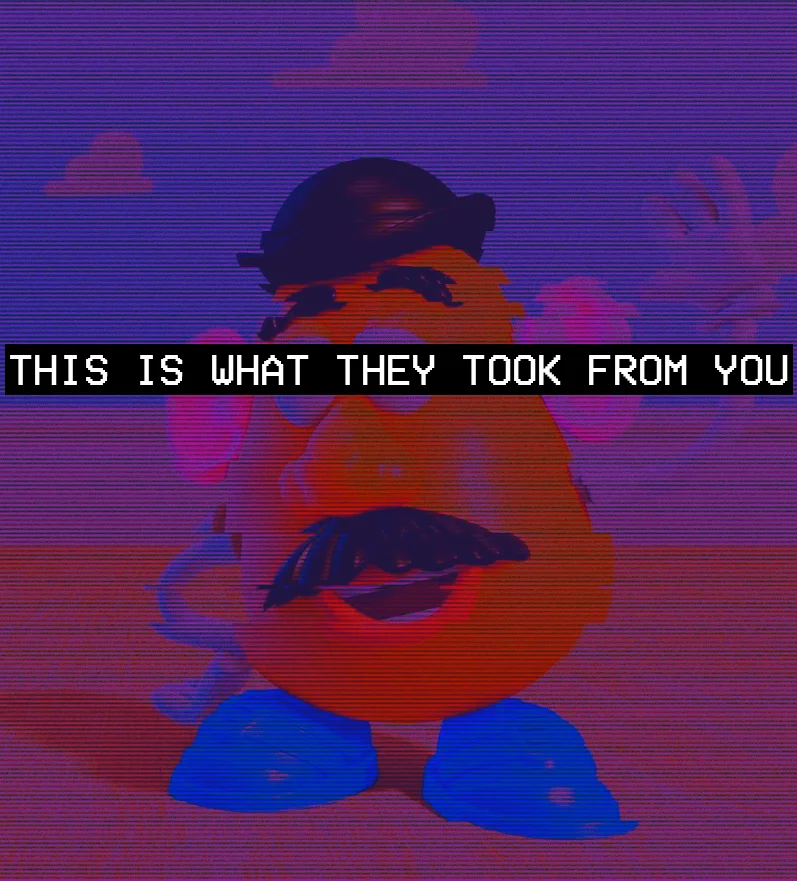
Mr. Potato Head

1952toy / characterclassic

Published September 7, 2026

Mr. Potato Head is Hasbro's plastic potato-shaped toy that lets kids stick interchangeable eyes, ears, arms and mouths into a hollow body. Invented by Brooklyn toymaker George Lerner in the 1940s and launched in 1952, it became the first toy ever advertised on American television and later broke through as a pop culture fixture thanks to its role in Pixar's Toy Story.

Overview

Mr. Potato Head is a plastic potato-shaped figure with a hollow body designed to hold pronged accessories: eyes, ears, arms, legs, a nose and a mouth that kids can rearrange into goofy faces1. The toy was Hasbro's first breakout hit and the piece that pushed the company from a small pencil-box maker into a major American toymaker2.

The joke of the toy is that the face never has to make sense. Ears where the mouth should go, a nose stuck in the forehead, arms poking out the top of the head, this is the whole appeal, and it is the same gag that Urban Dictionary entries still describe as "a toy which a child can rearrange the toy's features"3. On the internet, the character mostly shows up as a nostalgia reference and as reaction imagery pulled from the Toy Story films, where the version voiced by Don Rickles turned the toy into a recognizable cartoon personality1.

Origin & Background

Platform
Hasbro (retail toy) / Pixar Toy Story (viral pop culture spread)
Creator
George Lerner
Date
1952

In the early 1940s, Brooklyn-born toy inventor George Lerner started making dolls by sticking pronged body and face parts into real fruits and vegetables from his mother's garden, giving his younger sisters carrot-nosed, grape-eyed potato characters to play with4. Lerner spent years trying to sell the concept before Hasbro (then Hassenfeld Brothers) licensed it and launched Mr. Potato Head in 1952 as a set of plastic parts kids stuck into a real potato from the kitchen2.

The original 1952 kit did not include a plastic potato body, that was added in 1964 after complaints about rotting vegetables and new US safety rules about sharp toy pins2. The launch is also historically important for advertising reasons: Mr. Potato Head is credited as the first toy ever marketed directly to children on television, in a 1952 US TV campaign2.

How It Spread

Mr. Potato Head sold roughly a million kits in its first year on shelves, an unusually large number for a 1952 toy and enough to lock in Hasbro's future as a toy company2. Through the 1960s and 70s, Hasbro rolled out family members like Mrs. Potato Head, plus themed accessory packs, and the character showed up in TV ads, cereal tie-ins and Saturday-morning marketing1.

The biggest cultural jump came in 1995, when Pixar's Toy Story cast Don Rickles as the voice of Mr. Potato Head, giving the toy a sarcastic on-screen personality that carried through Toy Story 2, 3 and 41. That Pixar version is what most younger fans picture today, and it is the source of most of the reaction images, GIFs and quote memes tagged "Mr. Potato Head" on sites like DeviantArt, which hosts over 2,000 fan submissions under the tag1.

The name also lives a second life as internet slang. Urban Dictionary entries from users use "Mr. Potato Head" as a mildly rude nickname for a bald or featureless-looking guy, with definitions ranging from "a fat dickhead" insult to a crude joke about a man being "smooth down there"3. These slang uses are niche and mostly exist as jokes in comments and group chats rather than as a real meme format.

How to Use This Meme

Online, Mr. Potato Head typically shows up in three ways: as a nostalgia post ("who remembers this" style photos of the 1980s or 1990s toy), as a Toy Story reaction image or quote pulled from Don Rickles' scenes, or as a slang insult aimed at a bald or plain-looking guy in the style of the Urban Dictionary entries3. A common convention when using the Toy Story version is to pair a screenshot of the character's grumpy face with a caption about being annoyed or roasted, matching Rickles' delivery in the films1.

Frequently Asked Questions