Nice Guys

2002catchphraseclassic

Published September 8, 2026

Nice Guys is the mocking internet label for men who advertise their own kindness as leverage to demand attention or sex from women, then react with resentment when it doesn't work1. What began as an early 2000s critique on feminist websites snowballed into one of the loudest online arguments of the 2010s, powered by a viral Nigahiga song and a Tumblr that turned real OKCupid profiles into damning evidence2.

Overview

The label works less as a single image or catchphrase and more as an accusation lobbed at a specific online personality: the guy who insists he is different from other men, complains that women only date 'jerks,' and treats basic decency as owed romantic capital3. Read as a critique, Nice Guy behavior covers hypocrisy, passive aggression, and turning rejection into open misogyny, which is why feminist writers pick apart the pattern rather than the individual men4.

The most durable format is the exposé, where actual quotes from self-described nice guys are shown next to their smiling profile photos so they incriminate themselves without commentary1. Alongside that, the term shows up as shorthand in comment sections, songs, and reaction pieces whenever a man complains publicly about being overlooked romantically5. The framing hardened enough that even mainstream dating advice started treating 'stop calling yourself a nice guy' as first-lesson material6.

Origin & Background

Platform
Heartless Bitches International (concept) / Tumblr (viral spread)
Creator
Heartless Bitches International
Date
2002

The critique of the Nice Guy predates its viral moment by almost a decade. In early 2002, the website Heartless Bitches International ran a set of essays picking apart the 'Nice Guy' archetype, arguing that the men themselves, not the women who passed them over, were the problem3. The site drew a line between men who happened to be kind and self-professed Nice Guys whose kindness worked as a transaction, a framing later feminist writers borrowed heavily.

The label reached wider circulation on Urban Dictionary starting August 3, 2003, when the first entry described the Nice Guy as the one who 'always finishes last,' a line that became the meme's founding cliché7. More than 80 competing definitions followed, most of them defending the archetype rather than mocking it, which itself fed the critics' case3.

How It Spread

YouTuber Ryan Higa gave the concept its first pop-culture jolt on May 31, 2011, when he released the music video 'Nice Guys' as Nigahiga, playing the 'nice guys finish last' idiom straight before flipping it into a joke about affection actually working8. The song pulled in over 51 million views by January 2014, dragging the phrase into casual teen and college conversation well beyond feminist blogs3.

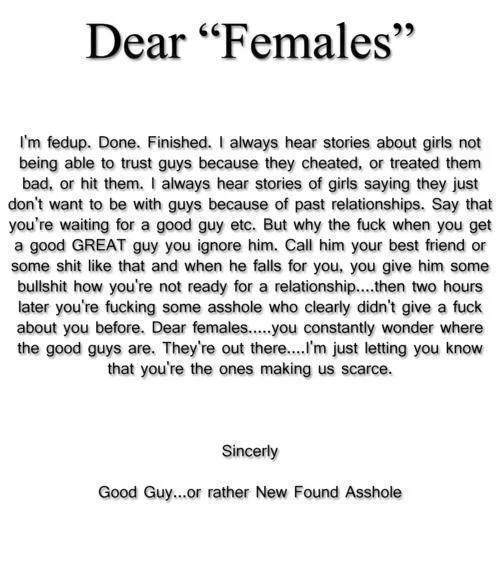
A few months later, on October 2, 2011, the Facebook page TheKillerTruth posted a screenshotted rant from a self-styled 'Good Guy' whining that women ignore the good ones close by, and Feministing dismantled it a week later, marking the moment the meme started running daily in feminist media3. The real explosion came on December 16, 2012, with the launch of the Tumblr 'Nice Guys' of OKCupid, which paired profile pictures of self-described nice guys with their own bigoted or coercive answers on the dating site1.

Between December 19 and December 21, 2012, Jezebel, The Cut, Feministing, BuzzFeed, The Huffington Post, and The Frisky all covered the Tumblr within three days of each other2. Jezebel called them 'so-called nice guys'2, The Cut zeroed in on the disturbing share who answered 'yes' when asked whether anyone was ever obligated to have sex with them4, and BuzzFeed's Katie Notopoulos tied the archetype to men's rights communities, the friend zone, fedoras, and Reddit9.

How to Use This Meme

The meme is used less as a template and more as a callout label. A common convention is to point at a man's own words, screenshotted from a dating profile, tweet, or Reddit comment, where his self-described niceness sits next to language that undermines it1. Writers often set up the archetype's greatest hits, complaints about the friend zone, resentment about 'douches' getting the girl, or the phrase 'I'm a nice guy but,' then let the source material do the work without a punchline4. In casual usage the phrase 'nice guy' in scare quotes is enough on its own to signal the accusation5.

Cultural Impact

Psychology Today built out the friend-zone concept the same year the meme peaked, arguing that men stuck there had usually set up unspoken exchange agreements and then blamed the woman when the payoff never came6. Pro-Nice Guy essays pushed back, with one 2013 blog claiming feminist hate was disproportionate and rooted in men calling out female hypocrisy, a defense that itself fed more critical coverage10. By the mid-2010s the Nice Guy label was a fixed reference point in online debates about masculinity, dating, and pickup-artist culture.

Frequently Asked Questions