NSFW
Published September 10, 2026
NSFW, short for 'not safe for work,' is the internet's warning label for porn, gore, and profanity, born from late-1990s forum etiquette and first documented in an August 22, 2000 Fark headline. The acronym escaped USENET, drew a doomed trademark fight from Fark's founder in 2007, and later prompted Roger Ebert to write a whole column debating when the tag applies. What started as a courtesy flag turned into an internet writing convention with its own joke variants.
Overview
The NSFW label typically appears at the start or end of a link title, often in brackets or all caps, warning readers that clicking will pull up sexually explicit images, extreme violence, or profane audio that would be awkward in a shared office8. Its counterpart, SFW ('safe for work'), signals the all-clear, and both tags are still standard courtesy on Reddit threads, tweets, blog posts, and email forwards whenever adult material is mixed with general-interest links.
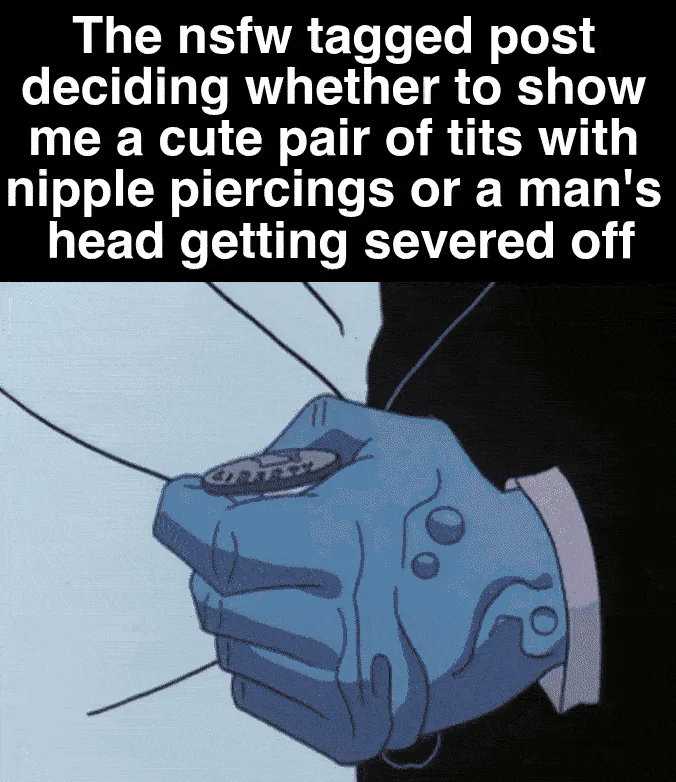
Beyond the utility tag, NSFW spawned a running joke where writers append absurd exceptions to make the warning funnier or more tempting. The blog Urlesque catalogued dozens of these in a February 2009 roundup, including 'NSFW, unless you work in a dildo factory, in which case it's research,' 'NSFW unless Clive Barker signs your checks,' and 'NSFW, Unless It's Your Job To F*$% Matt Damon'6. The witty-disclaimer format grew into a small subgenre of its own, treating the warning less as a barrier and more as an invitation set to a punchline3.
Gallery
Origin & Background
How It Spread
How to Use This Meme
Writers typically drop 'NSFW' into a link title, tweet, or post heading, often in brackets or all caps, to warn readers that clicking will surface porn, gore, or strong language8. A common convention is to add a specificity note such as '(NSFW: language)' or '(NSFW: gore, no nudity)' so readers know exactly what they are opting into. The parody format popularized by Urlesque, adding an absurd exception to make the warning funnier, is still a favorite writer flourish, with examples like 'Potato Porn: NSFW (unless in Idaho)' and 'NSFW unless the boss is one of those freaks that writes Ann Landers to gripe about public breastfeeding'6.
Frequently Asked Questions
References (8)
- 1
- 2
- 3
- 4
- 5
- 6
- 7
- 8