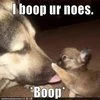
Boop

2003Catchphrase / image macroclassic

Also known as: Nose Boop · Boop the Snoot · Snoot Boop

Boop is a 2003-origin ideophone-catchphrase and image-macro depicting affectionate nose-poking gestures, popularized through early-2000s cute animal photo captions across Reddit and DeviantArt.

Boop is an ideophone and internet catchphrase used to describe the act of gently touching someone (or something) on the nose or head in a playful, affectionate way5. The word picked up traction online in the early 2000s through animal photo captions and fan communities before spawning its own image macro format around 20105. It became a staple of cute internet culture, with dedicated communities on Reddit, BuzzFeed, and DeviantArt keeping the gesture alive as a universal expression of tenderness across platforms13.

TL;DR

Boop is an ideophone and internet catchphrase used to describe the act of gently touching someone (or something) on the nose or head in a playful, affectionate way.

Overview

At its core, boop is a soft, silly sound word people attach to the act of lightly tapping a nose. Online, it's used as a caption, a reaction, and a verb. You boop a dog's nose. You boop your friend's nose. You boop cartoon characters' noses. The word functions as an ideophone, a class of words that depict sensory imagery through sound4. In English, boop sits alongside words like "boing" and "splat" as sound-symbolic expressions that describe an action through the noise it supposedly makes.

The meme format typically involves a photo or animation of one creature touching another's nose (or a finger approaching a nose), captioned with "boop" or some variation. Animal photos dominate the genre, with dogs and cats being the most popular subjects1. The My Little Pony fandom also adopted the word heavily, producing fan art and animations centered around pony nose-booping3.

The exact origin of "boop" as a word is unclear, but examples of the sound effect show up in mainstream media as early as the 1990s. In the 1992 *Simpsons* episode "Lisa's First Word," Bart places a postage stamp on baby Lisa's nose, and the gesture is accompanied by a boop-like sound effect5. A similar nose-touch moment appears in the 1999 Kevin Smith film *Dogma*, where God (played by Alanis Morissette) touches Bethany's nose while making a "Bwerp!" sound5.

The word's first recorded internet definition came on April 12, 2003, when a user submitted it to Urban Dictionary2. That early definition described boop as the act of tapping someone's nose while saying the word aloud6. The concept sat relatively quiet online for several years after that.

The jump to image macro format didn't happen until late 2010. Flickr user Doug Mahugh uploaded a photo called "Love Tap" showing one animal touching another's nose5. The image made its way to Facebook, where someone left the comment "You booped him!" and the combination of photo and caption got turned into a proper image macro5.

Origin & Background

Platform
Urban Dictionary (earliest definition), Flickr / Facebook (first image macro)
Key People
Doug Mahugh
Date
2003 (first documented online definition), with media precursors from 1992

The exact origin of "boop" as a word is unclear, but examples of the sound effect show up in mainstream media as early as the 1990s. In the 1992 *Simpsons* episode "Lisa's First Word," Bart places a postage stamp on baby Lisa's nose, and the gesture is accompanied by a boop-like sound effect. A similar nose-touch moment appears in the 1999 Kevin Smith film *Dogma*, where God (played by Alanis Morissette) touches Bethany's nose while making a "Bwerp!" sound.

The word's first recorded internet definition came on April 12, 2003, when a user submitted it to Urban Dictionary. That early definition described boop as the act of tapping someone's nose while saying the word aloud. The concept sat relatively quiet online for several years after that.

The jump to image macro format didn't happen until late 2010. Flickr user Doug Mahugh uploaded a photo called "Love Tap" showing one animal touching another's nose. The image made its way to Facebook, where someone left the comment "You booped him!" and the combination of photo and caption got turned into a proper image macro.

How It Spread

The boop concept spread across multiple platforms through the early 2010s. The subreddit r/boop launched on September 9, 2009, building a community around animal nose-touch photos and GIFs. By October 2015, the subreddit had over 33,600 subscribers.

BuzzFeed picked up the trend in 2012, producing multiple posts featuring "boop animals" with interactive nose-touching content. Their "Boop These Dogs' Noses" series let readers tap on dog photos, turning the passive meme into something participatory.

DeviantArt became another major hub. Artists across the site created boop-themed illustrations, animations, and fan art. The tag "boop" on DeviantArt pulls up thousands of works, with a heavy concentration of My Little Pony fan art showing ponies booping each other's "snoots". The related phrase "boop the snoot" (snoot being internet-speak for snout) became popular shorthand in pet-loving communities.

Urban Dictionary accumulated multiple definitions over the years, with entries describing boop as everything from a dog greeting to a playful flirtation tactic. The word's flexibility helped it spread. It worked equally well as a caption for a photo of two kittens touching noses, a comment on a friend's selfie, or an action in roleplay-style text conversations.

How to Use This Meme

Boop works in a few different ways online:

As a photo caption: Find or take a photo of an animal (or person) touching or about to touch a nose. Caption it "boop" or "boop the snoot." The simpler the caption, the better. One-word captions hit hardest.

As a comment or reaction: Drop "boop" in someone's comments or replies as an expression of affection. It's the textual equivalent of a gentle nose tap.

As an image macro: The classic format pairs an animal nose-touch photo with "BOOP" in large text, typically centered on the image. Some versions add a second line describing the scenario.

In fan art: Draw two characters with one touching the other's nose. The My Little Pony fandom popularized this variation, but it works with any characters or original art.

The key is keeping it light and cute. Boop doesn't work as sarcasm or aggression. It's pure warmth.

Cultural Impact

Boop crossed from niche internet slang into broader pet culture vocabulary. The word became standard language among dog owners and animal shelter social media accounts. BuzzFeed's interactive boop content brought the concept to mainstream audiences who may never have encountered the meme on Reddit or DeviantArt.

The word "boop" also gained traction in linguistics discussions as an example of how internet culture creates and spreads new ideophones. While English doesn't have a formal ideophone class the way languages like Japanese or Korean do, boop functions as one in digital communication. It depicts a sensory action through its sound, much like traditional ideophones in other languages that describe motion, texture, or gesture through phonetic shape.

Fun Facts

The Simpsons used a boop-style sound effect in 1992, predating the internet meme by over a decade.

In *Dogma* (1999), God's version of a boop is spelled "Bwerp!" in the script.

The word "boop" is technically unrelated to Betty Boop, though search data for the term often gets mixed up with the cartoon character.

DeviantArt's boop tag features art spanning dozens of fandoms, but My Little Pony artwork makes up a significant chunk.

Urban Dictionary's first boop definition dropped in 2003, making the internet usage over two decades old.

Derivatives & Variations

Boop the Snoot

— A popular variation that specifically targets animal noses ("snoots"), widely used on Reddit's r/boop and in pet communities[5].

My Little Pony Boops

— The MLP fandom created extensive fan art of ponies booping each other, with DeviantArt hosting a large collection of these works[3].

Interactive Boop Content

— BuzzFeed developed clickable "boop" articles where readers could tap on animal noses, adding a participatory layer to the meme[1].

Frequently Asked Questions

References (7)

  1. 1
    Booparticle
  2. 2
  3. 3
  4. 4
    Boopencyclopedia
  5. 5
  6. 6
    Ideophoneencyclopedia
  7. 7

Boop

2003Catchphrase / image macroclassic

Also known as: Nose Boop · Boop the Snoot · Snoot Boop

Boop is a 2003-origin ideophone-catchphrase and image-macro depicting affectionate nose-poking gestures, popularized through early-2000s cute animal photo captions across Reddit and DeviantArt.

Boop is an ideophone and internet catchphrase used to describe the act of gently touching someone (or something) on the nose or head in a playful, affectionate way. The word picked up traction online in the early 2000s through animal photo captions and fan communities before spawning its own image macro format around 2010. It became a staple of cute internet culture, with dedicated communities on Reddit, BuzzFeed, and DeviantArt keeping the gesture alive as a universal expression of tenderness across platforms.

TL;DR

Boop is an ideophone and internet catchphrase used to describe the act of gently touching someone (or something) on the nose or head in a playful, affectionate way.

Overview

At its core, boop is a soft, silly sound word people attach to the act of lightly tapping a nose. Online, it's used as a caption, a reaction, and a verb. You boop a dog's nose. You boop your friend's nose. You boop cartoon characters' noses. The word functions as an ideophone, a class of words that depict sensory imagery through sound. In English, boop sits alongside words like "boing" and "splat" as sound-symbolic expressions that describe an action through the noise it supposedly makes.

The meme format typically involves a photo or animation of one creature touching another's nose (or a finger approaching a nose), captioned with "boop" or some variation. Animal photos dominate the genre, with dogs and cats being the most popular subjects. The My Little Pony fandom also adopted the word heavily, producing fan art and animations centered around pony nose-booping.

The exact origin of "boop" as a word is unclear, but examples of the sound effect show up in mainstream media as early as the 1990s. In the 1992 *Simpsons* episode "Lisa's First Word," Bart places a postage stamp on baby Lisa's nose, and the gesture is accompanied by a boop-like sound effect. A similar nose-touch moment appears in the 1999 Kevin Smith film *Dogma*, where God (played by Alanis Morissette) touches Bethany's nose while making a "Bwerp!" sound.

The word's first recorded internet definition came on April 12, 2003, when a user submitted it to Urban Dictionary. That early definition described boop as the act of tapping someone's nose while saying the word aloud. The concept sat relatively quiet online for several years after that.

The jump to image macro format didn't happen until late 2010. Flickr user Doug Mahugh uploaded a photo called "Love Tap" showing one animal touching another's nose. The image made its way to Facebook, where someone left the comment "You booped him!" and the combination of photo and caption got turned into a proper image macro.

Origin & Background

Platform
Urban Dictionary (earliest definition), Flickr / Facebook (first image macro)
Key People
Doug Mahugh
Date
2003 (first documented online definition), with media precursors from 1992

The exact origin of "boop" as a word is unclear, but examples of the sound effect show up in mainstream media as early as the 1990s. In the 1992 *Simpsons* episode "Lisa's First Word," Bart places a postage stamp on baby Lisa's nose, and the gesture is accompanied by a boop-like sound effect. A similar nose-touch moment appears in the 1999 Kevin Smith film *Dogma*, where God (played by Alanis Morissette) touches Bethany's nose while making a "Bwerp!" sound.

The word's first recorded internet definition came on April 12, 2003, when a user submitted it to Urban Dictionary. That early definition described boop as the act of tapping someone's nose while saying the word aloud. The concept sat relatively quiet online for several years after that.

The jump to image macro format didn't happen until late 2010. Flickr user Doug Mahugh uploaded a photo called "Love Tap" showing one animal touching another's nose. The image made its way to Facebook, where someone left the comment "You booped him!" and the combination of photo and caption got turned into a proper image macro.

How It Spread

The boop concept spread across multiple platforms through the early 2010s. The subreddit r/boop launched on September 9, 2009, building a community around animal nose-touch photos and GIFs. By October 2015, the subreddit had over 33,600 subscribers.

BuzzFeed picked up the trend in 2012, producing multiple posts featuring "boop animals" with interactive nose-touching content. Their "Boop These Dogs' Noses" series let readers tap on dog photos, turning the passive meme into something participatory.

DeviantArt became another major hub. Artists across the site created boop-themed illustrations, animations, and fan art. The tag "boop" on DeviantArt pulls up thousands of works, with a heavy concentration of My Little Pony fan art showing ponies booping each other's "snoots". The related phrase "boop the snoot" (snoot being internet-speak for snout) became popular shorthand in pet-loving communities.

Urban Dictionary accumulated multiple definitions over the years, with entries describing boop as everything from a dog greeting to a playful flirtation tactic. The word's flexibility helped it spread. It worked equally well as a caption for a photo of two kittens touching noses, a comment on a friend's selfie, or an action in roleplay-style text conversations.

How to Use This Meme

Boop works in a few different ways online:

As a photo caption: Find or take a photo of an animal (or person) touching or about to touch a nose. Caption it "boop" or "boop the snoot." The simpler the caption, the better. One-word captions hit hardest.

As a comment or reaction: Drop "boop" in someone's comments or replies as an expression of affection. It's the textual equivalent of a gentle nose tap.

As an image macro: The classic format pairs an animal nose-touch photo with "BOOP" in large text, typically centered on the image. Some versions add a second line describing the scenario.

In fan art: Draw two characters with one touching the other's nose. The My Little Pony fandom popularized this variation, but it works with any characters or original art.

The key is keeping it light and cute. Boop doesn't work as sarcasm or aggression. It's pure warmth.

Cultural Impact

Boop crossed from niche internet slang into broader pet culture vocabulary. The word became standard language among dog owners and animal shelter social media accounts. BuzzFeed's interactive boop content brought the concept to mainstream audiences who may never have encountered the meme on Reddit or DeviantArt.

The word "boop" also gained traction in linguistics discussions as an example of how internet culture creates and spreads new ideophones. While English doesn't have a formal ideophone class the way languages like Japanese or Korean do, boop functions as one in digital communication. It depicts a sensory action through its sound, much like traditional ideophones in other languages that describe motion, texture, or gesture through phonetic shape.

Fun Facts

The Simpsons used a boop-style sound effect in 1992, predating the internet meme by over a decade.

In *Dogma* (1999), God's version of a boop is spelled "Bwerp!" in the script.

The word "boop" is technically unrelated to Betty Boop, though search data for the term often gets mixed up with the cartoon character.

DeviantArt's boop tag features art spanning dozens of fandoms, but My Little Pony artwork makes up a significant chunk.

Urban Dictionary's first boop definition dropped in 2003, making the internet usage over two decades old.

Derivatives & Variations

Boop the Snoot

— A popular variation that specifically targets animal noses ("snoots"), widely used on Reddit's r/boop and in pet communities[5].

My Little Pony Boops

— The MLP fandom created extensive fan art of ponies booping each other, with DeviantArt hosting a large collection of these works[3].

Interactive Boop Content

— BuzzFeed developed clickable "boop" articles where readers could tap on animal noses, adding a participatory layer to the meme[1].

Frequently Asked Questions

References (7)

  1. 1
    Booparticle
  2. 2
  3. 3
  4. 4
    Boopencyclopedia
  5. 5
  6. 6
    Ideophoneencyclopedia
  7. 7