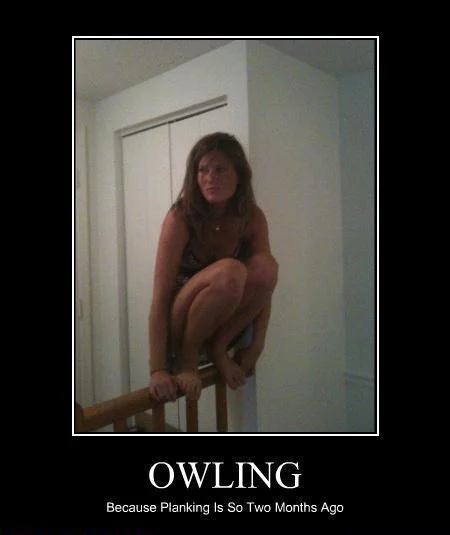
Owling
Published September 20, 2026
Owling is a 2011 photo fad where people crouched in a perched, owl-like pose on random objects, snapped a picture, and posted it online. Born as a direct swipe at planking, it went from a single Reddit thread on July 11, 2011 to Salon, BuzzFeed, and HuffPost coverage within 24 hours, giving planking its first real successor before burning out just as fast.
Overview
The format is deliberately simple. A participant squats or crouches on a random object like a railing, ledge, filing cabinet or kitchen counter, tucks their knees, positions their hands loosely like talons, and stares blankly into the middle distance while someone takes a photo2. The joke is the pose itself and how absurd it looks in ordinary spots, with bonus credit for owlers who picked unexpected or public locations, echoing planking's dare-in-public logic1.
Tone-wise, Owling wore its anti-planking attitude on the sleeve. The first Urban Dictionary entry defined it as "the new viral craze; a bit like planking, except you crouch down, and stare like an owl"1. A second definition described participants as "sitting on a random object/surface in a perched position, taking a picture of oneself and posting in on the internet," and framed the whole thing as planking's evolution1. Every early definition leaned into the same beat: planking was over, Owling was the replacement joke.
Gallery
Origin & Background
Owling kicked off with a Reddit thread posted on July 11, 2011 titled "Seems to be an increase in planking photos, so…"2. The thread led with a demotivational-style image macro of a woman perched on a railing, captioned "OWLING because planking is so two months ago." The individual who made that first image macro is not credited in the surviving coverage, so the meme has no confirmed creator2.
How It Spread
Timeline
2011-07-11
Reddit thread "Seems to be an increase in planking photos, so…" posts the origin demotivational image macro captioned "OWLING because planking is so two months ago."
2011-07-12
Salon, HuffPost Urlesque, NowPublic and BuzzFeed all cover Owling on the same day, framing it as the successor to planking.
2011-07-12
The first Urban Dictionary definition of Owling is submitted, calling it "the new viral craze."
2011-07-12
Google search interest for "owling" spikes sharply.
2011-07
User-generated owling photos surface on Tumblr and Reddit through mid-July before coverage drops off.
How to Use This Meme
To owl, a participant typically finds a raised or unexpected surface, crouches with knees bent and feet flat, curls their hands loosely like claws, and stares straight ahead with a neutral expression1. A friend takes the photo, and it gets posted online, historically to Facebook or Tumblr. Common convention favors odd or public spots such as railings, road signs, or filing cabinets over conventional seating1.