The Uncanny Valley
Published October 2, 2026
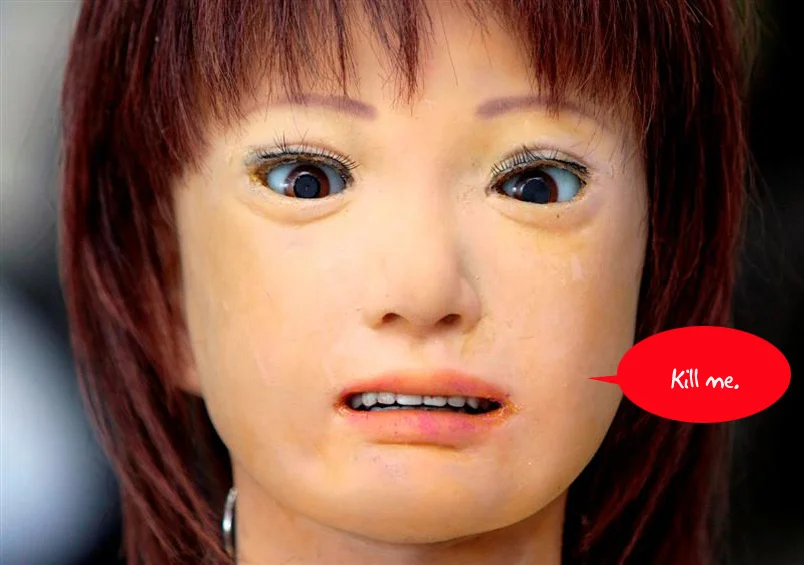
The Uncanny Valley is the dip in human comfort when a robot, CGI character, or doll looks almost but not quite human, a hypothesis Japanese roboticist Masahiro Mori proposed in 1970. The term crossed from academic robotics into online shorthand in the mid-2000s, becoming the default label internet users slap on creepy CGI faces, humanoid robots, and AI-generated imagery that triggers instant revulsion.
Overview
Online, The Uncanny Valley works as a snap diagnosis label. People drop the term under any clip or image where a face is almost human but off, dead-eyed animated characters, humanoid robots mid-motion, deepfakes, and AI image generations with warped fingers or melted smiles1. The underlying claim is Mori's graph: positive affinity rises with human-likeness until a sharp dip around near-human appearance, then recovers once something looks fully human.
The tag stuck because it names a feeling viewers already had but could not articulate, which is why a walking Boston Dynamics BigDog clip or a motion-capture demo gets flooded with the same two words in the comments2. TV Tropes catalogued hundreds of film, television, and video game examples under the heading, cementing it as media-criticism shorthand well beyond robotics labs3. By the 2020s the label was reflexively applied to AI-generated video and photos, where mangled anatomy and blank affect push outputs straight into Mori's dip.
Gallery
Origin & Background
How It Spread
Timeline
How to Use This Meme
Users typically drop "uncanny valley" as a one-line reaction under media showing near-human faces, CGI characters with dead eyes, hyperreal dolls, humanoid robots, deepfakes, or AI-generated people. The common convention is to tag the specific feature that broke the illusion, usually the eyes, mouth, or motion. Longer posts often include Mori's dip graph as a joke overlay with the subject plotted at the lowest point.
Frequently Asked Questions
References (8)
- 1
- 2
- 3
- 4
- 5
- 6
- 7
- 8